Aglianico
The black grape that’s known as the “Barolo of the South”
Katie Mather
Wednesday 21 May 2025
This article is from
The Italian South
issue 49
Share this article
The biggest travesty about Aglianico is that hardly any people outside of Italy have heard of it. This stunning grape variety from the southern regions of Campania and Basilicata has been turned into deep, purple-tinted wine for, it’s thought, more than 1000 years, with the Romans using Aglianico to make Falernian wine. It’s one of Italy’s most prized noble grapes, sitting alongside Nebbiolo and Sangiovese in terms of potential and deliciousness, and at one time it was taken to the brink of extinction by Phylloxera, which took so many vineyards from the world. Thankfully, dedicated vignerons in Campania kept Aglianico alive, and by hook or by crook it came back to the region as highly regarded to modern Italians as it was to their Roman ancestors. It might never reach the heights it once did in the hearts and minds of Italians, but it is still here, surviving an apocalypse in a volcano-pocked landscape.
Before Phylloxera (the invasion of microscopic mites that decimated much of Europe’s old growth vines during the late 1800s) Aglianico was the most widely-planted grape in all of Italy. Now its comparatively small indigenous region stretches through Avellino and Selerno, Benevento and Rionero del Vulture—from which the DOC receives its name “Aglianico del Vulture”. The wines made in this particular region are dark and full-bodied, full of tannin and the locality’s famous volcanic terroir thanks to the now extinct volcano Mount Vulture. They are often regarded by wine critics as the best and most overlooked wines in the whole country, so take this as an instruction to buy a bottle on sight if you ever see one. In Avellino, a similarly fine but expressively unique wine called Taurasi is made from Aglianico—it must be aged for three years at the very minimum, and one of those years must be in oak. For Riserva bottles, the minimum age is four. It’s the ageing of the Aglianico that turns it from a pleasant red wine with bold tannins to a highly finessed wine packed with complex aromas of tobacco, leather, and roses. Taurasi DOCG was made by one winery and one winery only until the early 1990s, Mastroberardino, but now there are around 250, all thanks to a boom in interest within small, obsessive circles outside of Italy itself. Taurasi has its cult followers, but there have been rumblings of a resurgence of late. Wine writer Simon Reilly calls it “the sleeping giant of Italian wine”, referring to its bold qualities and its maintenance of a status something along the lines of a hidden gem. He’s right, but how ridiculous, for a grape that was once the be-all and end-all of Italian wine just over 100 years ago, for a wine that was granted DOCG status in the 1970s. There are many cult wines around the world, and Taurasi was not always recognised as such, but after a brief period of being referred to as the “Nebbiolo of the south”, there was a boom and then a lull. It seems that the comparison was confusing, and people were unsure of what to expect. Perhaps now critics have stopped calling it a southern Barolo, wine collectors and drinkers alike can began to look at it a little differently.
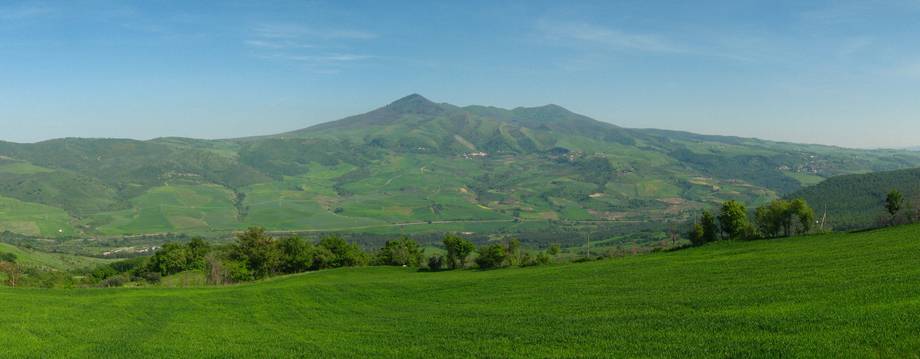
Mount Vulture
Of course, to liken any wine to another is unfair. Aglianico, for all its ageing potential and deep, tannic luxuriousness when made into Taurasi, is a wine all of its own. And while many winemakers from Campania might wish to capitalise on the global demand for complex, elegant Barolo by making ever more serious, refined Aglianico—and they should, it is very good wine—there are some who have decided that the grape, for them, can do more. In Campania, wineries like Vigneti Tardis are using modern techniques inspired by the past, such as biodynamics, to breathe new life into the black grapes of Aglianico. Led by Bruno de Conciliis, whose family have grown Aglianico in Cilento for generations, and English sommelier Jack Lewens, theirs is a vineyard where limestone reigns, not volcanic soil and rock. They make berry-bright wines that look like stained glass and taste like kirsch and dark chocolate and fresh black cherries. And that’s the curious nature of Aglianico—it can change, shift with the land. Under different custodianship, it can be suave, wrapped up in oak, or it can be fresh and new and delicious, exciting and interesting. With all the experience of a classical Aglianico winemaker, Bruno de Conciliis—and his peers—have recognised and honoured the true potential of the grape. That it is not only meant for years in the dark, a near-black wine being sculpted by time. That it can be beautiful when its differences are underlined, that it doesn’t have to be second-best to a northern grape well-known for its price tag. When the sunshine that made the grapes can shine right through onto the tablecloth below.
Share this article
You’ve reached your limit of 5 free articles this month.
Unlock unlimited access and more
Join Wine52 and get your first month half price
-
Get your first box for £18 (RRP £36).
-
3 wines & 2 snacks delivered monthly.
-
Printed Glug magazine included.
-
Unlimited access to all online content.


