Mezzogiorno
Ned Palmer rounds up his top cheeses of the region
Ned Palmer
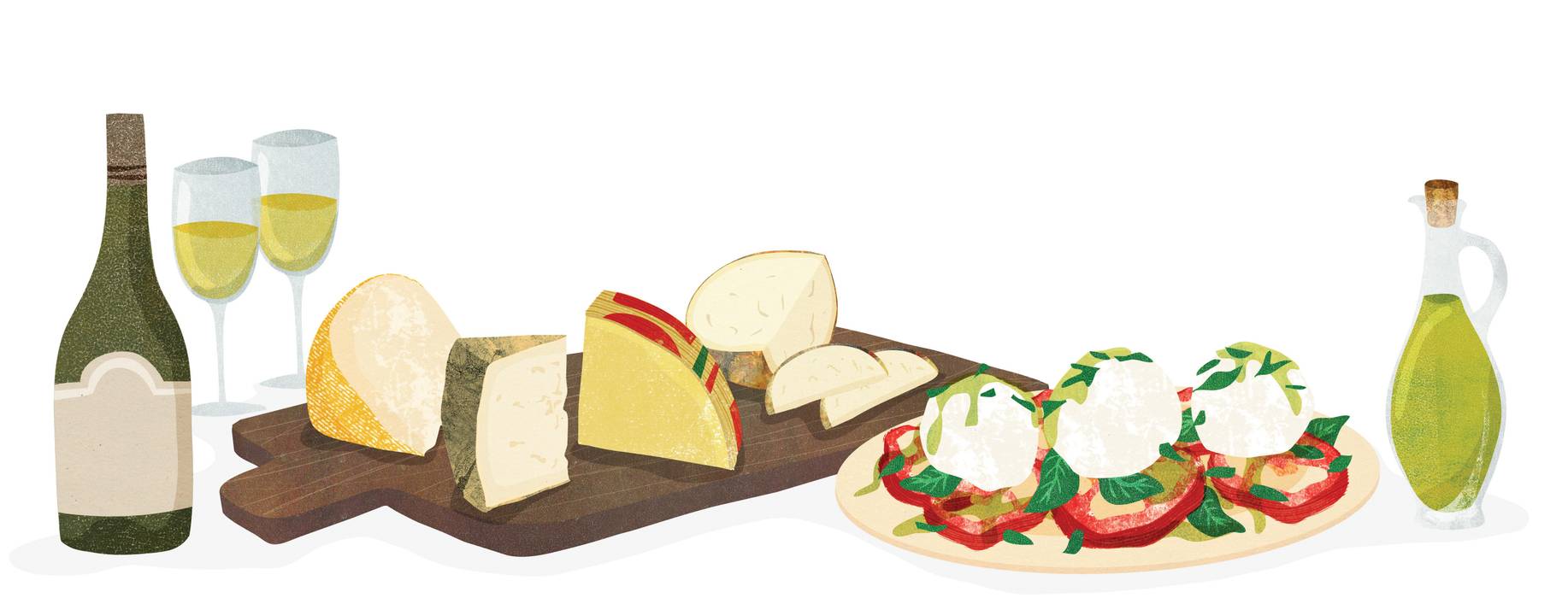
Illustration: Astrid Weguelin
Wednesday 21 May 2025
This article is from
The Italian South
issue 49
Share this article
Southern Italy, also named the Mezzogiorno for the Sun’s heat and position at midday, is famous for its stretched-curd cheeses. For this dramatic method the curd is cooked in boiling water or whey, then stretched and re-stretched in long skeins across the dairy until it becomes elastic. The most famous of all the stretched-curds is Mozzarella, and if all the Mozzarella you’ve ever had is the rubbery white blocks that come from the corner shop then you’re in for a big treat when you try the proper stuff.
Real Mozzarella is made from the rich milk of the water buffalo and is lusciously giving, its fist-sized rounds made of concentric layers of the stretched curd, moist with drops of pearlescent whey. The flavour is delicate, so taste this cheese mindfully, but your attention will be rewarded—it is sweet and milky with hints of earth and moss, which is wonderfully refreshing under the hot southern sun.
For the peak Mozzarella experience, you’re going to have to travel, because to enjoy this cheese at its very best, you need to eat it on the day it is made. A generic version, Mozzarella di Latte di Bufala, is available all over Italy, but the tip-top PDO cheese (DOP or Denominazione di Origine Protetta in Italian), Mozzarella di Bufala Campana, has a more restricted area. This reaches up to Rome, but the main areas are southern—Apulia, Molise, and of course Campania, the real home of these magnificent, massively dignified beasts. Water buffaloes, or to give them their marvellous Latin name, Bubalus Bubalis, were indigenous to Italy but seem to have disappeared with the Ice Age. My favourite account of their reintroduction is that they were a gift from the Khan of the Avars to an Italian king in the 6th century. The Avars—a Eurasian nomadic civilisation—were effectively wiped out by the Franks in the 8th century, but left these wonderful animals and their lovely cheese as a relic.
Having made your way to Campania, and visited the caseificio, or creamery, for your fresh Mozzarella, the next question is how to eat it. I suggest, that to honour its delicacy, and making sure you are among friends, just get a whole one and bite into it like an apple, enjoying the sensation of its cool juices running down your chin. If you’re not feeling quite this decadent, my friend Fausto—an eminent Italian cheesemonger—allows that you might slice it and drizzle a little cold-pressed extra virgin olive oil of the highest quality over the top. The previous day’s cheeses can be enjoyed with basil, tomato and more oil as an insalata caprese, or even on a pizza.
Provolone is another well-known stretched curd cheese which originated in the south though it is now found across Italy, but this is an aged hard style. The cheeses comes in a few shapes but the best one is looks like a colossal egg which you could imagine a dragon bursting out of it, an appropriate image because the aged version, Provolone Piccante, is a fiery creature. Older cheeses have a dusty aroma with an animal note; a chewy texture delivers an initially sweet musky flavour that rapidly develops intense heat. My wife, tasting this for the first time said with a startled yet not unhappy look ‘it goes right up your nose!’ The finish is long and spicy with a powerful numbing action on the tongue like Szechuan pepper—a fun experience in a cheese, if, as she said ‘you like toying with oral paralysis.’
Not enough people realise that the first written recipe for a cheese appears in Homer’s Odyssey
Not enough people realise that the first written recipe for a cheese appears in Homer’s Odyssey, when Odysseus and his shipmates watch the Cyclops making cheese while hiding in his cave. The one-eyed giant, a shepherd, sets his sheep milk with rennet and presses the, this time un-cooked, curd in baskets to make a hard cheese, which when finished would retain the markings of those baskets. If this sounds at all familiar it is because it is. Hard sheep’s cheese like this is still made all around the Mediterranean shore, and whether it is known as Brebis, Ossau Iraty, Manchego or by any other name, it is fundamentally the same. The Odyssey was probably first written down in the 8th century BCE, making this style at least a thousand years old. In Italy, the cheese is known as Pecorino. I like to think it’s prevalence in the Mezzogiorno is a memory of the ancient period when the region was known as Magna Graecia, or ‘Greater Greece’ for its large Greek population.
Pecorino Dolce, which you will find all over the South, is a young, mild cheese, with a caramel aroma and a gentle sheepy note. The flavour is juicy, with apple-blossom and milk-bottle sweets, a backbone of bitterness and a light peppery burn in the finish. Following the sommelier’s ruling that ‘what grows together goes together’ I like it with a Vermentino de Sardegna, a DOC white (DOC is to wine what DOP is to cheese). The wine has a light green shade, an enticing aroma of limes, and its creamy mouthfeel is lifted with a little acidity. A note of white blossom compliments that floral element in the cheese, with an astringent flavour which enhances the bitterness in a pleasingly refreshing way. The buttery mouthfeel of the wine also combines with the creaminess of the young cheese to create a lovely silky texture, cut through with the wine’s citrusy finish.
Have it as the first cheese—for its mildness—on your southern Italian cheeseboard, or in the Spring make a salad with the new season’s fava beans and some generous shavings of Pecorino, with a bit more of that good olive oil and another glass of the Vermentino. This is how to live.
Sardinia is home to a particularly fine and distinctive Pecorino called poetically Fiore Sardo, or Flower of Sardinia. After a sojourn in the brine bath the cheeses are set on shelves in an airy room in which is lit a fire made from the typical aromatic plants of the Mediterranean like rosemary, sage, hyssop, savoury and thyme, conferring a subtle fragrance on the cheese.
Eating Fiore is an exciting and intriguing experience, and lots of fun
Eating Fiore is an exciting and intriguing experience, and lots of fun. The rind is moist and pink, giving off the funky aroma one would expect of a softer washed-rind cheese, with just a hint of aromatic smoke. The flavour is more sheepy then the Dolce—mutton rather than lamb—and has a vigorous umami note, a blue cheese flavour, and a sharp sensation of ammonia in the nose. It is still a startlingly sweet cheese but much more spicy even than Provolone Piccante, with that tongue numbing heat coming much sooner, building to a strong finish with added fizzy tingle, like Szechuan-flavoured pop rocks. My wife, once again with impressive articulacy describes it as ‘mad shit’.
Amazingly, that elegant Vermentino gives no ground to this uncompromising cheese, in fact they seem to get on very well. The cheese sweetens the wine, which in turn softens the more aggressive character of the Fiore, allowing it to blossom, so that I notice more of that herby smoke flavour, though together both still build to an impressively spicy finish.
These are but a few of the many cheeses of the Mezzogiorno, some more sophisticated and elegant, some still honestly rustic. Most are of such small production that you will have to go there to seek them out, which I heartily recommend. If you can’t wait that long, you can order a few excellent examples of Sardinian cheeses and wines online from importers Isola Buona.
My thanks as always to the inestimable Fausto Caserio for infinite knowledge and inextinguishable passion for Italian cheese.
Share this article
You’ve reached your limit of 5 free articles this month.
Unlock unlimited access and more
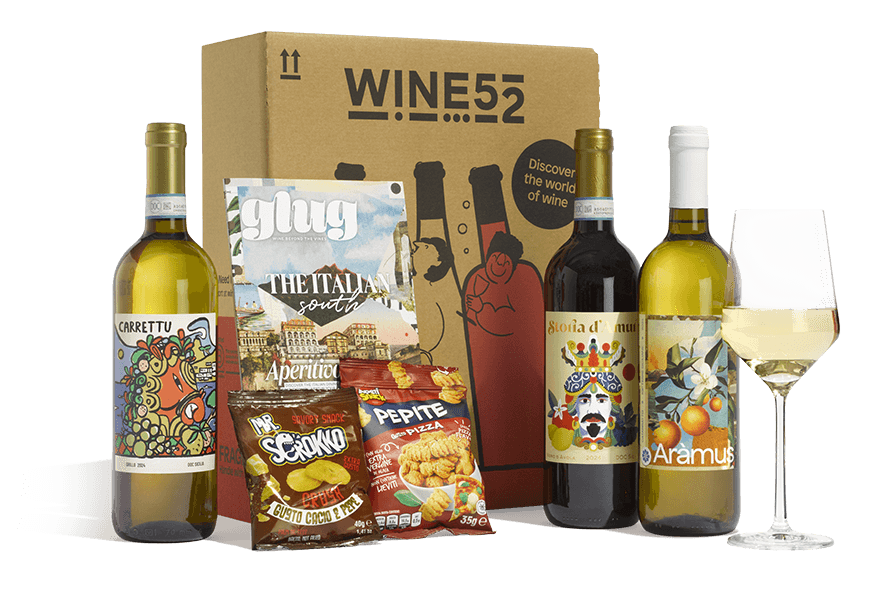
Join Wine52 and get your first month half price
-
Get your first box for £18 (RRP £36).
-
3 wines & 2 snacks delivered monthly.
-
Printed Glug magazine included.
-
Unlimited access to all online content.


