Tradition in tension
From Lecce to Villa San Martino, a new chapter opens for Italy’s most divisive culinary duo, writes Joel Hart
Joel Hart
Wednesday 21 May 2025
This article is from
The Italian South
issue 49
Share this article
Picture the scene. You’re cruising through Puglia’s flat, sunburnt countryside—silvery olive groves, spiny prickly pear plants, and limestone, cone-roofed trulli dotting the landscape. Up ahead, you reach a whitewashed town with narrow, cobbled lanes, weathered shutters, and the odd Baroque church anchoring the square. You pull up to a trattoria tucked behind a beaded curtain, and feast on verdant orecchiette con le cime di rapa (ear-shaped pasta with turnip tops), earthy fave e cicoria (fava bean purée with chicory), and tender polpo alla pignata (octopus stewed in tomato), washing it down with a splash of spicy Primitivo.
If this sounds like something so close to perfection that modernising it would feel like a crime, that’s because it is. This deep reverence for tradition is something chefs in Puglia hold dear, as Floriano Pellegrino and Isabella Poti of the Michelin-starred BROS and BROS Trattoria, one of Italy’s most divisive culinary duos, can attest.
“We’re not here to reinterpret tradition,” Pellegrino says, “we’re here to respect it by leaving it untouched.” At their trattoria, which opened in 2018, and is now housed inside a traditional trullo, it remains a focus.
“We cook Puglian food the way it has always been done,” he adds, “with ancestral techniques and modern awareness. That’s where tradition lives.” This means classic Puglian dishes like orecchiette con le cime di rapa and spaghetti all’Assassina, a fiery, almost-burnt tomato spaghetti dish from Bari, as well as lesser-known combinations like pasta and potatoes, and Podolica beef tartare with anchovies and capers. These seem like fairly simple orchestrations, right? Not quite. “Puglian simplicity is never basic,” says Pellegrino. “It’s built on time, patience, and silent technique. We don’t try to elevate it—we try to listen to it. Then, we move beyond it, with awareness.”
For the two chefs, this kind of cooking should remain pure, with research, innovation and the cultivation of gastronomic identity taking place only in their fine-dining restaurant BROS. “For us, tradition and avant-garde are two separate languages,” Poti explains. “We speak both, but we don’t mix them.” At BROS, they are guided by “taste, narrative, and tension,” but there is still a strong connection to the land. “Our creative process doesn’t begin with ingredients or techniques,” she adds. “It begins with who we are. It starts from our territory, but refuses to be caged by it.”
Functioning out of a restaurant in Lecce from its opening in 2015, BROS has recently relocated to Villa San Martino—a coral-hued, greenery-covered house that defines rustic elegance—in the town of Martina Franca. “Martina Franca gives us silence and clarity,” Poti tells me. “It’s slower, deeper, and that affects how we think, cook, and feel.” The spacious, layered property itself is a key factor in the next chapter of BROS. “It’s like an extension of our minds,” she adds.
Innovation isn't about showing off... It’s about knowing exactly why you do something. It’s clarity, not spectacle.
“Before, we were cooking in a kind of bunker,” Pellegrino adds. “Now we can breathe, and that changes everything. It affects rhythm, thought, and ambition. And for us, ambition is a matter of space.”
These chefs are part of a new movement in Italian cuisine across the country. Less pinned to tradition, globally minded, ecologically aware chefs are raising their voices, unafraid to provoke. From Franco Pepe’s pineapple-stuffed prosciutto cone to Chiara Pavan and Francesco Brutto’s turning of invasive species into fine dining in the Venice lagoon; across Italy, vegetables take centre stage, waste is treated as creative fuel, and Italian cuisine is reimagined. Pellegrino and Poti are especially loud voices in this new generation, less concerned with preserving a past stuck in time than building on it.
A tasting menu at BROS—which can be opted for in 17, 20, or 23 courses—contains multitudes. “Minimalism, for us, is a starting point,” Poti tells me. “Not an aesthetic, but a discipline. We go deep into the essence of flavour. When we push that tension further, that’s where our avant-garde begins.”
There are more comforting elements like steamed bread and a somehow both earthy and futuristic looking bruschetta with tomato and oregano. Pasta courses are often magically playful: with a current dish assembled with a Yayoi Kusama-like whimsy to the pasta, with egg yolk emulsion and dwarf peas arranged with obsessive precision, transforming the plate into a quietly psychedelic sunflower.
“Innovation isn’t about showing off,” Pellegrino remarks, “It’s about knowing exactly why you do something. It’s clarity, not spectacle.” That doesn’t mean they shy away from challenging diners, sometimes through optical illusions, like a banana and chocolate dessert disguised as three bananas in various stages of ripeness: green, yellow, and prune-wrinkled black. It’s a kind of storytelling that’s rooted in place, but never confined by it. “We’re not doing ‘local’ because it’s trendy,” Pellegrino explains. “We use local because we’ve learned how to tell it, not just repeat it. Outside influences didn’t pull us away from Puglia; they brought us closer to it, in a more evolved way.”
Does this mean looking beyond Puglia? “Definitely,” Poti confirms. “Travelling taught us that local isn’t enough. The more you see of the world, the more you realise how powerful your roots are, but also how much work they need.” Pellegrino, who is from Lecce, spent a few years in the Basque country at three-Michelin starred Martín Berasategui, who is a mentor-like figure for him. Poti—who already brings the outside influences of her half-Polish, half-Roman heritage—worked on pastry under Claude Bosi in London, and Mauro Colagreco in Menton on the French-Italian border. “Techniques we learned abroad helped us look at our ingredients with sharper eyes,” Poti adds. “We treat them now with more depth, more discipline.”
In a country so bound by rich culinary tradition, there’s always tension between innovation and tradition, locality and globality, and perhaps no region more than Puglia. “In a region that tells you to stay still, we choose to move,” says Pellegrino. “Innovation is a position. A mindset. It means taking risks with purpose,” Poti adds. “We don’t chase applause. We chase evolution.”
Share this article
You’ve reached your limit of 5 free articles this month.
Unlock unlimited access and more
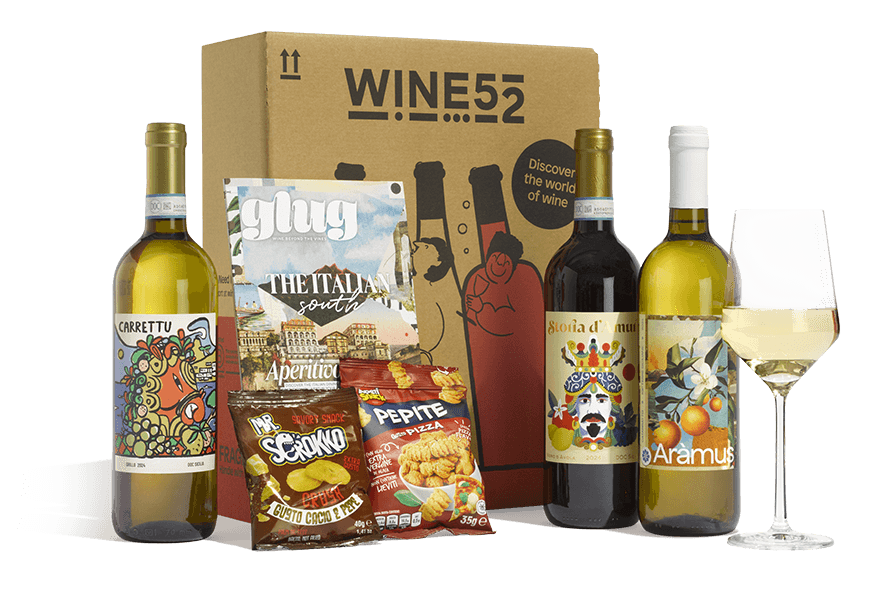
Join Wine52 and get your first month half price
-
Get your first box for £18 (RRP £36).
-
3 wines & 2 snacks delivered monthly.
-
Printed Glug magazine included.
-
Unlimited access to all online content.


