Indigenous Grapes: South Australia
Meet the stars of this month’s show
Katie Mather
Wednesday 15 July 2026
This article is from
South Australia
issue 64
Share this article
The oldest vines in Australia are 125 years old, or slightly older. Many of these can be traced back to Aussie immigrant James Busby, whose family moved from Scotland to Australia in the 1820s. He travelled to winemaking countries and took cuttings from vines back with him, planting what are now some of the oldest vineyards in the country.
There are around 400 hectares of vines aged from 100 years old to over 125 in South Australia. These vines make up a proportion of the area’s most highly prized wine producing regions, such as the Barossa Valley and Coonawarra, and they are mostly Shiraz and Cabernet Sauvignon—but there are old Mataro, Semillon, Pedro Ximenez, Riesling and Trebbiano vines all over the state, according to Wine South Australia and the South Australian Wine Industry Association.
Australia, of course, has no indigenous grapes of the Vitis vinifera variety; every vine was shipped in from grape-growing regions or is descended from plants that were. However, Australia’s own unique biodiversity throws some fascinating indigenous berry-producing plants our way. Causonis clematidea, or “slender grape”, is a shrub that grows from tubers, and it’s actually these tubers that are eaten by Aboriginal Australians—the berries don’t actually taste that exciting.
Apocissus hypoglauca, or “jungle grape” is a mangrove-dwelling plant that also grows over land cleared of forests by fire. Their sweet, blue berries are edible and are usually made into jellies or preserves. But not wine. Neither of these truly Australian plants produce true winemaking grapes.
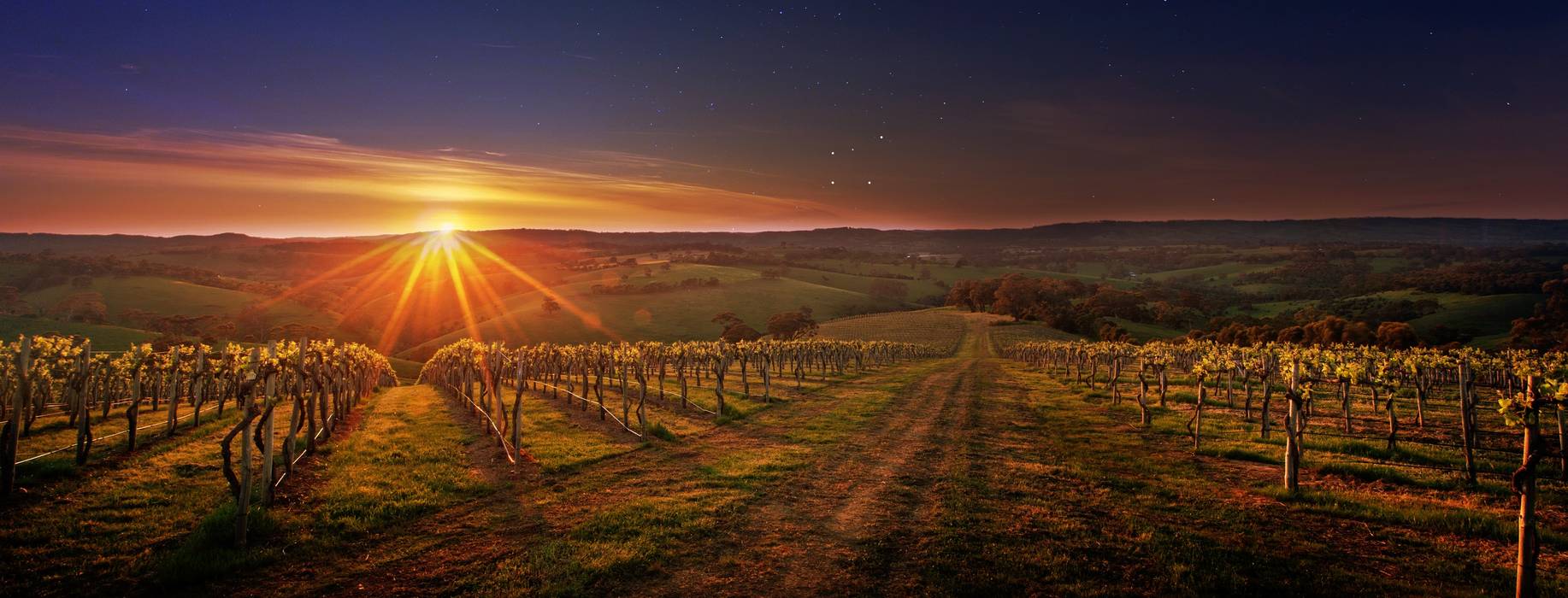
All winemaking in Australia comes from vines that James Busby, and people like him, brought to the country from elsewhere. What Australia can offer, however, is its own diverse climate and immense space. In reliably warm temperatures with sunlight hours rivalled only by South America, Australia’s wine regions can offer ideal growing conditions for mass-production. In the hills and valleys, finer wines are made, taking full advantage of microclimates that cool the vineyards and moisten the earth.
The most famous Aussie grape is Shiraz. It took to the baked, iron-rich soil and golden sunshine like a duck to water, and in return for irrigation, winemakers haul in harvests of bold, juicy grapes with all the round fruit flavours of jammy plums, strawberries and cherries. Some of Australia’s well-known brands like Jam Shed and 99 Crimes made their mark with big Shiraz wines, and its in South Australia’s Riverland region where the majority of the country’s bulk wine is grown.
Australian winemakers do make more subtle Shiraz though. Following the French style we know as Syrah, regions with cooling breezes and more shade offer a chance for the grapes to catch their breath, enabling a slower ripening period and a more elegant wine.
The next most popular grape on a South Australian vineyard is Cabernet Sauvignon. Again, the hot, sunny summers of South Australia enable a huge production of Cabernet Sauvignon. There are top quality regions of South Australia for Cabernet Sauvignon, and it’s here that some of the country’s finest wines are made.
Coonawarra, also known as the Limestone Coast, is where some of the best Cabernet Sauvignon in Australia is made. The combination of soil types including that instantly identifiable “terra rossa” red limestone and clay gives the vines plenty of deep-rooted water cavities under the ground and away from the burning sun. These Cab Sauvs are complex and perfect for ageing, with structure, balance and intriguing aromas of eucalyptus and blackcurrant.
Mataro, known as Mourvèdre or Monastrell too, depending on where you are in the world, has been planted in South Australia for more than a century. It’s a fantastic blending grape for Shiraz, adding tannin and structure to a wine that may have endured warm temperatures and therefore became too sugary and lost its acidity. It’s a funky, farmyardy grape with a lot of complexity, but it loves the sun, hence why winemakers have been growing it here for so long.
Mataro (or whichever name you like to call it, it doesn’t mind) makes up the GSM blend along with Grenache and Shiraz. Our friend James Busby was the first person to bring the grape to Australia, and since then it’s been a useful blending grape. You are unlikely to find a single variety Mataro wine in South Australia without making an effort to seek one out.
Fruity and fun Grenache is a South Australia favourite because of its bouncy red and purple fruit flavours like jewel-coloured sweets melting in a hot car. Sometimes, that’s exactly what you want. As mentioned, Grenache is used as part of the GSM blend which is a hugely popular wine in Australia. However, in parts of the region where cooling breezes and microclimates exist, it can be used to make fruity rosés with notes of raspberry and guava.
It would be remiss not to mention Riesling in a roundup of South Australian grape varieties, being that it is the heartland of Australian Riesling. Using the warm sun to fully ripen its high acid grapes, Riesling from the Clare Valley, Eden Valley and Adelaide Hills are regarded worldwide as some of the best available, and each with their own distinct character from floral and powerful to elegant and focused.
In small pockets of the region, a grape that is only a couple of years or so old in Australia is being planted. Xynisteri, a white grape originating on the red hot island of Cyprus is showing that South Australia is also at the epicentre of vineyard research. Beginning in Riverland and the Barossa Valley, parcels of the grape were planted because of its increased resistance to drought. It’s also extremely tolerant of high temperatures, with a thicker skin that can withstand temps of up to 45 degrees celsius.
The trials have gone so well, in fact, that the Barossa Valley winemakers who made wine with Xynisteri have sold out of their first vintage already. Expect to see it on shelves in the coming years.
Share this article
You’ve reached your limit of 5 free articles this month.
Unlock unlimited access and more
Join Wine52 and get your first month half price
-
Get your first box for £18 (RRP £36).
-
3 wines & 2 snacks delivered monthly.
-
Printed Glug magazine included.
-
Unlimited access to all online content.


