Giusti
Meet the winery
Glug Staff
Wednesday 12 August 2026
This article is from
Alpine Italy
issue 65
Share this article
Ermenegildo Giusti grew up in a working class family on the Montello—the long wooded hill that rises above the Piave north-west of Treviso—among relatives who grew the local grapes Glera, Bianchetta, and Verdiso. He left Veneto at seventeen, emigrating to Canada with his younger brother and almost no English, and spent four decades building up a substantial construction business in the country’s west.
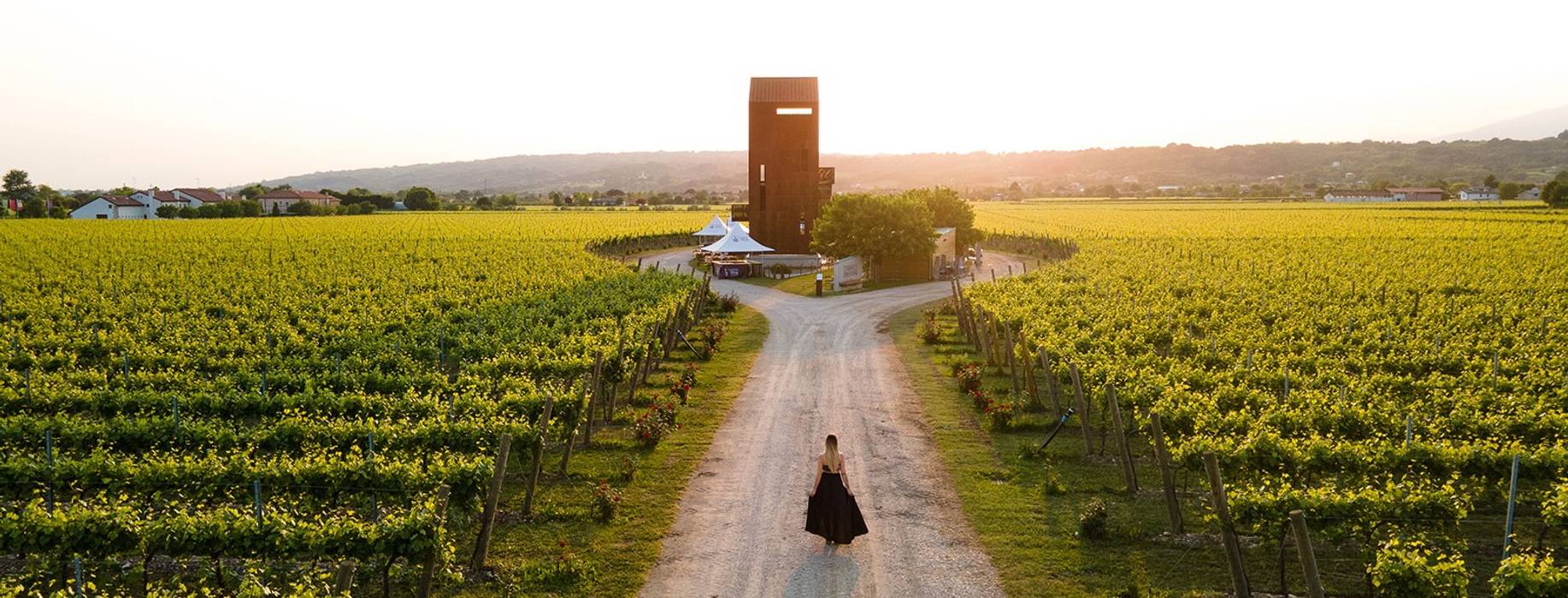
Only in 2002, after he had achieved his success abroad, did Ermenegildo return home to begin buying land on the slopes of the hill on which he had grown up. The resulting winery is built on that double history: a fortune made in North American infrastructure, reinvested in the vineyards of home.
His new wine business grew quickly. From an initial two-hectare plot—developed out of an existing vineyard belonging to his wife’s family, which dated to 1945—the estate now extends across well over a hundred hectares. It is divided into ten separate holdings, spread between the alluvial plain along the Piave and the Montello and Asolo hills above; the flatter ground is perfect for making the DOC Proseccos, while the slopes, where the fruit is finer, supply the DOCG wines and the estate’s reds.
The Montello and Asolo hills sit in the band of foothills the locals call the Pedemontana—the ground that rises toward the mountains proper—and the cool air off the high country gives the Prosecco its freshness in the same way it does across these slopes. Giusti also reaches west to the Valpolicella to make Amarone, and has revived Recantina, a near-vanished native red of the Treviso hills.
Anyone seeking evidence of the ambition behind this estate need look no further than the individual Giusti persuaded to join as winemaker. Graziana Grassini is the consulting oenologist behind Sassicaia—the Tuscan wine that effectively invented the Super Tuscan category and remains among the most celebrated in the world—a role she inherited from her mentor Giacomo Tachis, the father of modern Italian winemaking. A Tuscan by birth, trained partly in Bordeaux, biologist as well as oenologist, she is one of the most decorated figures in Italian wine, and Giusti was the first project she had ever accepted in Prosecco’s Veneto heartland.
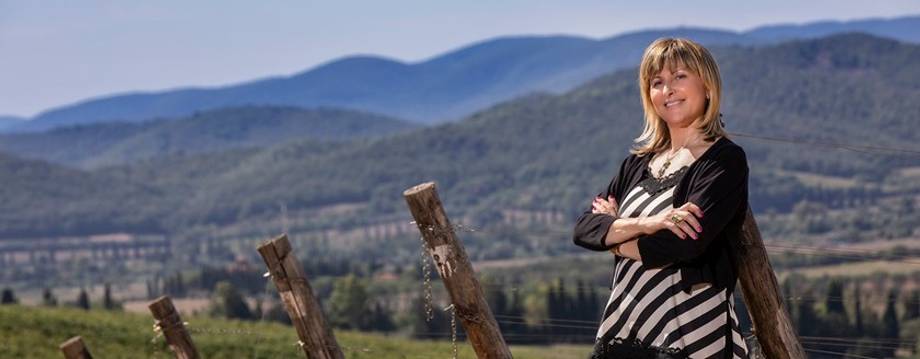
Graziana Grassini
And by Ermenegildo’s own account, that was exactly the point. He had come to fear that Prosecco was drifting toward mass production—“water and sugar” in his blunter moments—and he wanted a winemaker with no habits formed in the region, who would approach its grapes without the assumptions of the local trade. Grassini’s brief was not to make more of the same, but to find out what the Montello and Asolo hills were capable of, in pursuit of a serious, mineral, age-worthy expression of Glera at the top of the range, and reds from the hill’s clay-and-iron soils to sit alongside it. Her own well-established belief in native varieties, with a particular fondness for the perfume of white wines, suited an estate trying to make the case for quality in the region.
Ermenegildo’s construction background can definitely be seen in the winery building itself—a stylishly understated structure, dug deep into the hillside, shaped to echo the rolling profile of the Montello and kept low to avoid interrupting the view of the nearby Abbey of Sant’Eustachio. The former Benedictine abbey, whose records reach back around a thousand years, sits among Giusti’s vineyards, and was extensively restored by Ermenegildo himself. It was here, in the sixteenth century, that Monsignor Giovanni della Casa wrote the Galateo, the treatise on manners that effectively founded the European literature of etiquette.
It is a fitting thing to have at the centre of the estate. Giusti has spent two decades and a considerable fortune making an argument—that this stretch of the Treviso hills belongs in the same conversation as Italy’s grander wine regions—and in hiring the woman who tends Sassicaia to make its Prosecco, he has staked that claim about as plainly as it can be staked. For a winery barely old enough to have found its feet, it is a strikingly confident bet on the ground he grew up on.
Share this article
You’ve reached your limit of 5 free articles this month.
Unlock unlimited access and more

Join Wine52 and get your first month half price
-
Get your first box for £18 (RRP £36).
-
3 wines & 2 snacks delivered monthly.
-
Printed Glug magazine included.
-
Unlimited access to all online content.


