You say ‘buongiorno’, I say ‘guten tag’
Austria meets Italy in South Tyrol
Marianna Hunt
Illustrations: Beck O'Hara
Wednesday 12 August 2026
This article is from
Alpine Italy
issue 65
Share this article
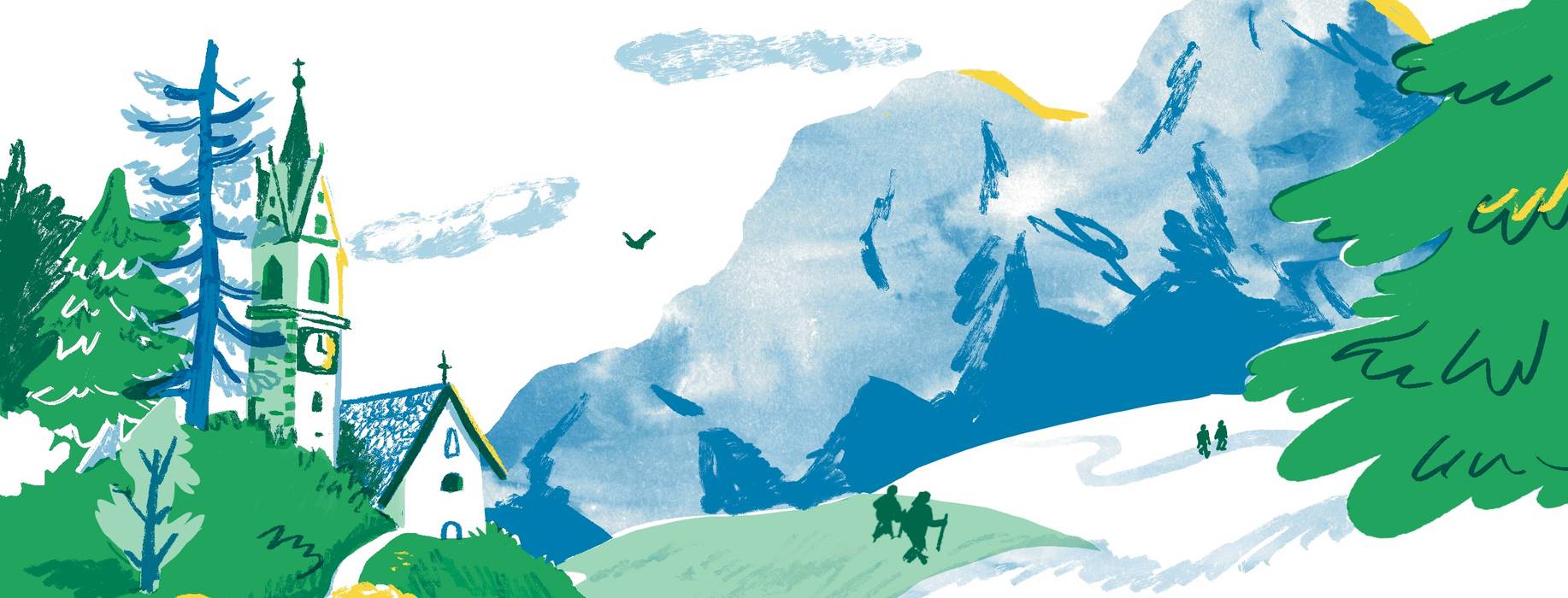
As my partner and I tramped through Alpine meadows and along rocky ridgelines, the melodious “Ciao” that rang out from our fellow ramblers gradually morphed into a jolly “Guten Tag”. Restaurants selling pizza and pinot grigio were replaced by wood-beamed huts serving up apple strudel and steins of frothy beer.
We had not passed any physical borderline or checkpoint—only that amorphous mush of lines in people’s heads that makes up their sense of themselves.
But that’s South Tyrol for you. A region with so many sides to its personality, it has two separate names: Alto Adige if you’re feeling Italian, or Südtirol if you’re more Germanic.
It shouldn’t be all that surprising when you think that, along with neighbouring region Trentino, this mountainous slice of continental Europe has only been part of Italy for around a century. For about 550 years before that—bar a short break—both formed the southern edge of the County of Tyrol, ruled by the Habsburgs from their power base in Austria.
The break with Austria only came after WWI, when South Tyrol and Trentino were annexed (to the horror of many German-speaking locals) to Italy. In the 1920s and 30s, the country’s fascist dictator Benito Mussolini attempted to “Italianise” the region—encouraging southerners to settle there, banning the German language in schools, media, and public life, and even forcing many local people to change their surnames to sound more Italian.
But, thanks to dogged resistance from the German-speakers, the area’s Austrian heritage was never expunged entirely. Today, the two provinces form one region, Trentino-Alto Adige/Südtirol, where you can see street signs in both German and Italian, order kaiserschmarrn pancakes (a Habsburg-era special) alongside your spaghetti, and hear Oompah bands playing during your après-ski. It’s not unusual for locals to have one parent whose first language is Italian and the other German.
Although there has been a great deal of pain along the way, today the two cultures co-exist mostly quite happily and the result is a delicious mishmash of Mediterranean Italian and Alpine Germanic influences that is not to be found anywhere else in the country.
But it’s not simply a binary distinction between Italian versus German-speaking areas. As I learned during my travels, in some villages, you’ll find a third tongue too: Ladin.
Ladin is a language that evolved from the “vulgar” Latin spoken by the ordinary Roman soldiers and workers, shaped over centuries by older languages spoken by the region’s Alpine peoples.
“In the whole of South Tyrol 4% of the population today speak Ladin,” Nicole Dorigo, a Ladin-speaker herself, told me. “They are principally based in the valleys of Val Badia and Val Gardena. The other Ladin speaking people live in the regions of Trentino (Val di Fassa) and Veneto (Livinallongo and Cortina d’Ampezzo).”
She added that residents of Alta Badia, the pretty mountain resort where she works for the local tourist board, regularly switch from language to language without even noticing it. “When I wake up, I think in Ladin about what I have to do during the day. I leave my apartment and exchange a few words with some guests in Italian. Then I get a call from a colleague from Bolzano and we speak in German.”
Ladin is not just a language either. The local people wear their Ladin identity proudly like a sash—whether that’s donning folk costumes on feast days, telling ancient legends to their children, or in the delicate regional craftsmanship.
So, what’s the best way to experience this charming cultural patchwork?
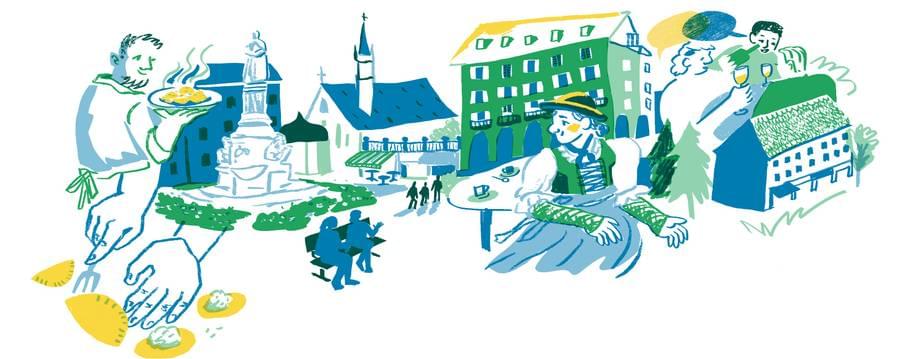
First off, the food and drink. Trentino-Alto Adige/Südtirol’s appeal is not just that you get both superb Italian and Austrian food, it’s the unique way in which the two proud culinary cultures meld together in dishes like Schlutzkrapfen (known in Italian as mezzelune, or “half moons”).
Semi-circles of silky pasta are stuffed, usually with spinach and ricotta (hello Italy!), but sometimes beetroot or sauerkraut, and finished with melted butter and chives (welcome Austria!). A butter-dripping love child of ravioli and dumplings.
Then there’s canederli (or semmelknödel)—plump Tyrolean bread dumplings that work just as well in a rich broth or game stew as they do smothered in melting parmesan.
One of their key ingredients is another perfect example of Italian craftsmanship meeting hearty Austrian flavour: speck. Unlike Austrian ham or Italian prosciutto, it combines the Italian tradition of air-curing pork with the Austrian insertion of smoking and spicing - the meat laced with flavours of juniper and bay leaf.
“My favourite example [of the cultural combination] is for sure the gastronomy,” said Dorigo. “Dumplings on one side and pasta al pomodoro on the other. What better mix?”
And then there are the wines. South Tyrol’s high altitude and cold nights mean it is perfect for developing crisp, fresh white wines—whether that’s delicate Italian pinot grigios or more aromatic Germanic grapes. Alta Badia hosts an annual Ski Safari where you can ski from chalet-restaurant to chalet-restaurant tasting dozens of local wines. It’s one of the best ways to compare the taut elegance of South Tyrol’s pinot grigios to the heady floral notes of its kerners and gewürztraminers.
Once you’ve gorged yourself silly on Tyrolean food and wines, make sure to find time for some sight-seeing. The co-mingling of cultures over the centuries comes through strongly in sites like Roncolo (Runkelstein) Castle, with its spectacular frescoes depicting legends and courtly life from the German-speaking world, or Piazza Walther (Waltherplatz) in Bolzano. With its elegant café culture, Gothic cathedral, and bustling Christmas market, the piazza feels more like Vienna than Rome.
Then there’s Castello del Buonconsiglio in Trento, which served as the opulent residence of the Prince-Bishops of Trento (part of the primarily German-speaking Holy Roman Empire) for nearly 600 years. It has manicured Italian gardens and frescoes by both Bohemian and Italian painters. The castle was later used as a military jail by the Austro-Hungarian Empire and you can visit the cells where locals who were fighting for Trentino to be part of Italy were imprisoned and executed during World War I.
And don’t forget the Ladin side of things. A number of experiences have emerged in recent years allowing visitors to get a feel for traditional Ladin life. Alta Badia’s own “Nos Ladins” programme includes opportunities to spend the day with shepherds, make cheese at a dairy, work with craftsmen, and go night sledding.
Descending from the mountains on the last day of our South Tyrol trip, the “Guten Tags” gradually began to be outnumbered by the “Ciaos”. By then, I had stopped noticing the difference. Here, the two languages are less a dividing line than part of the landscape itself—zigzagging back and forth like the jagged peaks of the Dolomites behind us.
Share this article
You’ve reached your limit of 5 free articles this month.
Unlock unlimited access and more
Join Wine52 and get your first month half price
-
Get your first box for £18 (RRP £36).
-
3 wines & 2 snacks delivered monthly.
-
Printed Glug magazine included.
-
Unlimited access to all online content.


