Steep stakes
The precipitous life of the terraced alpine wineries
Ian Bancroft
Photo: Arpepe © Beniamino Pisati
Wednesday 12 August 2026
This article is from
Alpine Italy
issue 65
Share this article
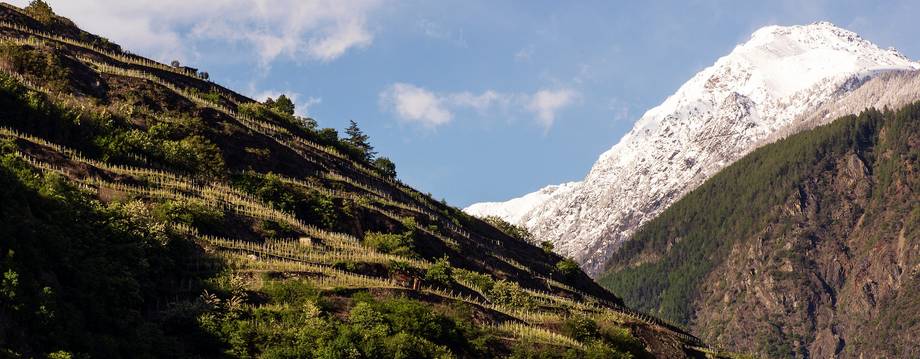
In the Central Alps of northern Italy, framed by peaks topping 4000 metres, lies the region of Valtellina, home to one of winemaking’s most spectacular landscapes. Here the steep slopes have been tamed by some 2500 kilometres of dry stone walls—muri a secco—that hold the terraced vineyards in place. It is the great stone wall of Italy.
For Mamete Prevostini, President of the Consorzio di Tutela dei Vini di Valtellina—the Consortium for the Protection of Valtellina Wines, which oversees all regulated wine production in the region—Valtellina “represents a viticultural terroir that is truly unique in the world”. Where most alpine valleys run north to south, gouged out by creeping glaciers, this is “one of the few alpine valleys with a strict east-west orientation,” he says, “a specific topography that creates extraordinary climatic conditions”—the cooling breezes that funnel down the slopes among them.
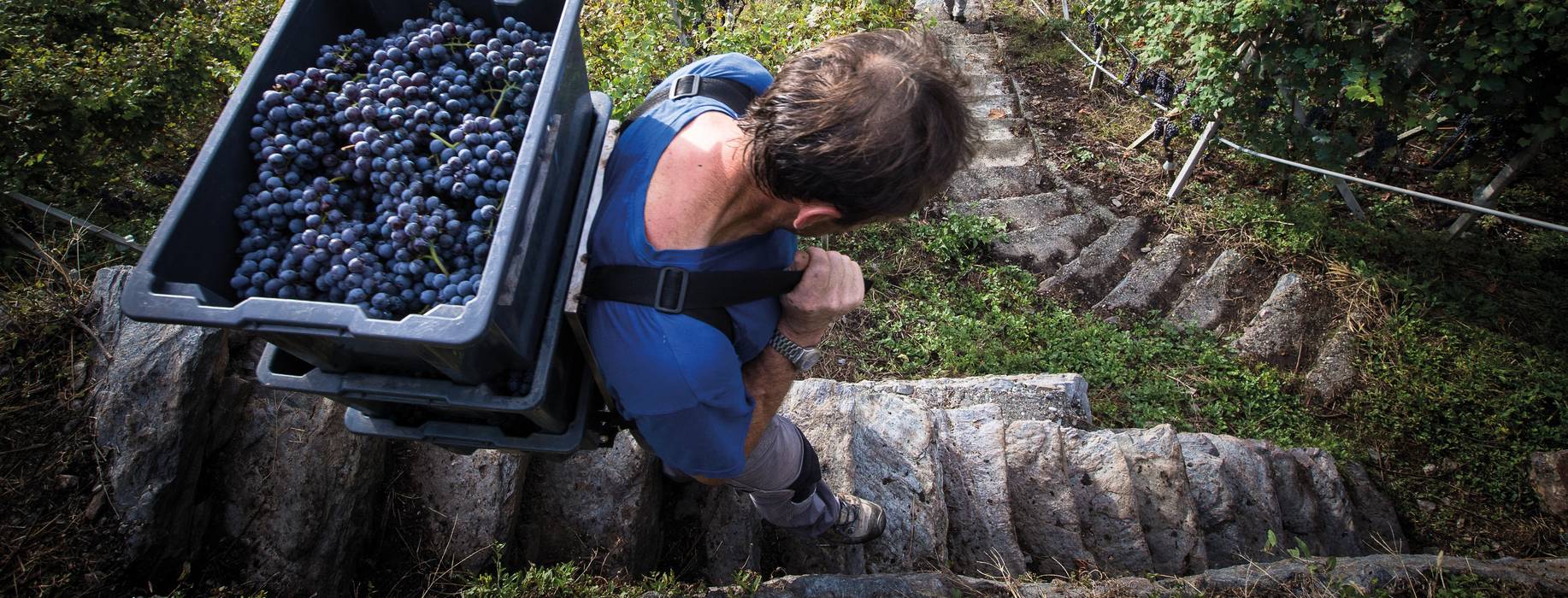
Keeping the terraces standing is a monumental effort and, in Mamete’s words, “testament to the region’s historical dedication to high-quality wine production”. The walls themselves—built without a drop of mortar or cement—have earned a place on UNESCO’s list of Intangible Cultural Heritage. At ARPEPE, where the Pelizzatti Perego family is now into its fifth generation, the upkeep never really stops. “We preserve the terraces through daily monitoring that extends far beyond the vines themselves,” says Guido Pelizzatti Perego. “From clearing weeds between the walls to scaling loose rock, everything needs constant manual labour.” Mountain viticulture is arduous work.
Then there is the logistics of working the slopes, which Guido says amounts to “a true defiance of gravity”. The incline is so severe that almost every operation, the harvest included, still has to be performed by hand. It is winemaking on the margins. Only 750 hectares of vineyard remain, down from 3000 in the 1970s, lost to abandonment and the sheer difficulty of cultivation. What survives demands roughly 1,500 hours of manual labour per hectare each year.
© Vini di Valtellina
The grape that thrives here is Nebbiolo, known locally as Chiavennasca—the “Nebbiolo of the Alps,” as Guido has it. It grows on sandy loam weathered from metamorphic rock, and the altitude, he says, lends the wine “a vertical freshness, an innate elegance, and a razor-sharp minerality that cannot be replicated anywhere else.”
Mamete adds: “Over the centuries, this grape has perfectly adapted to the valley’s microclimates, developing distinctive traits that make it exceptionally suited to an alpine environment… On these slopes, the grape achieves one of its most elegant and terroir-driven expressions.”
Newer infrastructure has eased some of the load. On the gentler sections, motorised monorails carry crates of grapes down to the nearest road, while in the steepest, most cut-off parcels, growers occasionally resort to helicopters to lift the fruit straight to the winery before it spoils. It is both labour-intensive and costly.
Climate change has brought harsher extremes—heatwaves one week, sudden downpours the next—but it has, Guido says, also forced the region to adapt. “Protecting our historic dry-stone walls and ensuring the quality of the grape clusters now requires extra care,” he says, “but we view managing these new climate dynamics as an essential investment in the future of Valtellina.”
Technology is starting to fill some of the gaps. “Autonomous drones for targeted treatments and automation systems offer promising new avenues,” Mamete says, and the Consortium is funding much of the research itself.
“This type of technological innovation would bring great benefits to a territory like ours,” Guido comments. The valley has long relied on cableways to bring grapes down the slopes, and the systems going in now are markedly more capable than what came before.
One of the hardest problems is generational. “We need to attract and train a new demographic of professionals capable of maintaining the ancient dry-stone walls,” Mamete says. The stakes run well beyond the vineyards: the masonry holds back soil erosion and landslides, making it vital, in his words, to “the ecological safety of the entire valley.” A widening labour shortage sharpens the difficulty.
“Finding the right hands for this dedicated work is a challenge,” agrees Guido, “but it is also our greatest opportunity.” Bring new people to the craft, he adds, and “we can safeguard these unique slopes and ensure that no more vineyard acreage is lost.”
We can safeguard these unique slopes and ensure that no more vineyard acreage is lost
Like any wine region, Valtellina wants to be better known. The recent rise in estate-bottling growers, Guido says, “proves that our viticultural heritage is a precious asset, unique in the world and capable of generating real economic value”—and a reason for young people to “build a future in these mountains”. To that end, the Consortium has put serious money into promotion at home and abroad.
Geography works in its favour, too. The valley lies just north of Milan, a short hop from Lake Como, shares a border with Switzerland and connects directly to alpine names like St Moritz and the Engadin. This past winter it staged events for the Milan-Cortina Winter Olympics.
For Mamete, the terraces are “an authentic, open-air museum, showcasing humanity’s historic ability to adapt a complex mountain environment for viticulture”.
Yet none of it can be taken for granted. “In a land like ours,” says Guido, “fighting tooth and nail to preserve this heritage requires immense passion and resilience.” The Consortium and the valley’s growers mean to see these vineyards through to the next generation, taking on new tools without letting the slopes slip away. They deserve our support.
Share this article
You’ve reached your limit of 5 free articles this month.
Unlock unlimited access and more
Join Wine52 and get your first month half price
-
Get your first box for £18 (RRP £36).
-
3 wines & 2 snacks delivered monthly.
-
Printed Glug magazine included.
-
Unlimited access to all online content.


