Holy vines
Jacopo Mazzeo likes his wines pre-blessed
Jacopo Mazzeo
Wednesday 12 August 2026
This article is from
Alpine Italy
issue 65
Share this article
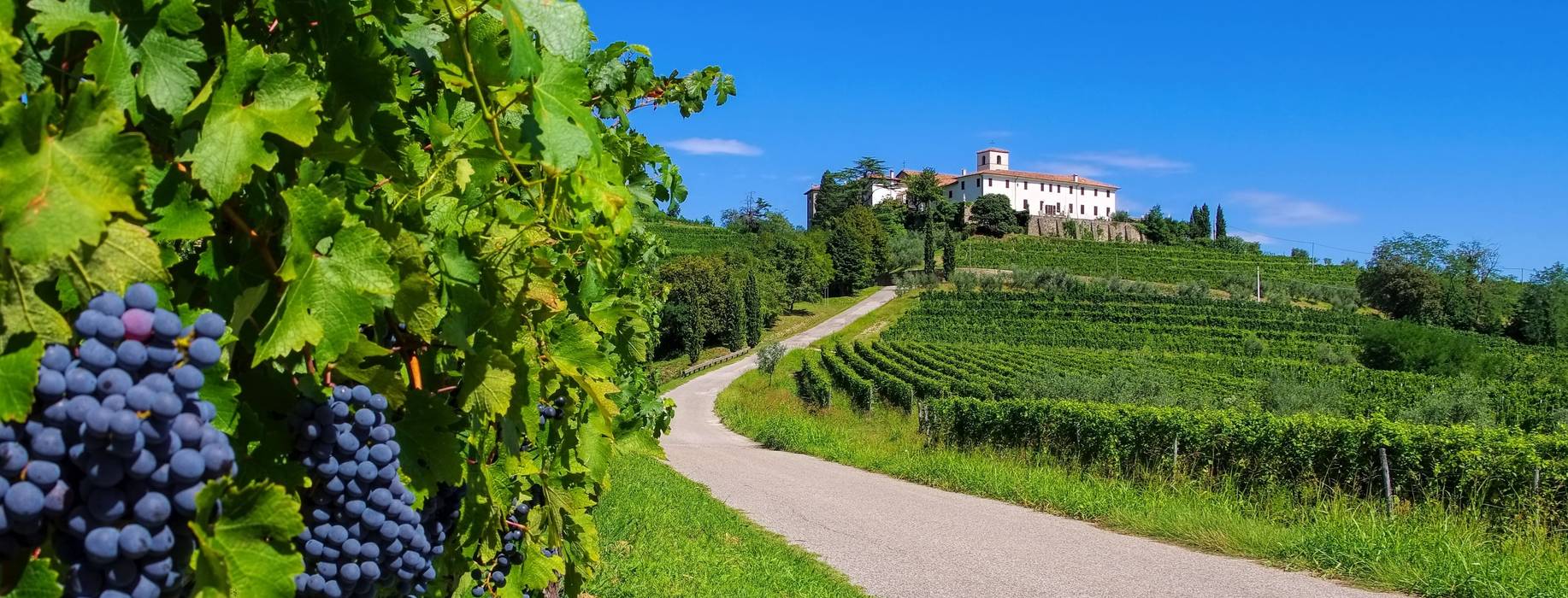
Venice’s Santa Lucia is a rather unusual railway station. Instead of opening onto a wide piazza or a multi-lane boulevard, it spills directly onto the edge of the Grand Canal. If the more than 30 million travellers who pass through it each year weren’t enough to create a sense of congestion, that tight space outside the station makes the area feel even more crowded. Just around the corner from this bustle, as tourists jostle for the last remaining spaces on the vaporetti, lies the Mystical Garden of the Order of Discalced Carmelites. Enclosed within walls and covering around a hectare, this true oasis of silence and contemplation serves as the private garden of the adjacent convent. The space is filled with fragrant flowers, fruit trees and even has its own small gateway onto the quiet back canal. Its defining feature though, is the rows of vines planted with local grape varieties including Raboso, Glera, Incrocio Manzoni and Malvasia. Here, wine has been made for centuries, and while vinification now takes place at a partner site, Father Ermanno, the prior, continues to oversee all agricultural work.
The Mystical Garden might feel like a truly unique place. And as a refuge of calm right in the heart of Venice, it certainly is. But it’s far from the only vineyard tended by monks. Italy is dotted with abbeys that still produce wine (including more in Venice itself), and many on a far larger scale.
Music, literacy, and viticulture
For centuries, winemaking lay at the heart of monastic life across the peninsula. In the aftermath of the collapse of the Roman Empire, as much of Europe descended into political instability, monasteries, abbeys and nunneries became islands of continuity, literacy and record-keeping. Within their walls, knowledge considered essential to religious life was preserved and transmitted, from musical notation to book writing, and viticulture too. Wine was not only a source of daily sustenance, it was also a symbol of hospitality—offered to pilgrims or visiting dignitaries—and, above all, it was a non-negotiable liturgical necessity. This central role prompted monasteries to secure winegrowing know-how, preserve grape varieties, and meticulously document vineyard sites (in Burgundy, for instance, monks effectively laid the foundations for the terroir-driven system that still defines the region today).
“If we drink excellent wines today and know so many native grape varieties, we owe it in large part to the abbeys,” argues Rocco Tolfa, founder of Abbey Wines, an annual event dedicated to monastic wines held at the striking Abbazia di Fossanova in Lazio. “After the fall of the Roman Empire and the barbarian invasions, the countryside was abandoned and it was the monks who rebuilt its agricultural fabric.”
Surviving vines
As Napoleon’s forces swept through Italy in the early 19th century, many monastic vineyards were dismantled or transferred into private hands. Italy’s unification in the 1860s dealt a further blow, with more abbey vineyards being confiscated, sold off or simply abandoned. Despite this upheaval, a handful of monastic vineyards—many of them located along the Alpine arc—managed to survive.
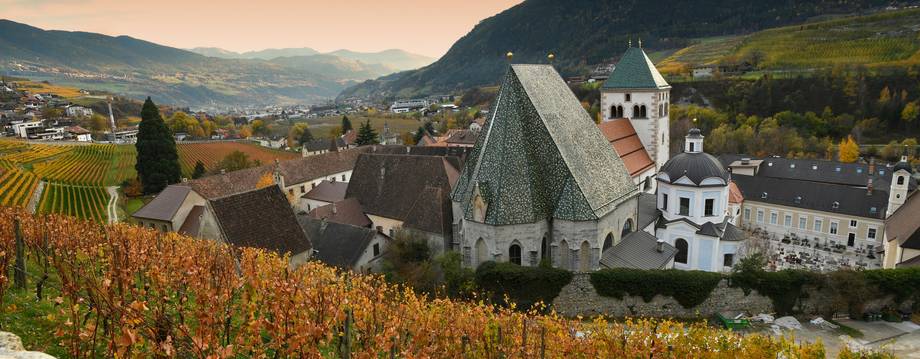
“That has a historical reason,” explains Werner Waldboth, who oversees the wine business at Novacella Abbey. “In the late Middle Ages, our monasteries were often the main suppliers of wine to southern Germany. In Alto Adige in particular, many Bavarian monasteries either owned vineyards directly or bought wine from local growers. That trade helped establish the historical importance of monastic wine production in this region.”
Muri-Gries and Novacella itself, for instance, are both in Alto Adige. Praglia Abbey is near Padua in neighbouring Veneto; Venice itself is home to another monastic vineyard at San Francesco della Vigna; while Friuli is home to Rosazzo Abbey. And there are more further south too (like the Trappist monastery of Vitorchiano, home to a community of cloistered nuns), for a total of over 30 winemaking monastic operations across the whole country. Several are now in the hands of secular entities but others are still tended directly by monks or nuns. Experienced laypeople are only brought in to manage part or all of the vineyard and winemaking operations in case of lack of manpower or other practical considerations.
“The winery is part of the abbey, so the entire operation remains a religious institution and we are simply its employees,” Waldboth says of his role at Novacella. “In fact, the monks’ job has never been to make wine themselves. They have always relied on staff to oversee the winemaking, so in that sense very little has changed throughout the history of this place.”
Novacella Abbey
Modern contradictions
What has changed is the scale of the operation. As demand grew during the 1960s, Novacella began working with a consortium of local growers to increase production, transforming the winery into a rather sizeable enterprise. Similar developments took place at several other monastic wineries, particularly those that had passed into private hands.
The demands of a modern business might seem to sit uneasily alongside the rhythms of abbeys and nunneries, yet the two are not necessarily at odds. The production of agricultural goods has been a cornerstone of monastic life since its earliest days and, while commercial sales were not originally part of that equation, they have become an essential source of income at a time when many religious institutions must find new ways to sustain themselves financially. Judging by the growing interest in monastic wines, this appears to be a successful strategy. “The first edition was an overwhelming success, and that is when we realised this wasn’t just an event, it was a mission,” says Tolfa of his Abbey Wines festival. “Nothing like it existed in Italy, or even in Europe.”
The appeal may stem from the spiritual aura that surrounds these wineries, or it may simply reflect a broader appreciation for the slower pace and more thoughtful approach to winemaking that they embody. “There is a clear common thread,” says Tolfa. “We are talking about wines made with the support of modern technology but according to rituals and practices that monks have handed down for centuries. It means preserving the landscape, respecting the earth, and communicating a spirit of hospitality that goes beyond the simple glass.”
Despite their wine’s growing popularity, the steady decline in religious vocations has affected monasteries and convents across Europe, including those involved in viticulture, putting their long-term future in doubt. “We are down to just 12 canons now, and half of them are very elderly, 80 or older,” Waldboth admits. “Young people are scarce. Our youngest, Maximilian, is 30 and is the only person to have entered the abbey in the last seven or eight years. If nothing changes, Novacella will have a problem soon.”
Yet the growing interest in monastic wines may offer part of the solution. Beyond generating income to support the upkeep and restoration of these historic institutions, the renewed visibility of abbey wineries can also appeal to the new generation of monks.
“A young person who decides to enter a monastery has many communities to choose from,” Waldboth continues. “In the end, they will choose the one that appeals to them most. In that respect, Novacella is certainly among the more attractive options because of its winery. It is a place where you can live well, and it enjoys a certain degree of financial stability.”
Just as monasteries and abbeys once played a fundamental role in safeguarding wine through centuries of upheaval, wine has now become a lifeline for many of those same communities, whose survival matters for reasons that transcend religious belief. At a time when wine is increasingly viewed as a commodity, monastic productions offer a reminder of its deeper spiritual, historical and human significance.
Share this article
You’ve reached your limit of 5 free articles this month.
Unlock unlimited access and more
Join Wine52 and get your first month half price
-
Get your first box for £18 (RRP £36).
-
3 wines & 2 snacks delivered monthly.
-
Printed Glug magazine included.
-
Unlimited access to all online content.


