The Cheese Board: Alpine Italy
Ned Palmer rounds up his top cheeses of the region
Ned Palmer
Wednesday 12 August 2026
This article is from
Alpine Italy
issue 65
Share this article
Every June groups of hardy men go up into the high pastures of the Italian Alps with their herds to live in roofless stone huts and make cheese for the summer season. These devoted dairymen are part of a culture of transhumant cheesemaking which has been practiced throughout the Alps for over two thousand years, although the Swiss and French cheesemakers stay in cosier chalets.
This shared culture, which began long before the birth of nation states, has produced a family of cheese known as ‘Alpine Style’. Made to last, these Alpine cheeses are characteristically large; Gruyère can weigh around thirty-five kilos, the mighty Beaufort forty-five, and the even mightier Emmental over a hundred. They have a firm if supple texture and are known for their sweetness. Floral and fruity notes dominate in the younger cheeses, which in more aged versions can develop into dried fruit, toasted hazelnuts and the savoury smoky flavours of the darker more offaly meats.
Still, the cheeses of the Italian Alps are quite distinctive. They tend to be smaller, with a softer texture and are either notably more funky, or milder and creamier than their French and Swiss counterparts. Also, funnily enough, not all cheeses made in the Alps are alpine - the mountainous regions of northern Italy are blessed with some excitingly unique varieties.
Fontina is Italy’s most well-known and successful alpine cheese. Generic versions are made all over Europe, in Canada, the U.S. and even Argentina, but if you want to go to the source, look for the PDO version, Fontina V’Al D’Aosta, named for its home, the Aosta valley in Lombardy. Weighing in at up to twelve kilos, their moist, sticky rinds are an enticing orange pink, their aroma farmy, and their flavour sweet, with toasted hazelnuts and a good dose of funk. If you are after a really special Fontina, look for the Alpeggio label which shows they were made on the high flower and herb-rich pastures, and consequently deliver more complex and floral flavours.
All PDO Fontina must be made from raw milk from the Valdostana cow, a pied red and white Alpine breed, whose hardiness and agility serve them well on the steep exposed slopes. One strain, the Pezzata Nera, like to spar among themselves to establish hierarchies, which has led to an ancient annual competition; herdsmen organise batailles de reines, and the winner becomes the Reina delle Reines, local French/Italian patois for Queen of Queens. You may be eating the cheese of bovine royalty.
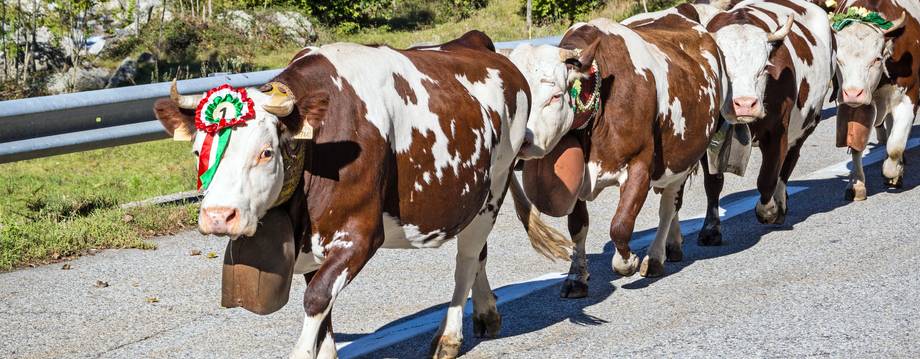
Valdostana cows © Andmorg
Taleggio, another famous child of the region, is a washed-rind style, as funky and gooey as this family usually is. Originally from Lombardy, it was traditionally made at the end of the season after the cows had come back down to the valley, mirroring the French and Swiss seasonal production of Vacherin. End of season cheese like Taleggio is referred to as stracchino in Italian, derived from a dialect word for ‘tired’, referring to the hard working cows. Tired they may be, but this late in their milking period their milk is particularly rich, giving this cheese an opulent creamy texture. Taleggio’s terracotta-coloured squares with their arcane markings of circles and lines remind me of a Roman artefact, and its pale soft paste delivers delicate herbaceous flavours which become funkier and more intense as it ages.
Piedmont is an unmissable destination for the intrepid cheese tourist. It is heaving with cheese varieties, many of which are unique, and the region is the home to a biannual cheese festival in the commune of Bra. This is probably the largest cheese fest in the world—in 2025 the town welcomed fifty-thousand visitors—so book your accommodation now for 2027.
Robiola di Roccaverano alone is worth the trip. It is made in the lush green hills of the Langhe region from raw goat’s milk. The most traditional producers use whey from the previous day’s cheese to sour the milk instead of bought starter cultures, giving their cheeses the unique character of each farm’s microbiome. You can find the older or affinato cheeses in the UK, their rumpled rinds surrounding a liquid paste and giving a vegetal flavour. For the younger, fresco cheeses though you’ll have to travel to Piedmont, because these are at most only ten days old, with a giving texture, and refreshing acidic mineral flavours.
Castelmagno, unlike the more supple alpine styles, has a crumbly craggy texture much like Parmesan, and has a unique step in its make. Once the curd is firm enough, it is cut into slices which are then put back into the whey where they sit for up to a week. This might have been to save up enough curd from a small peasant herd until there was enough to make a good-sized cheese, and the make certainly contributes to that distinctive crumbly texture. Younger cheeses are sweet and floral, older ones salty and spicy with an animalistic tinge; some even develop a haze of blue fading in from the rind. Locals soften the intensity of these with an accompaniment of honey or nuts.
And now, back to those hardy men in their roofless huts, who make the most singular cheese of the Italian Alps. The rather spartan huts, called Calécc in the local dialect, mean that the men following their animals higher and higher up the mountain pastures as the season progresses, can make the cheese there and then with milk that is unruffled from travel, perfectly fresh, and still warm from the cows and goats who graze companionably on the flowery pastures. The itinerant cheesemakers take everything with them from hut to hut including their wood-fired copper vats and the tarps that make the temporary roofs. No starter culture or bought feed can be used in the production of this cheese, which is formed in wooden moulds with concave sides like French Beaufort. The PDO version is called Bitto, for its home valley, but designation is more contentious than you might think. In 1996 when the cheese got its PDO, industrial producers insisted on widening the permitted area, allowing starter culture and bought feed. A rebellious group of mountain men left the PDO in disgust, and now make their own version, Storico Ribelle, or Historical Rebel, a rugged cheese for a rugged people.
This fromage fracas and passive-aggressive name are not the only unusual characteristics of Storico Ribelle. These cheeses can be aged from five years, which is rare, to ten which is almost unheard of. Some are aged even more, and attract ‘collectors prices’. In 2018 a wheel made in 2000 was sold for twelve thousand euros, at least a thousand euros a kilo depending on its dry weight. When they reach this august age, the paste develops a deep sunset yellow colour and looks more like granite than the sandstone appearance of Castelmagno or Parmesan. The flavours include flowery hay, butter and dried fruit, and if your teeth don’t feel up to gnawing at its uncompromising texture you could have it melted in the local buckwheat pasta dish, Pizzoccheri.
There are many more distinctive cheeses to be enjoyed in the area, and only the more well known ones are available here in the UK. If you really wanted to do a thorough sampling of all that the Italian Alps have to offer, you’d have to go there. If you buy me a bit of eighteen year old Storico Ribelle, I’ll come along and be your guide.
Share this article
You’ve reached your limit of 5 free articles this month.
Unlock unlimited access and more
Join Wine52 and get your first month half price
-
Get your first box for £18 (RRP £36).
-
3 wines & 2 snacks delivered monthly.
-
Printed Glug magazine included.
-
Unlimited access to all online content.


