A slice of heaven
Taste the alps, in the charcuterie of the north
Richard Croasdale
Wednesday 12 August 2026
This article is from
Alpine Italy
issue 65
Share this article
Italy’s national salumi tradition is built on pig, salt and time: a leg of pork, a cool cellar, and the patience to wait a year or more while the chemistry does its glacial, transformative work. Head north though, into Alto Adige, the Valle d’Aosta, the Valtellina and the valleys of Carnia, and the formula shifts, as gastronomic culture and technique blurs across the border. What comes down from the hills is still recognisably Italian, but also undeniably something else.
You can spot the crucial differences in an instant. Hold a slice of good speck up to the light and it’s like a stained glass window, deep red shading to near-mahogany at the rind, ribboned with firm white fat and an aroma no prosciutto ever had, with woodsmoke, juniper, and something reminiscent of cold, clean mountain air.
Let’s start with the smoke. Speck Alto Adige PGI is the region’s calling card, a deboned pork leg rubbed with salt, juniper, pepper and bay, then cold-smoked over beech—clearly drawing on the smokehouse traditions north of the border—before months of slow drying in the mountain air.
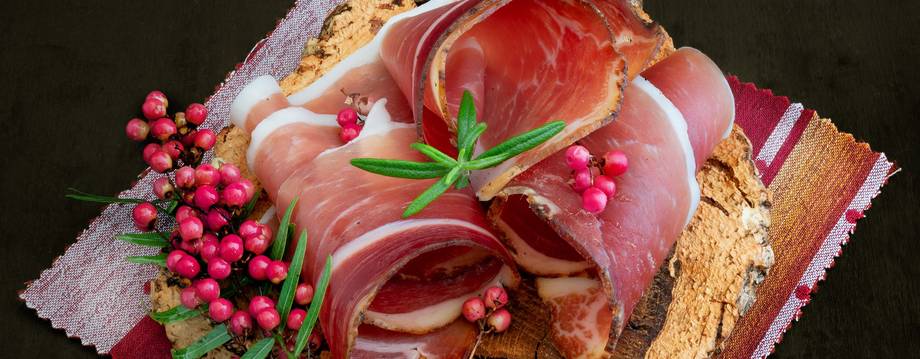
Speck Alto Adige PGI
Then there’s the beef, which takes over from pork as you drop into Valtellina, the long Lombard valley running east towards the Swiss border. Bresaola della Valtellina PGI is made from lean beef, topside and silverside, trimmed closely, salted and air-dried in the cold, dry wind that funnels down the valley. The result is dense, deep purple-red and, traditionally eaten with rye bread and a scrape of butter. It is the leanest thing in Italy’s cured-meat repertoire, and one of the very few built on beef.
The further into the mountains we venture, the stranger (and more exciting) things get. The Valle d’Aosta, wedged into an alpine cleft between France and Switzerland, is a small region with a big food tradition. Its Lard d’Arnad PDO is pork back fat layered into chestnut-wood boxes called doils with brine and foraged herbs and aged for months. It’s traditionally served in slices on warm black bread, under a thread of honey; it’s hard to explain the magic of this combination to someone who’s never experienced it. Another local standout, Jambon de Bosses PDO, is a raw ham cured with mountain herbs and aged up to thirty months at high altitude on a bed of hay. Then there is mocetta, a dried, herb-cured beef from chamois or ibex. And there’s still more in the larder: boudin, dark with blood and beetroot, and teuteun, salted and pressed cow’s udder, which might sound like a dare, but which I assure you is utterly delicious.
East in Friuli, the Pordenone valleys give us Pitina PGI, basically a salami that had to give up being a salami. Casings were a luxury the high villages couldn’t afford, so the meat—mutton, goat or whatever game came down off the hill—was minced, cloaked in a little pork fat, rolled into balls, coated in cornmeal and smoked over the open hearth, or fogher.
Naturally, the markedly different character of these far-northern, Germanic-tinted meats requires mindful local pairings, and the cool vineyards of the north oblige. Bresaola, lean, austere and salt-dark, demands brightness, and Cantina Lavis’s Teroldego, ‘Vampata’, lends blackberry, mountain-herbs and soft tannins to the meat without overwhelming it. Speck needs something that plays nicely with the smoke, and the same winery’s Müller-Thurgau, ‘Bergwind’, brings aromatic lift to meet the juniper, with the acidity to cut the fat behind it. The Arnad lard, honey and all, meets its counterpoint in Asolo Prosecco, Dal Bello’s extra-dry ‘Osteria dei Ragazzi’.
While it’s a charcuterie culture partly born out of necessity—keeping families fed during those long winters—it’s by no means a poor cousin to the big Parma and Emilian names found in the plains to the south. This corner of the country brings something unique, characterful and quintessentially alpine to Italy’s charcuterie board, and that’s worth celebrating.
Share this article
You’ve reached your limit of 5 free articles this month.
Unlock unlimited access and more
Join Wine52 and get your first month half price
-
Get your first box for £18 (RRP £36).
-
3 wines & 2 snacks delivered monthly.
-
Printed Glug magazine included.
-
Unlimited access to all online content.


