In the field
Modern Hungarian wine doesn’t hide behind the cellar door. We’ve rounded up some of the best wine-friendly festivals in its impressive national calendar.
Richard Croasdale
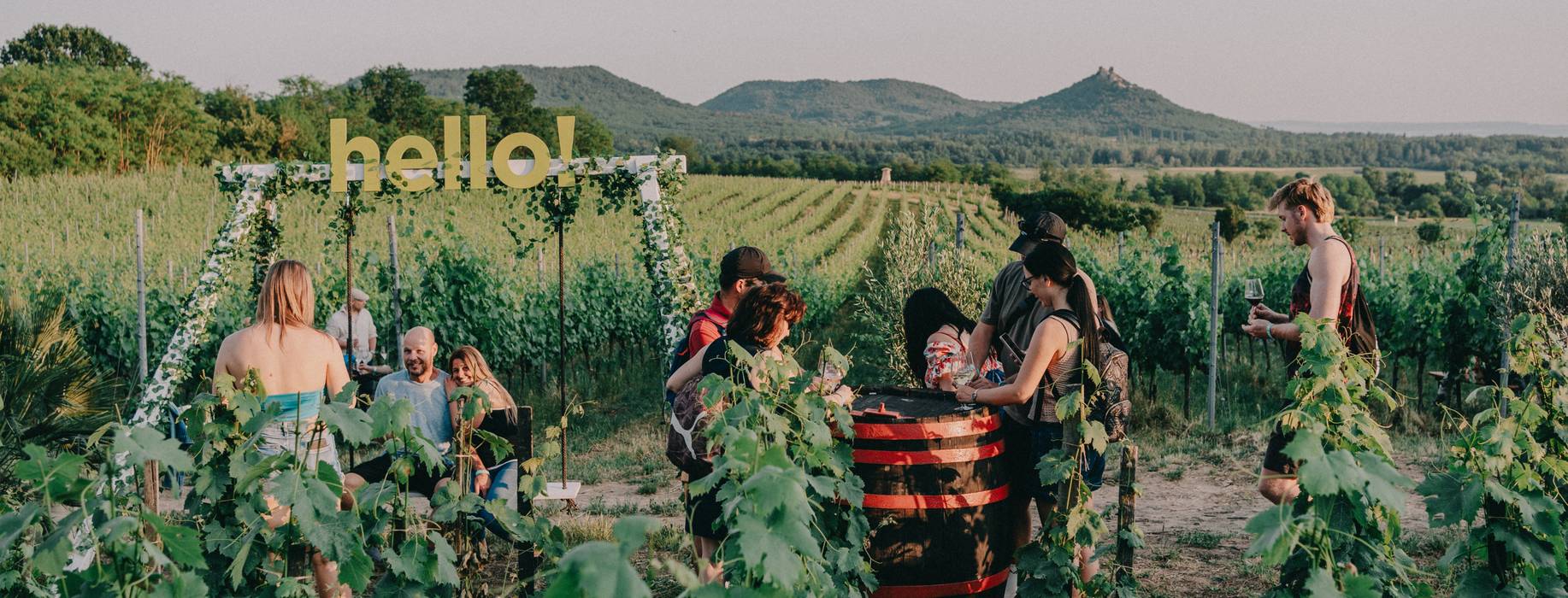
Photo © Szent György-hegy Hajnalig
Wednesday 09 September 2026
This article is from
Hungary
issue 66
Share this article
While Hungary has built one of Europe’s most rewarding lineups of wine events, the most interesting thing arguably isn’t the wine itself, but the company the wine keeps. Over a single summer, Hungarian wine shares a stage with Grammy-winning jazz musicians, hangs alongside Munkácsy in the National Gallery, anchors the wine village at one of the country’s best-loved rock festivals, and keeps the cellar doors of a volcanic hill open until sunrise.
Budapest at the heart
The Budapest Wine Festival is where the story starts, in more ways than one. Founded in 1992, in the first uncertain years after Hungary’s political transition, it has grown into the country’s defining wine event: four days each September in the courtyards of the Royal Palace, with 120–150 exhibitors pouring for close to 40,000 visitors above the Danube.
Its director, Zoltán Zilai, traces a thread across those 30 years. Its first ten years, he says, focused on education, teaching a country of wine drinkers to become a country of wine tasters. Then it turned its attention to the producers themselves, helping to modernise how Hungarian wineries thought about selling and presenting their work. “We hope it does not sound immodest to say,” says Zilai, “that the Budapest Wine Festival has been one of the key forces shaping Hungarian wine culture” through the transition and ever since.
Today, the education is done, and what remains is a genuine social occasion – one where most wineries are represented in person by the winemaker or owner – and a premium showcase for Hungarian wine abroad.
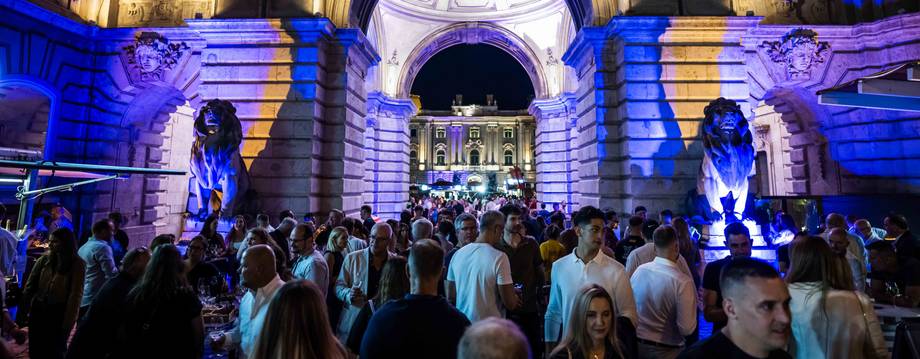
© Budapest Wine Festival
Culture club
Fifty metres from those festival courtyards stands the Hungarian National Gallery. On Wednesday evenings each July, the Gallery’s Borszerda (“Wine Wednesday”) series pairs a curator-led exhibition tour with live music and a tasting from a different Hungarian winery each week, poured on the panoramic terraces above the city. Now in its fifteenth year, it is one of the museum’s most popular programmes; the 2026 incarnation is built around colour, with five evenings themed to five moods and the wineries matched accordingly.
The same equal partnership between wine and culture also operates 130 kilometres away on the shore of Lake Balaton. During the Balatonfüred Wine Weeks – three weeks of free-entry festival along the Tagore Promenade, where around 25 vetted wineries showcase the Balatonfüred–Csopak region –visitors to the town’s museums and exhibition venues receive a voucher redeemable at any winery stand for a glass of Olaszrizling, the region’s flagship grape. Long dismissed as a workhorse white fit only for spritzers, Olaszrizling has been rehabilitated over the past two decades into something serious, and Csopak has staked its reputation on it. In a resort that holds the title of International City of Grapes and Wine, the pairing feels like a perfect expression of civic pride.
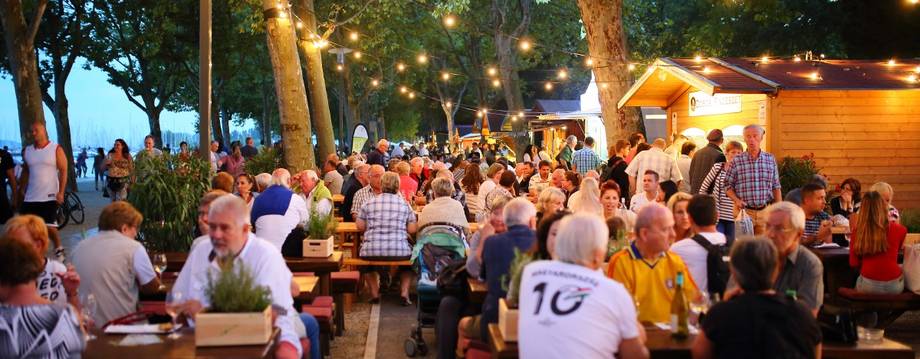
© Balatonfüred Wine Weeks
Beat this
At Fishing on Orfű, a famously friendly music festival in the wooded Mecsek hills near Pécs, wine has a village of its own. The Borfalu, as it’s known, gathers ten wineries from Villány, Szekszárd and the surrounding south, and acts as one of the festival’s main meeting points. That geography is a roll-call of red: Villány is the country’s warmest region, where growers have adopted Cabernet Franc as their flagship and bottle it under the “Villányi Franc” name, while Szekszárd is home to the spicy Kadarka, deep-structured Kékfrankos and the original Bikavér – the first wine recorded under the “Bull’s Blood” name, back in 1846.
The result is a surprisingly serious wine list to find at a rock festival. Each morning, a ‘spritzer hike’ sets off from the campsite, taking in the lakeshore and village courtyards, led jointly by one of the festival’s musicians and a winemaker, with fröccs and oven-baked bread at every stop. There are blind-tasting workshops in the woods, and a festival wine competition in which a panel selects the wine of the year.
An hour north at Lake Balaton, the Paloznaki Jazzpiknik wine pours to a jazz soundtrack. This boutique three-day festival in a preserved Balaton Uplands village at the edge of the Csopak wine country draws international names such as Gregory Porter and Rick Astley to open-air stages surrounded by vineyard rows. Its founder, Orsolya Valde, has been clear that the wineries of Paloznak and Csopak are part of the festival’s fabric, and that supporting the region’s growers is central to the event’s purpose.
© Szent György-hegy Hajnalig
The hill that stays up all night
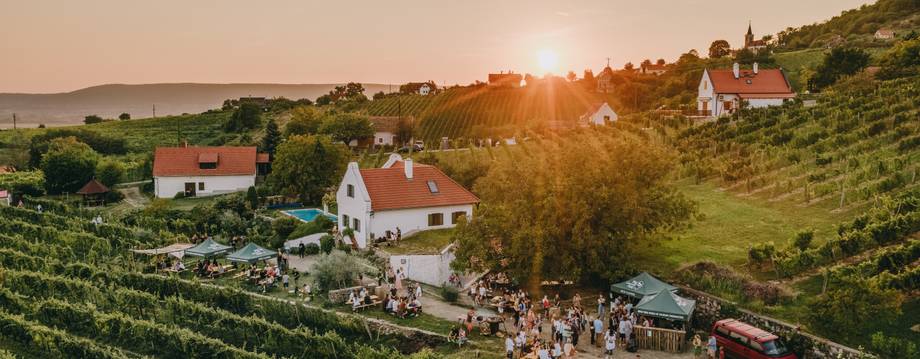
And then there is Szent György-hegy Hajnalig – ‘till sunrise’ – which takes place on a single June night on Szent György-hegy, a volcanic hill above the Balaton. “It doesn’t create a traditional festival venue – it transforms the mountain itself,” says Dóra Budavári, founder of the event. Cellars, gardens and winding paths become the venue, with courtyards normally closed to the public filled with guests for one night of wine and culture. The winemakers often host in person, pouring rare bottles, running quizzes and inviting their own favourite musicians. “Some of the best conversations are born while walking from one venue to another,” Dóra adds.
Every ticket includes a map, a set of conversation-starter cards, and a festival glass redesigned each year – “it’s a kind of passport for the adventure,” says Dóra. Szent György-hegy is one of a cluster of extinct volcanoes rising abruptly from the Balaton uplands, and its basalt bedrock lends the wines a saline, stony minerality found almost nowhere else. Olaszrizling is a star turn here too, but the hill is also one of the last strongholds of Kéknyelű – a rare native ‘blue stem’ variety, so temperamental it nearly died out, now being coaxed back as the area’s signature grape. The wines are volcanic, frequently natural, and deliberately cover a broad spectrum of character, giving attendees multiple perspectives on the same remarkable mountain. In recent years the hill has become a magnet for a younger, more experimental generation of low-intervention growers. This is Hungarian wine culture at its most contemporary, informal, and communal. An unforgettable vibe.
People first
Ask Budapest Wine Festival’s Zoltán Zilai what’s the festival’s biggest draw after three decades, and it’s not the stunning venue, the views across Budapest, or even the wine list itself. It is the crowd: always open, enthusiastic, and deeply knowledgeable about wine. “They are what we are most proud of,” he says. That kind of audience, that sees wine as part of a broader cultural story, takes a generation or more to grow, and Hungary has done just that. All that’s missing is you.

© Budapest Wine Festival
Dates for 2027
Szent György-hegy Hajnalig: 5 June 2027 (10th anniversary)
Fishing on Orfű : Late June 2027
Borszerda, Hungarian National Gallery: Wednesday evenings, July 2027
Balatonfüred Wine Weeks: August 2027
Paloznaki Jazzpiknik: Early August 2027
Budapest Wine Festival: September 2027
Share this article
You’ve reached your limit of 5 free articles this month.
Unlock unlimited access and more
Join Wine52 and get your first month half price
-
Get your first box for £18 (RRP £36).
-
3 wines & 2 snacks delivered monthly.
-
Printed Glug magazine included.
-
Unlimited access to all online content.


