Italians, talking with their mouths full
Jacopo Mazzeo, on food’s impact on the Italian language

Jacopo Mazzeo
Illustrations: Fabio Rodaro
Wednesday 07 October 2026
This article is from
Best of Italy
issue 67
Share this article
Mozzarella is one of the most imitated foods on earth. The worst cloning attempts are rubbery, tasteless gastronomic travesties masquerading as fresh cheese. The real deal is a deliciously creamy, richly juicy creation, roughly the size of a handful, dripping milk when gently squeezed.
For Italians, for whom food is one of the greatest cultural and economic exports, mozzarella is an enormous source of national pride. But as summer comes, it also becomes a highly telling food-inspired idiom. Being called a mozzarella is a direct, gently mocking way of pointing out you haven’t made it to the beach yet that summer, your blindingly white skin standing out like a lamppost in a dark back alley when surrounded by perfectly tanned beachgoers.
Apparently superficial though it may seem, this rather harsh mockery reveals a critical element of Italy’s modern history. As the country’s society gradually shifted from being predominantly rural to increasingly urban, a suntan ceased to be associated with hard outdoor labour such as farming and shepherding and instead became a visible badge of prosperity, proof that one could afford to escape to the beach for a summer holiday. Today, most Italians can afford some kind of summer break, but the need to show it off with a good tan endures.
Mozzarella is far from the only food to be digested into the Italian language. Countless others have found their way into everyday speech, from antipasti to dolci, each offering intriguing insights into the mindset of Italians and all reflecting the central role food plays in their everyday lives.
The lobster, for instance, is served at the opposite end of the tanning spectrum. It refers to the almost fluorescent, dramatic shade of red acquired by naïve beachgoers who expose their mozzarella-white skin to the fierce summer sun armed with neither sunscreen nor much regard for their health. More often than not, this crustacean epithet is reserved for foreign tourists, gently mocked behind their backs for their supposed inability to master the unwritten rules of Mediterranean lifestyle. They may love the beach, but they simply don’t have it in them to achieve the perfect bronze.
Primi Piatti & Eggs
When it comes to primi piatti (soups, pasta, rice and other substantial dishes not centred around animal proteins), the meaning of culinary references tends to reflect the very nature of the dish itself. Tutto fa brodo (“everything makes broth”), for instance, originates from the traditional practice of making the most of scraps of meat, bones and leftover vegetables by throwing them into the broth pot.
Taken literally, the phrase might appear to convey the positive idea that every contribution, however small, helps achieve a greater result. As is often the case in Italian culture, however, the expression carries a distinctly bitter note of sarcasm, referring instead to a small, opportunistic action taken for personal advantage at the expense of one’s dignity. Your football team is leading by a single goal with ten minutes left to play. The goalkeeper catches the ball and hangs on to it for a laughable couple of extra seconds before taking the goal kick. Definitely tutto fa brodo to win the game.
But if the team can’t hold on to its lead until the final whistle and concedes three goals in a matter of minutes, then they’ve “made a frittata”. Two goals down with only seconds remaining, they’ve cracked the eggs, whisked them together, and there’s simply no putting them back in their shells.
Halfway through its cooking process, the frittata offers another culinary metaphor that’s particularly apt for describing the behaviour of cunning communicators. Rigirare la frittata (“to flip the omelette”), referring to the moment the omelette is turned over to cook evenly on the other side, means to deftly deflect a discussion away from the main point to one’s own advantage. Politicians are masters of rigirare la frittata. “Minister, where is all the funding you promised for public schools during your election campaign?” asks a reporter. “Where is all the money the previous government left behind to allow me to do that?” the minister replies.
Proteins
Proteins enjoy an especially rich afterlife in Italian idiomatic language, particularly cured and preserved meats, which often carry mildly negative connotations. Essere un salame (“to be” or “to act like a salami”), for instance, describes someone who is silly, clumsy, socially awkward or simply slow on the uptake. The origins of the expression most likely lie in the salami’s physical appearance: stocky, rigid and tightly enclosed within its casing. The association is reinforced by the curing process itself, the meat being literally stuffed, compressed and tied up before being hung completely motionless for weeks or months.
Salami may be one of Italy’s most beloved foods, but in everyday language it certainly gets a bad rep, as things don’t improve once it’s sliced. Avere le fette di salame sugli occhi (“to have slices of salami over your eyes”, with regional variants involving other cold cuts) describes someone who is completely blind to the obvious, oblivious to glaring red flags and unable to see what is right in front of them.
Veggies
Italian cuisine boasts no shortage of outstanding vegetarian dishes, so it is hardly surprising that vegetables, too, have found their way into the country’s idiomatic language. Salvare capra e cavoli (“to save the goat and the cabbages”) means to find a solution that satisfies two conflicting needs without sacrificing either. It says much about how Italians value traditional wisdom (the expression is likely derived from Alcuin of York’s famous wolf, goat and cabbage puzzle) as well as their propensity to find solutions that try to keep everyone happy (before inevitably ending up having the opposite effect, of course).
The Compromesso Storico (“Historic Compromise”) was a political accommodation in the 1970s between Christian Democracy – Italy’s dominant post-war centrist party – and the Italian Communist Party, then at the height of its popularity. The strategy devised by the leaders of the two factions sought to keep Italy firmly within the Western, pro-American orbit while at the same time integrating the Communist Party into government, thereby avoiding civil conflict. In 1978, however, Aldo Moro, the Christian Democratic leader and former prime minister, was murdered, and the Communist Party never made it into government. It was the archetype of salvare capra e cavoli and, as such, it ultimately failed.
Puddings & Wine
While salvare capra e cavoli carries a rather serious undertone, moving on to wine and pudding brings us back to a quintessentially Italian sarcastic tone.
Finire a tarallucci e vino (“to end with savoury biscuits and wine”) symbolises the resolution of a disagreement by sitting down together over a snack and a glass of wine to make peace. The expression originates from a time when tarallucci and wine were staples in Italian homes, especially across the south, and therefore what families could almost always afford to offer guests at the end of a meal (or of a successfully resolved dispute). While it evokes reconciliation, it is more often used ironically to describe people setting aside their differences for convenience or personal gain, with politics once again providing a textbook example.
In 1997, the country was, for a change, in the grip of a political crisis. The centre-left and centre-right clashed relentlessly over judicial reform, constitutional changes and media regulation. The atmosphere was tense and any compromise seemed impossible. And yet, their leaders eventually decided it was time to settle matters amicably.
Over that meal, they reached a broad agreement on several key issues, including the postponement of judicial reforms that threatened Silvio Berlusconi. It all ended a tarallucci e vino. Quite literally.
Food in Italy is more than just sustenance or a source of national pride. It is a cultural lexicon, a passe-partout key to understanding the most intricate nuances of Italian identity.
Share this article
You’ve reached your limit of 5 free articles this month.
Unlock unlimited access and more
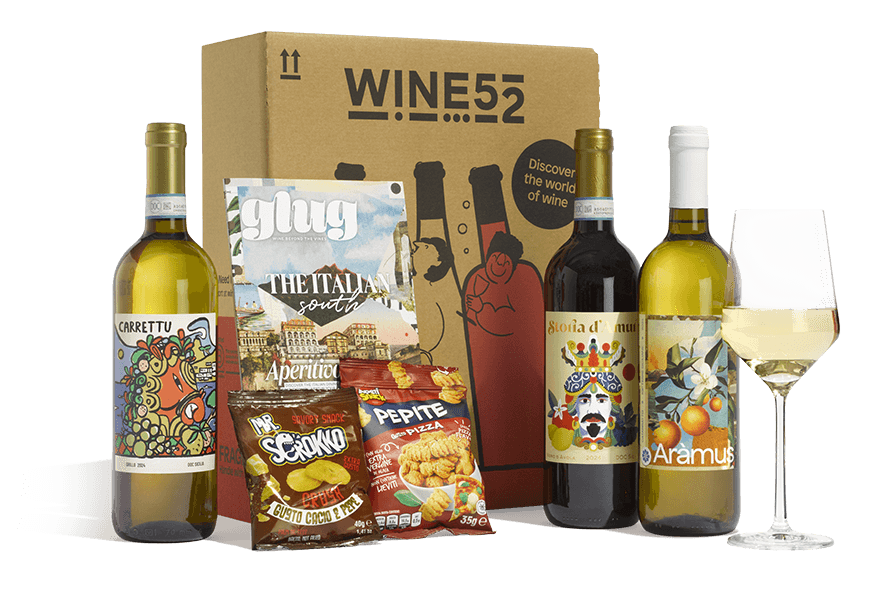
Join Wine52 and get your first month half price
-
Get your first box for £18 (RRP £36).
-
3 wines & 2 snacks delivered monthly.
-
Printed Glug magazine included.
-
Unlimited access to all online content.


