Devour the world: Rhubarb
Melissa Cole flexes her obsession with rhubarb, digging deep into the fascinating story of the fruit imposter that lights up our winter larders.
Melissa Cole
Monday 09 June 2025
This article is from
Siren's 10th Birthday
issue 90
Share this article
My fascination with Rhubarb’s mysterious background started over a decade ago, as I was researching a name for a rhubarb saison I was brewing with Ilkley Brewery. To my surprise, it originates from Siberia, although not necessarily in the form that we now know it.
The etymology comes to us through Greek, Persian, Latin and French, and essentially references the plant coming from the banks of the River Volga, known as ‘Rha’ and the word ‘foreign’ which was ‘barbaron’. While the roots of the word are fairly straightforward, the history of the plant itself is deep and tangled; the form of rhubarb we enjoy eating now is a hybrid of partially unknown heritage, and just one of over 60 sub-species.
Coming in from the cold
Rhubarb as medicine has a very long and revered history. In Chinese medicine, the first documented use of the plant was in 270 BCE, where it was deemed to be a top tier medicinal ingredient. Used traditionally as a laxative and anti-inflammatory throughout history, it is also still very much of interest to modern medical research.
Drama queen that I am though, what particularly caught my interest was the dramatic story of how it seems to have hit these shores. In his paper on Rhubarb: the role of Edinburgh in its cultivation and development, author MR Lee documents how, during The Enlightenment, rhubarb roots were exported to the UK, but only in their dried form. And this is where it gets deliciously messy, courtesy of the Romanov dynasty.
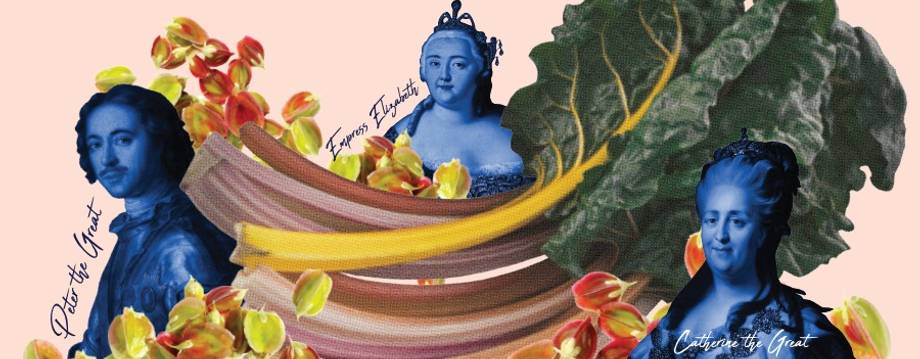
From about 1750, Peter the Great grabbed the opportunity to put a stranglehold on the supply of rhubarb. For a century, the Romanovs, recognising its immense financial benefits, banned the export of the plant’s seed and forbade it being grown anywhere else. In fact, it was so immensely valuable that Catherine the Great used it to help finance her military campaigns and rhubarb seeds became worth more than their weight in gold.
But we’re getting ahead of ourselves now, so let’s rewind slightly to the reign of Empress Elizabeth, Catherine the Great’s mother-in-law…
Pocketing the Wealth
At this moment in history, Dr. James Mounsey was studying medicine at the University of Edinburgh. His teachers were immersed in botanical remedies, so even though he didn’t graduate, he would certainly have known of the benefits of rhubarb roots in the treatment of patients.
After he dropped off the academic radar, he turned up in London and was recruited by Prince Kantemir of Russia, and served two stints in the Russian military – graduating as a full doctor at Rheims in France in between – before returning to Russia and setting up a private practice. It was here that he came to the attention of Empress Elizabeth, who made him First Royal Physician and Privy Councillor. Despite not being able to save her on Christmas Day, 1761, her heir Peter III further elevated him to ‘Archiator’; basically chief medical officer.
Peter didn’t last long as emperor, but his wife Catherine II (The Great) gained huge support in the court and took the throne from Peter in 1762, very shortly before he died. Setting aside scurrilous historic gossip surrounding the death, all this horse-trading led to a terrifyingly precarious situation for the senior members of Peter’s court, including Mounsey. Facing either execution or exile to Siberia, he somehow managed to convince Catherine to allow him to retire on grounds of ill health, whereupon he fled back to Scotland with immense personal wealth… and a pocket full of the forbidden rhubarb seeds.
Seeds of Change
After presenting the Royal College of Physicians in Edinburgh with a pound of rhubarb seeds in 1763, Mounsey spent the rest of his days holed up in an estate in the county of his birth, paranoid that the Russian court was coming after him.
The then president of the College, Sir Alexander Dick, was however overjoyed with his new bounty and, as a man fascinated with botany, he planted some of the seeds at his family home, Prestonfield House, as did Dr John Hope who was, at the time, the King’s Physician.
Hope had concerns that his efforts to grow rhubarb in Leith may not be successful, due to the climate (somewhat amusing given the plant’s native weather), and sent some to both Bute and Kew Gardens in London just in case. He needn’t have worried.
The cultivation of rhubarb up until the early 1800s was still mainly for medicinal purposes. Folklore has it that an upturned bucket was accidentally left over some rhubarb shoots, and the resulting stems were tender and tasty, but the most reliable credit we have for rhubarb’s transition from medical to culinary ingredient goes to Joseph Myatt.
Physic Pies
Born in Staffordshire in 1771, Myatt’s frankly fascinating life saw him settle in Camberwell in 1814, growing fruit and veg on an industrial scale, with a specific interest in strawberries. Upon receiving some rhubarb stems from a friend who had got them out of Russia, he found these to be far superior to the variety previously grown in the UK, and began experimenting with forced cultivation, creating large plants with more appealing flavour, texture and colour.
His descendent Kathryn Darley picks up the story on her superb blog (josephmyatt.weebly.com):
“Famously, in 1824 Joseph sent his sons, James and William, to the Borough Markets with five bunches of rhubarb, of which they sold only three. The next week they took ten bunches, all of which were sold. Some have said that they took a recipe for rhubarb tart with them to promote sales. It was reported at the time that Joseph was ridiculed by green-grocers and his fellow market gardeners as “'the man who sold physic pies’.”
This initial skepticism soon gave way though, and before long rhubarb was a familiar fixture at the Victorian dining table. In fact, rhubarb production at Myatt’s Ground increased so swiftly that he left his son to run the Camberwell site, moving himself out to Deptford to found Manor Farm, from which thousands of bunches of rhubarb were sold during the growing seasons, firmly establishing rhubarb on the British Isle’s culinary map.
Romancing the stem
However, by the late 19th century, London’s rapid growth saw the blacked-out rhubarb greenhouses making way for much-needed housing, and crops that benefitted from light soil and cold frosts headed north to Yorkshire and Lancashire. Yorkshire proved to be the most successful for the pink and ruby spears, though even there the industry has been through its ups and downs though, as ‘Rhubarb Rob’ Tomlinson explains:
“I’m fourth generation of rhubarb growers, and we still pick by candlelight,” says Bob. “We started building forcing sheds in the early 1900s, they were second hand and a lot of them built out of wooden crates from an air base. We had many round Kirkstall and most of the buildings were around Pontefract and then it spread out and there were more and more around Leeds, but as the city expanded it moved towards Wakefield.
“I mean, there’s a lot of work that goes into it, you’re not making a fortune. We’ve got four sheds this year and we’ll have five next, so only half way back to our heyday, when there must of been hundreds of thousands of tonnes sold because it was the only fresh veg available this time of year… I would urge people to eat more seasonally and less imported; it means farming can return to much less intensive ways.”
Anyone whose parents were active in PTAs in the 80s and 90s will probably remember rhubarb wine was frequently on the tombola tables (probably due to the aforementioned cheap prices) and possibly have some horrifying stories of teenage drinking to go with it. But it’s been undergoing a bit of renaissance in the US, which also has a bit of a love affair with rhubarb, with some New England winemakers heralding it as ‘the new rosé’, crediting the craft beer movement with making people adventurous enough to embrace it.
Season of love
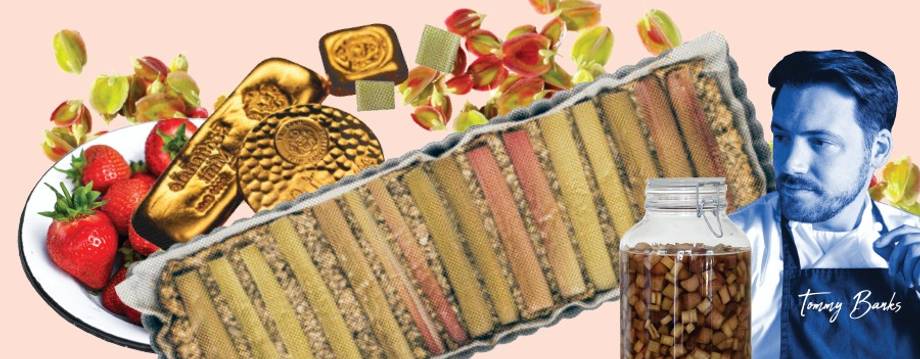
And those wine makers aren’t alone in asking people to look at rhubarb differently. Tommy Banks, owner of the Michelin-starred Black Swan at Oldstead, really wants people to look beyond using rhubarb as just a sweet ingredient and embrace its versatility.
“It’s the only thing actually in season when you talk about UK produce, so it’s great to think beyond just crumbles, pies and jams. First off, I would suggest making rhubarb schnapps, which is similar to making sloe gin but with much less sugar and the flavour works better with a vodka base. You get that vibrant pink and it’s a quick win, ready within two to three weeks.
“Make salads with raw rhubarb, make a dressing with rhubarb juice and if you want to be adventurous – and I think we might have been the first people to do this – make Rhuboshi, based on the process for making Japanese umeboshi.” (You can check out his Instagram account @tommybanks for more details.)
“Anything that’s fatty or rich is also something that rhubarb is perfect for, so use it instead of apple sauce for pork, mackerel done in a teriyaki-style accompanied by honeyed rhubarb, duck, venison… it can be used with all these things that are also in season.”
And you can bet you’ll be seeing rhubarb pop up on the menu of Banks’s new pub, the Abbey Inn at Byland, which is where he and his brother started their careers, with Tommy on pot wash.
Finally, it’s still a favourite of Yorkshire brewers as well, as Seb Brink, head brewer of North Brew Co., speaks proudly of:
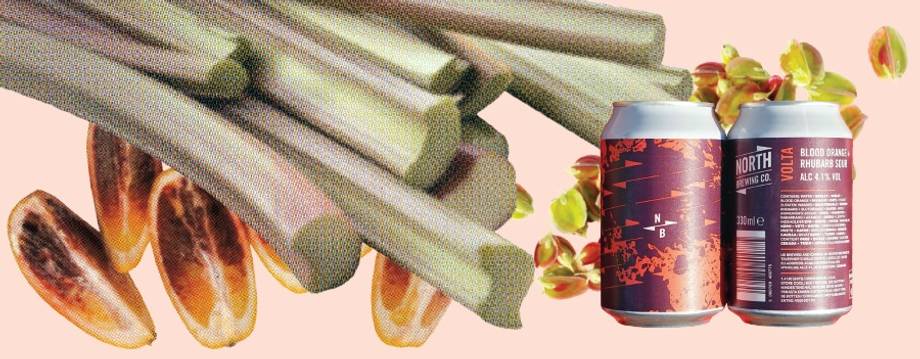
“We use forced rhubarb in Volta, and it stands out as the most dry, spritzy and refreshing of our sours and was one of the earliest specials we made as kettle sours were very popular at the time and Mike from Chorlton was kind enough to give us some of his culture which we used for a number of years.
“It was designed as a beer to celebrate the fruits in season of blood orange and rhubarb, making it dry and citrus, we use a lot of the rhubarb in the kettle and you get malic acid from it, which gives you more of that puckering acidity than the lactic acid brings and, of course, you get that lovely aroma as well.
“We just really like the idea of using locally sourced ingredients and local producers. Sometimes in England, especially in our northern climate, we don't have many options except malt and hops. It’s also the first fresh produce of the new year that we can brew with and it’s really fun to get the boxes with the PDO on it, not to mention it’s probably the only one where we drive to the farm and pick it up, so that adds to the fun of the whole experience.”
Share this article
You’ve reached your limit of 5 free articles this month.
Unlock unlimited access and more

Join Beer52 and get your first month half price
-
Get your first box for £13.50 (RRP £27).
-
8 beers & 2 snacks delivered monthly.
-
Printed Ferment magazine included.
-
Unlimited access to all online content.