Mashing it up
Meet the new kids, who’ve been around the block on Lisbon’s beer scene
Robyn Gilmour
Photos:
Fermentage
Saturday 26 July 2025

This article is from
Iberia
issue 120
Share this article
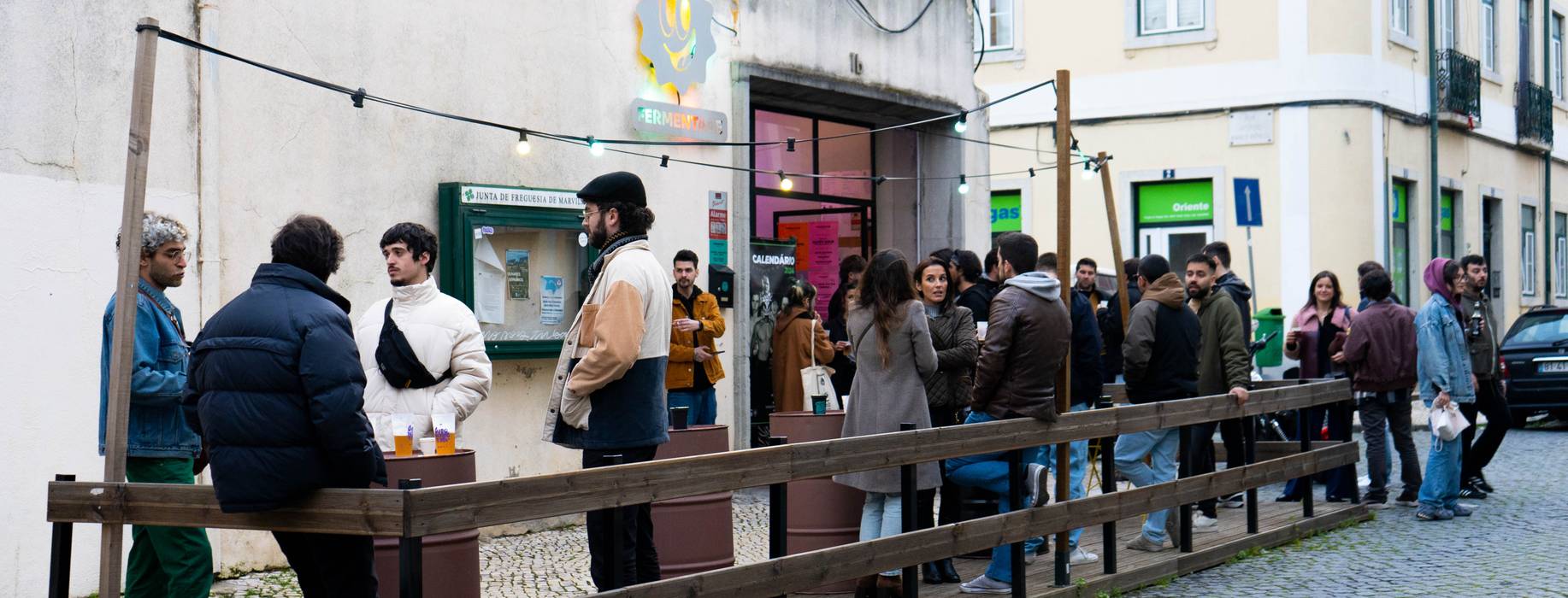
Those among us whose interest in alcohol extends beyond the world of beer, might be familiar with the term ‘coupage’. In winemaking, it refers to the blending together of various grape varieties to produce a wine with the desired characteristics. Jorge Tomé, co-founder of Lisbon-based brewpub Fermentage (a hybrid of ‘fermentation’ and ‘coupage’), has a more poetic definition: “it’s a process which brings together lots of different elements to create something that’s bigger than the sum of its parts”.
For Jorge, knowledge of any form of fermentation benefits the practice of others. Miso and soy sauce have common building blocks, as do pickles and kombucha, even beer and wine; learning about one teaches you something about the other. It therefore felt important to incorporate the principles of coupage into the brewery which, for more than a decade, Jorge and three friends dreamed of opening together. When that dream came to fruition in 2023, all agreed Fermentage should celebrate experimentation and creativity above all else. “We weren’t trying to offer answers, but instead, wanted to ask the questions,” says Jorge.
But ‘coupage’ connotes a lot more than the joyous amalgamation of fermentation practices; it speaks to the looming presence of Portugal’s wine industry. “50 years ago, there was very limited access to beer because we were in the midst of a huge lobby for wine, so that impaired its initial growth,” says Jorge. “Wine was being leveraged as an economic tool to drive companies, drive the workforce. As a result, 80% of our agricultural landscape in Portugal is now vines. Wine pays no excise tax, and has reduced VAT in certain situations, like for market, wine pays VAT at 13% against beer that pays 23%. It's a huge lobby, it's part of our culture, I get that. But it also meant that by the late ‘90s beer had been reduced to just two industrial brands.
“It was even difficult to find any imported products; it was a very niche market, and you had to really try to find beers from abroad. By 2012 you had the first small craft projects show up, and they were just enough of a success to lay the foundation for the next ones to come in 2015. That's when the more modern, European and American-style craft beer started to blow all across the country. In Lisbon, the first proper brewery was Dois Corvos. They started in 2015, then opened a taproom in 2016, and I’d say that’s when it all started.”
As it happens, Dois Corvos is where Jorge’s career in beer began. He’d been a homebrewer before that, a hobby he picked up from a Kiwi friend who brewed styles from back home. It had initially intrigued him because, with no beer culture to speak of in Portugal, the idea of brewing beer you otherwise couldn't access was highly unusual. He’d only been homebrewing for a year when he applied to work at Dois Corvos. “I worked there for about five years, and those were the baby steps of the craft beer scene in Portugal,” says Jorge. “So I was able to see everything developing from inside one of the most important breweries. That was pretty amazing.”
COVID proved particularly disruptive to Portugal's burgeoning beer industry. With a deeply social drinking culture, Jorge estimates the market was then 80% on-trade focused, meaning many breweries found themselves in times of lockdown without online shops, resulting in an almighty scramble to reorganise. At that moment, all signs seemed to be pointing Jorge towards the wider beer world, where he could learn more and deepen his knowledge while the dust settled in Portugal.
“I wanted to see what else was out there and, at the time, this brewery in the Netherlands, Moersleutal, had two open positions,” says Jorge. “So, I applied with Paulo, my long-time friend and one of my now-partners at Fermentage. We were working together in Lisbon at that time. It’s kind of a funny story because we applied as a package deal. So it was either they would take both or they would take neither of us. We even did a joint interview.”
Close bonds formed through beer are really what brought all four of Fermentage’s founders together. Jorge, Paulo, Nuno and Fransisco would meet as safely as possible during the early days of COVID to barbecue and brew in Jorge’s back yard. They even started a blog about brewing, which eventually became a book.
Paulo left his pharmaceutical career to pursue more fulfilling work, which for him looked like brewing at Dois Corvos. He then moved to the Netherlands with Jorge, where he found his inner calling as a self-taught brewery engineer. Nuno had previously had a small contract brewery, and an interest in beer far before it was popular in Portugal. He then balanced brewing with his career in IT, and spent all his free time traveling to breweries, festivals and making beer. Francisco had similarly run a brewery before, though he’d done so with several partners whose paths didn’t align. Around the time that Fermentage was forming, he was ready to leave behind his nearly 40-year career in IT, and pursue full-time work as a brewer. Jorge describes Francisco as creative and resourceful and “definitely was the missing piece of our puzzle”.
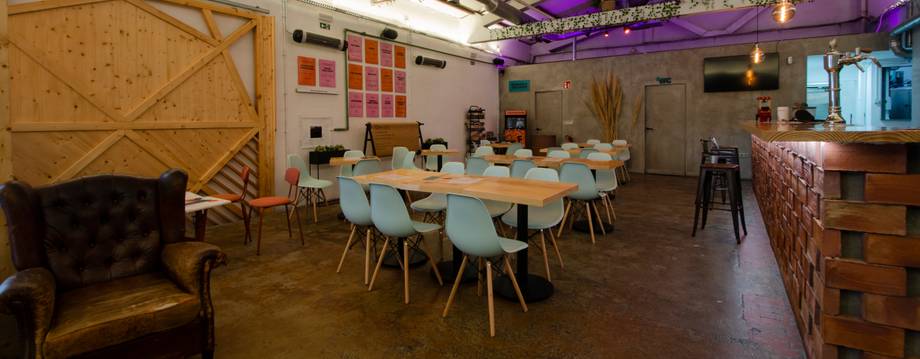
While Fermentage’s four founders clearly don’t do anything in half measures, their intention for the brewpub itself is to keep operations as nimble and uncomplicated as possible. “One thing we always wanted to protect as a company, if we’re to talk about core values and vision for the brewery, is the desire to make it less complicated in general,” says Jorge.
“We’re happy being small, we can cover our costs, we pay our employees better than we pay ourselves. These sound like small achievements, but they were once massive dreams to us. We could never have done this by ourselves because that’s not how we want to grow; we want to be a community, locally-based place that’s very easy going and where people can just come with their family. We’re so experimental because as you grow you need to compromise some of the more experimental stuff that you do, so we wanted to embrace that as a benefit of our size.”
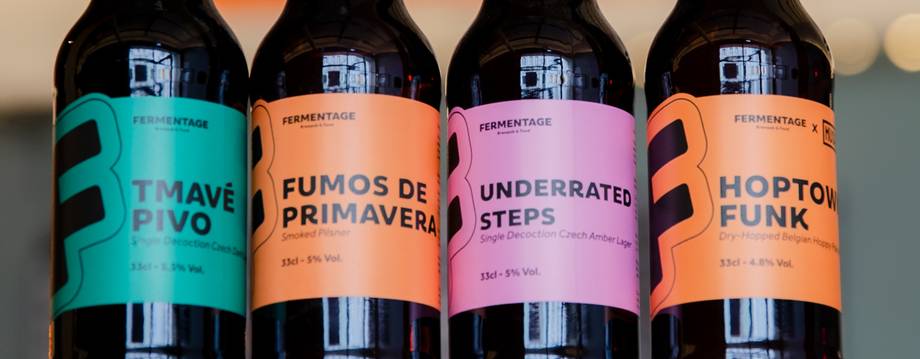
Jorge says that although craft beer is making meaningful steps towards development and growth in Portugal, the market is still so small that being specialised in one particular kind of beer or style isn’t sustainable, at least if you don’t want to export the majority of what you make. He says Fermentage’s belief has always been that it’s best to brew something for everyone, and so its range can be broken down into roughly three categories; classic styles, like lagers and ales, more modern beers like sours, imperial stouts and super-hoppy IPAs, and finally the super experimental stuff, made with different kinds of yeast, and incorporating different kinds of fermentation practices.
Today, three of the brewpub’s four founders constitute three of its four full-time members of staff, so the likelihood of running into one of them if you stick your head in the door is high, if not guaranteed. Jorge says they all enjoy it: “it creates better connections with people, and that one on one time at the bar is really important”. Funnily enough, Fermentage is based on Rua Capitão Leitão, a 300m stretch of road which, when Fermentage first moved in, it shared with Dois Corvos and Musa, the two biggest craft breweries in Portugal. There’s something symbolic, or perhaps serendipitous, about ending up where you started.
Share this article
You’ve reached your limit of 5 free articles this month.
Unlock unlimited access and more

Join Beer52 and get your first month half price
-
Get your first box for £13.50 (RRP £27).
-
8 beers & 2 snacks delivered monthly.
-
Printed Ferment magazine included.
-
Unlimited access to all online content.