There and back again
From Bamberg to Berlin, London to Paris and back, Benedikt Koch is the craft world's favourite classical German brewer writes Richard Croasdale
Richard Croasdale
Photos:
Blech.Brut
Saturday 20 September 2025
This article is from
Oktoberfest 2025
issue 122
Share this article
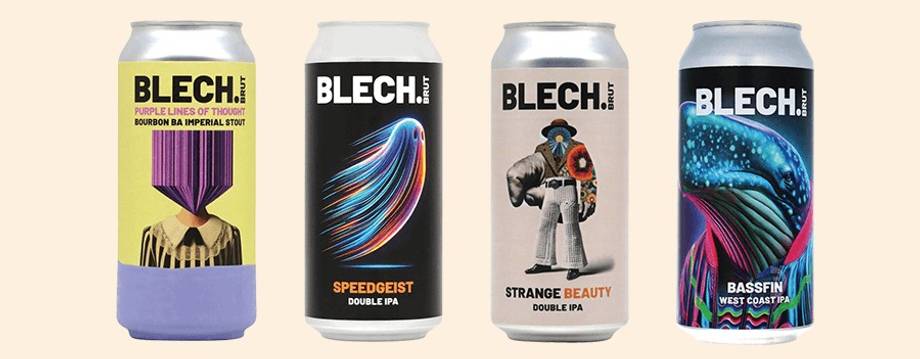
Bamberg doesn’t feel like a natural home for craft beer; restrained, conservative, and by all accounts not the most fun city in which to grow up. It’s little wonder that Benedikt Koch turned his back on the place for more than a decade and a half, to embark on a beer adventure that would take him from the traditional rigours of formal German brewer training to the wild and creative mid-2010s world of London craft, to France, and finally full-circle back home. Today, he’s settled back in Bamberg, running his own outfit; Blech Brut, the gypsy brewery whose bright, hop-forward beers and eye-catching cans have found fans from the Netherlands to Norway.
The fact that he got into brewing at all though is curious enough in itself, as Benedikt explains. “I was never really into beer. I’d been studying for a degree in Sports Engineering, but was also working for a carpenter part time, where we would often have lunch in a nearby brewery restaurant. I became friendly with the owner there, and one day he mentioned they were struggling to find an apprentice. So I thought, why not try?”
That casual decision landed him in the deeply traditional world of Franconian brewing, learning his technical craft at Brauerei Zehendner in Mönchsambach. “It was very classical,” continues Benedikt. “At that time, craft beer in Germany was maybe five years behind the UK, so there wasn’t really a scene yet. But it gave me a strong foundation.” Here he learned the finer points of decoction mashing, the discipline of precise repetition, and an instinct for detail that would never leave him.
After completing his apprenticeship, Benedikt moved to Berlin to study brewing science at the city’s world-famous VLB brewing school. He fell in love with the city and its culture, but was still frustrated at the lack of a modern brewing scene there; “everyone kept saying, ‘Stone Brewing is coming,’ like that was going to be the answer to everything, but it took years before it happened,” he says.
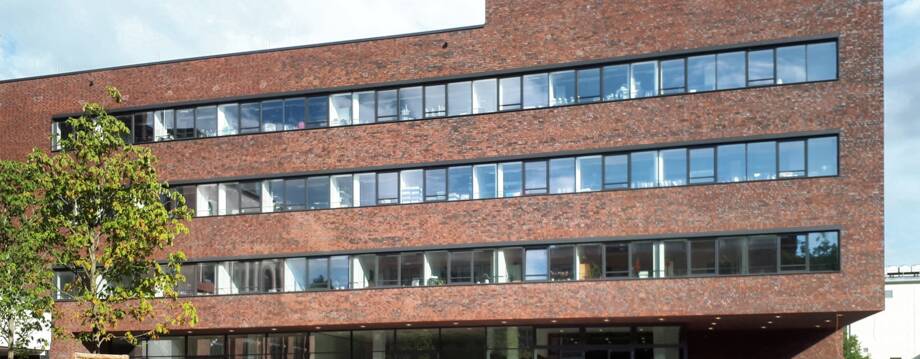
PHOTO: VBL Berlin (Fridolin Freudenfett (CC BY-SA 4.0))
Salvation came in the form of a job offer from London Fields brewery, which at the time was at the epicentre of the UK capital’s craft brewing explosion. Two weeks after making the move though, Benedikt received a very unexpected call from his wife in Berlin; she was pregnant, and his London adventure had a hard nine-month deadline. He resolved to make the most of the experience.
“I only stayed at London Fields nine months, but that time was incredible,” he recalls. “The equipment, the way they brewed, the creativity — it was so different from Germany, I just had my mouth open the entire time. You had Americans, Brits, Italians, just throwing ideas in. It really expanded my brewing skills in a creative way.”
London also gave him a network of like-minded brewers, many of whom have gone on to become highly influential figures in British brewing. “I met Tom [Palmer] and Todd [Matteson] from Mondo, who are still good friends, and Fabio Israel, who went to Bedlam Brewery in Brighton. It was like a nursery for so many brewers.”
The experience also led to his next stop, in Paris, where an Australian contact offered him the chance to co-founded the Paname Brewing Company, which they built together from scratch on the Quai de la Loire. Having gone briefly back to Berlin to be with his wife and son, Benedikt’s whole family now made the move to France.
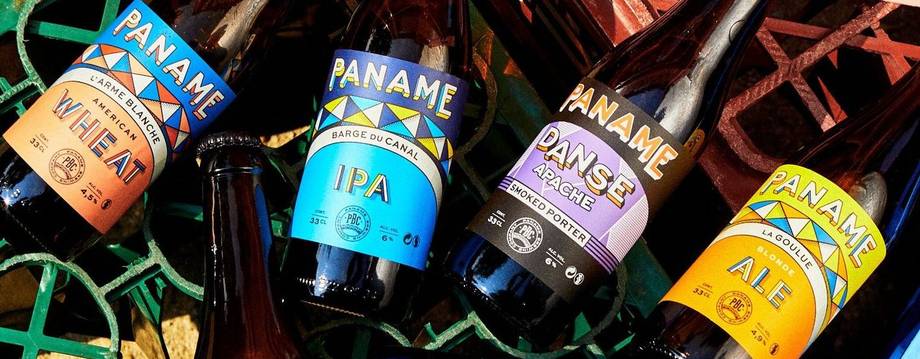
PHOTO: Paname Brewing
“It was pretty mind-blowing,” says Benedikt. “They showed me an empty space and said, ‘build it’. French drinkers were coming from wine, so they were open to fruitier beers. They didn’t know what beer ‘should’ taste like, so you could try anything, which was very liberating. That was the opposite of Bamberg, where everyone knows exactly what beer should be, and it’s lager.”
After three years in Paris, and with a second child on the way, Benedikt and his wife decided to return to Bamberg so the grandparents could be part of their children’s lives. Even then, he continued brewing for Paname, but working from Germany.
Eventually though, Benedikt and his wife decided it was time to create something that was truly his own, in the place where it all started. Blech Brut launched in 2018 with no physical brewery or taproom; an intentional decision to avoid the constraints of Bamberg’s conservative beer market. “If I had my own place here, I’d have to adapt to the local market, and people in Bamberg don’t drink IPAs,” he says, candidly. “A couple of bottle shops might take a few cases, but that’s it. It’s too expensive, and it’s not lager, so if we wanted to brew craft beer, we knew we’d need to focus on export.”
The model worked. Blech Brut became renowned for balanced yet hop-forward beers and a string of high-calibre international collaborations with the likes of Fuerst Wiacek in Berlin, FrauGruber in Augsburg, and Finback in New York. It was a RateBeer sensation, with Benedikt personally picking up the site’s coveted ‘best new brewer worldwide’ award in 2019.
But even while the reputation grew, the market shifted. “After COVID, everything got unpredictable,” continues Benedikt. “You can’t calculate how much your customers will buy next month, plus younger people are drinking less, because we’re educating them to drink healthier. I see a problem coming in 10 or 15 years when a lot of them won’t drink beer at all.”
Alcohol-free beer is obviously huge, but it will never be the same as real beer
While he is still very much focused on beer for now, you can see the wheels turning in Benedikt's mind about where the future interest and opportunity may lie. Perhaps surprisingly, he doesn’t believe alcohol-free beer is the long-term answer.
“Alcohol-free beer is obviously huge, but it will never be the same as real beer. People compare it to beer and it’s not; you’re expecting a character that you just can’t get without alcohol. You need to move away from that comparison and make something different.”
That “something different” is where he sees the real potential: fermented drinks with complexity, freshness, and layered flavour, but without high alcohol content. “Your magazine already has the answer in its title,” he says. “There’s so much you can do with fermentation that still gives you that feeling — that complexity in the glass — without it having to be beer. It’s still about process, ingredients, balance. You can make something that fits into the same moments where people drink beer, but it doesn’t have to be beer.
“Our professor at university used to talk about the SCOBY that’s used to ferment drinks like kombucha, saying you could create any flavour with it, in any direction. He was saying that 20 years ago, but he was right. You can go dry, fruity, herbal, floral… it’s still fermentation, so you get that depth and interest that you don’t get from a soft drink. And people are up for healthier. You just have to make it easy to drink, interesting, and consistent.”
So is this Benedikt’s next project? Maybe he’ll finally build his own bricks and mortar brewery, but making kombucha for the cool kids, with its own hip Berlin taproom? Nope.
“Oh, I definitely want to have my own brewery one day, but I’ll keep it small, no IPAs, brewing traditional regional lagers and selling them locally through a pub – actually pour it and put it into the hands of the people drinking it. And I’d do it in the countryside where I grew up, where my family still are, and I’d get my brothers involved. I actually brewed a smoked beer a few months ago with a fruitier, modern twist. People loved it – in Bamberg, you can tell a good story with smoked beer.”
If this seems odd at first, as the conclusion to a narrative that’s seemed to be driven by relentless progress, I would argue it’s also rather beautiful. It’s a vision that connects every dot of Benedikt’s career: the discipline of his apprenticeship, the creative energy of London, the openness of Paris, and the independence of Blech Brut. Having taken in the breadth of the beer world, Benedikt would finally be brewing for the people right in front of him.
Share this article
You’ve reached your limit of 5 free articles this month.
Unlock unlimited access and more

Join Beer52 and get your first month half price
-
Get your first box for £13.50 (RRP £27).
-
8 beers & 2 snacks delivered monthly.
-
Printed Ferment magazine included.
-
Unlimited access to all online content.