Franconia via London
Will Hawkes catches up with the London brewery so steeped in Franconian beer tradition that it’s now opening in Vienna and Berlin
Will Hawkes
Photos:
German Kraft Brewery
Saturday 20 September 2025
This article is from
Oktoberfest 2025
issue 122
Share this article
January was a busy month for Felix Bollen. The co-owner of German Kraft Brewery spent new year’s eve in Austria before heading to Berlin, where he lives, a week later. Two weeks on, he took a bus to London, the birthplace of German Kraft (his car —“a piece of shit,” he says, with a smile—broke down en route) before flying back to the German capital for a few days. He ended the month back in Vienna.
Such is Felix’s life now. German Kraft, which he founded alongside pals Michele Tieghi, Anton Borkmann, and Andrea Ferrario at Elephant and Castle food hall Mercato Metropolitano in 2017, is expanding rapidly across Europe. Venues in London and Vienna (at Gleis//Garten, the city’s first food hall) have recently been joined by more in Austria, while a Berlin bar called Dufte, based on the ground floor of Kant-Garage, a converted 1930s multi-storey car park on fancy Kantstrasse, will open this summer.
This is just the start: German Kraft, Felix says, is currently looking at around 20 potential sites around Europe, from Finland to Portugal. At a time when breweries across the Continent are struggling, that’s sure to raise eyebrows. How has it been achieved? A can-do attitude, easy access to cash, good beer—but also, perhaps, an unusually acute understanding of how modern Europeans like to socialise.
On a cold January morning at Mercato Metropolitano, Felix Bollen and Helen Busch, German Kraft’s London-based beer expert/all-round fixer, are a touch bleary-eyed. Last night was German Kraft’s London Christmas party, and their languor reflects the market itself, which is gradually waking up before the doors open at noon.
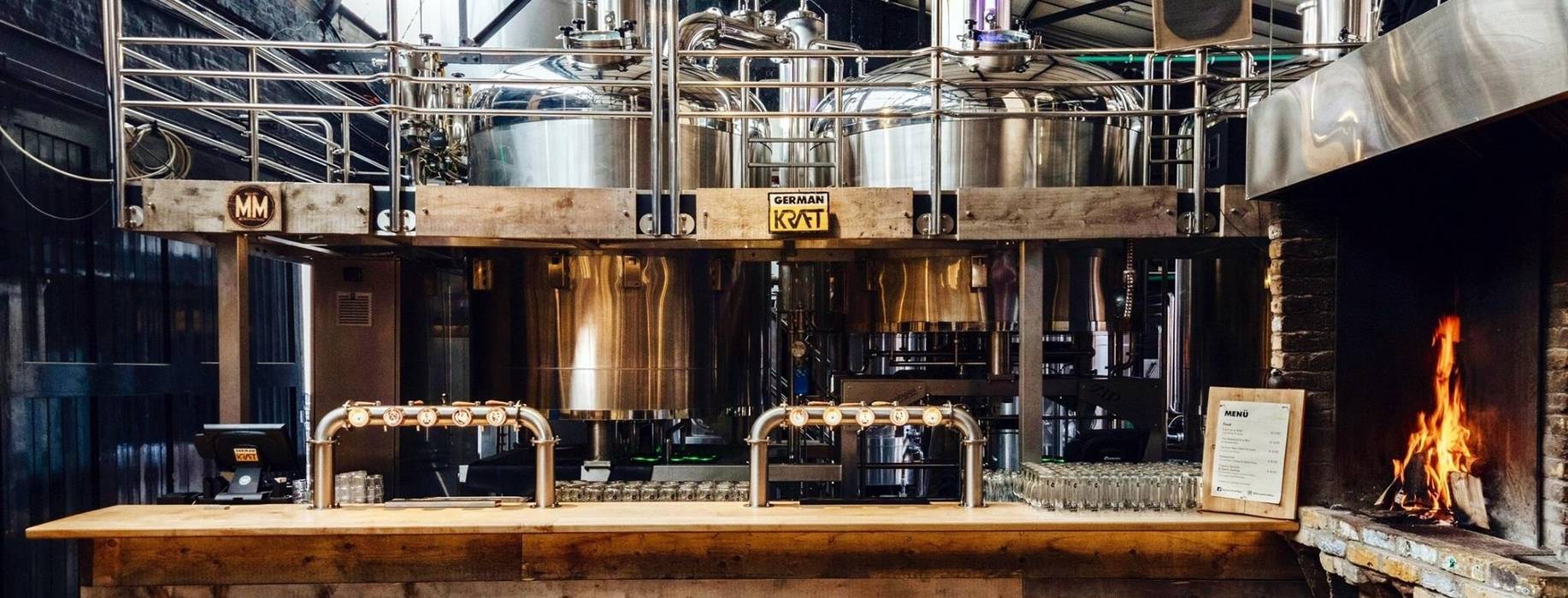
Such sluggishness isn’t typical of German Kraft, even if Felix, with his floppy blond locks and slightly dreamy demeanour, looks more surfer than entrepreneur. It is a no-holds-barred business, he insists, offering as physical evidence a huge hole—now patched up—in the Mercato’s back wall. The hole was made in 2017 in order to squeeze the brewhouse in, apparently without the freeholder’s permission.
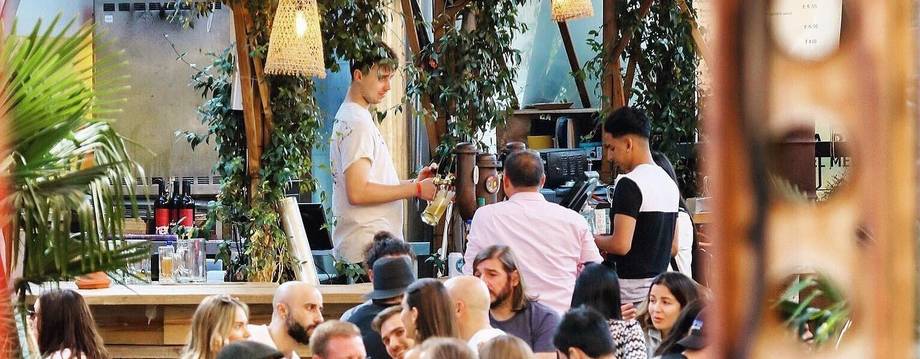
The brewhouse, a 20 hectolitre kit built by Hungary’s ZipTech, sits at one end of the main bar, in a long, slim room towards the back of the Mercato, past stands selling pizza, pasta, Argentine steak, Korean pancakes, smash burgers, and all the other Instagrammable treats you’d expect to find in a modern food hall. Outside, beyond a coldroom put together by the German Kraft team, is a similarly slim biergarten; partially covered, which buzzes with youthful fervour on warm evenings, a unique outdoor space in a city of pokey pub gardens.
This is German Kraft’s first home, but not its source. That’s Erlangen, the town in Upper Franconia, southeast Germany, where Felix’s mother Silvia grew up, and where he spent holidays as a child and a teenager—the hometown of Helen, too: a fact she used to her benefit in her job application. This charismatic northern chunk of Bavaria has perhaps the world’s richest beer culture, boasting hundreds of small breweries. The lagers made here are frequently unfiltered and unpasteurised, served mere yards from where they’re made—and at their best, they’re very delicious.
Initially, everything about German Kraft was Franconian, from the malt, imported from Steinbach-Bräu in Erlangen, to the head brewer, Tobias Medla. Beer was (and is) unfiltered and unpasteurised, and brewed, Felix says with evident pride, according to the Reinheitsgebot, Germany’s purity law.
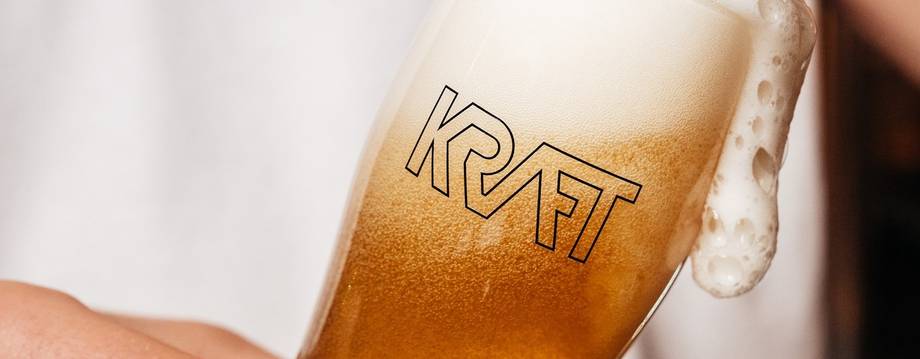
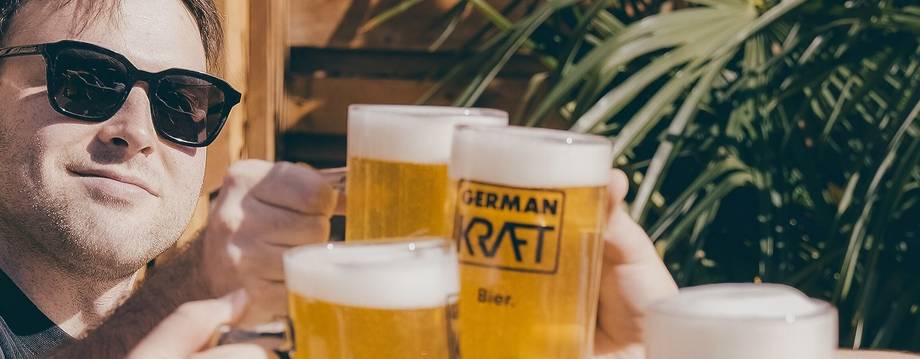
“This is our USP,” Felix says. “We don’t really see ourselves as a craft beer brewery, but as a kraft brewery. It’s a play on words: In German, kraft means strength and power, and we want to bring German efficiency into the craft beer scene. We focus on that German-ness, and on our core beers.
“I want every detail to be perfect. A desire to replicate German brewing culture in the UK, that’s what drives me.”
A focus on efficiency is reflected in the partners’ division of power. Michele, an Italian who studied Business and Management at King’s College, London (and who doesn’t actually like beer, according to Felix), is the money man, the one who, as Felix puts it, is clear-headed in the morning; Andrea, also Italian, is the practical one (“So good at everything,” insists Felix) who covers hospitality; and Anton, German, runs the Vienna end of the operation and shares Felix’s passion for Franconian beer.
But wait, there’s a fifth Beatle, a George Martin figure: Felix’s dad, Florian Bollen. With a background in cinema—he helped produce, finance and distribute films like The Wedding Planner and Terminator 3—Bollen senior is a master wheeler-dealer as notable for his commercial instinct and work ethic as for his trademark thick-rimmed glasses.
Florian is now in charge of finding new venues, having been the driving force behind the Gleis//Garten project, which German Kraft runs itself, unlike in London, where the brewery sits within a separate business at Mercato; the food hall in Berlin will, like Vienna, solely be German Kraft’s party.
It’s a brewery that likes to do things a little differently, even from site to site. “We don’t want to be a high-street brand,” insists Felix. “This location [Elephant and Castle] is completely different to Mayfair, to our bar in Brixton, to Gleis/Garten. And Berlin will be different, too. We adapt to the location and the space.”
While the beers themselves are unmistakably German, the person in charge of producing it since Tobias went home (“London was a bit too big-city for him,” Felix says with a chuckle) is James Mozolewski, who grew up in Northampton.
At the moment the company makes about 4,500 hectolitres, or 792,000 pints, each year across its sites
A keen homebrewer with a background in Scotch whisky production, James is clearly infatuated with Franconia. “I’ve had some of the most incredible lagers there,” he says. “We take the brew team out for the Bergkirchweih [Erlangen’s annual beer festival]. My two favourite breweries—Elch Bräu and Lindenbräu—are in the Franconian country. I’ve been lucky enough to go into the Lindenbräu brewery, where they’ve got these incredible open-top fermenters and the cellar is like a Tardis—I’m always amazed in Franconia how much they fit into really small spaces.”
James, who has a three-person team working for him in London, also oversees brewing in Austria, Berlin—and, presumably, wherever else German Kraft might end up. At the moment the company makes about 4,500 hectolitres, or 792,000 pints, each year across its sites, with the lion’s share, 3,300, produced at Mercato Metropolitano. That will obviously increase once the Berlin site opens.
This new Berlin site is based in the six-storey KantGaragen Palast; built in 1930, it is imposing rather than beautiful, and remains a key landmark on Kantstrasse, the Charlottenberg street that has become famous for food from across Asia. “Berlin’s tastiest street,” some have called it.
The project is being overseen directly by Felix, who recently relocated back to his birthplace from Peckham, where he had lived since he was four. “It pulled me back to my fatherland,” he says, with a smile. He’s still a young man, and you can sense that the idea of living in Berlin—and experiencing a different way of life, techno et al—was also very appealing.
For how long, though? Good lager served in food halls is clearly in demand all over Europe, and new projects for this ambitious business are inevitable. There are a couple of new possibilities in London, albeit at too early a stage to discuss. Meanwhile, the prospect of redevelopment has been hanging over Mercato Metropolitano in Elephant & Castle for its entire existence; soon, perhaps, it will be replaced by a towering block of flats, like those already crowding this lively corner of London.
“When we started here, none of these high-rises existed,” Felix says. “A lot of them sell themselves on being close to this market, they charge premium prices for it, so they want to keep an element of it nearby. If the market closes, hopefully we’ll be able to find another place nearby, and I think the landlords want to help us.”
And if they don’t, no need to worry: there’ll always be another opportunity. Europe is a big place.
A version of this article was published in Pellicle in June 2025.
Share this article
You’ve reached your limit of 5 free articles this month.
Unlock unlimited access and more

Join Beer52 and get your first month half price
-
Get your first box for £13.50 (RRP £27).
-
8 beers & 2 snacks delivered monthly.
-
Printed Ferment magazine included.
-
Unlimited access to all online content.