A Lebensgefühl of its own
Twelve years in and Bierol’s love affair with Tirol is only getting deeper, and stronger
Robyn Gilmour
Photos:
Bierol Brauerei
Saturday 15 November 2025

This article is from
Winter Wonderland
issue 124
Share this article
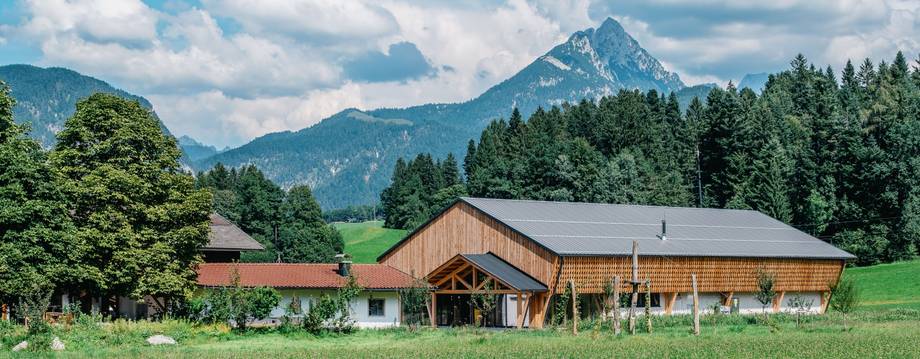
I could talk to Lisa Luginer-Bichler all day. The co-owner of Bierol is a born storyteller, and a breath of fresh air. Alpine air, that is. Though originally from Bavaria, Tirol in west Austria is now the place Lisa calls home. Her husband, Chris Bichler — a native Tirolean and founder of Bierol — played no small part in attracting her to the region. “People think the ‘ol’ in Bierol refers to Aperol, but no, it’s Tirol,” she says. My vision of the region is a pastoral paradise, punctuated by traditional, wooden buildings, pristine ski slopes and bucolic mountain hikes. “That's exactly how it is here,” Lisa replies when I share this.
“We’re based in an old wooden farm building with the mountains in the background, and lots of nature and woods around us. My father-in-law has done classic farming here, like generations before, so we had cows and pigs roaming around, like in the movies. He also had a hut in the mountains that would open in the summer and close in the winter.” In Tirol, a ‘hut’ refers to a rest stop for hikers and skiers where they can get something to eat and drink. The offering can range from hearty meals and snacks to high-end dining.
As Lisa tells it, Chris’s dad, Peter decided one day to start making his own beer. “He had a feeling that there was more to life than just classic farming; he wanted something different to his daily work. Because the hut on the mountains was already producing cheese and speck [a cured, often lightly smoked ham, traditional in Tirol], he thought ‘what fits better to that than a homemade beer?’.” The resulting brewpub, Stöfflbräu, was born in 2004 and produced classic styles like helles and wheat beers, both of which were perfect companions to the schnitzel and kaspressknödel [a flattened, fried, cheese dumpling, also local to Tirol] that was served on-site.
The operation was a huge success, but over time, managing the hut, brewpub and farm proved untenable, so Peter decided to focus his energy on the hut, leaving the brewery to his son Chris.
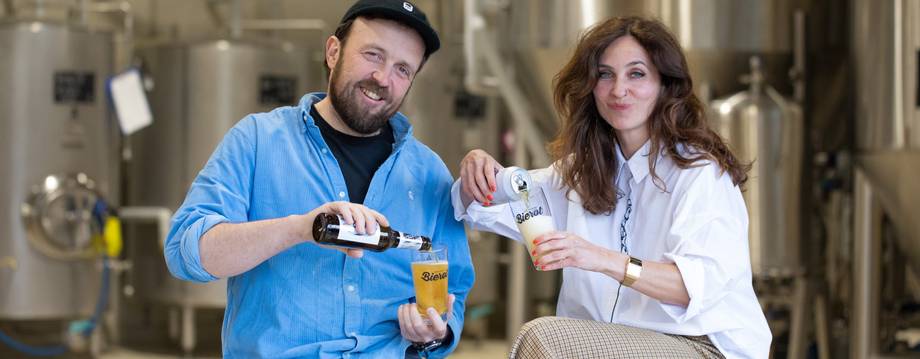
PHOTO: Chris and Lisa, the owners
Chris’s journey to beer and brewing began some years earlier. In Austria, high school students can specialise their education from age 16, and begin studying towards practical qualifications if they so choose. A lot of students in Tirol choose to study tourism and gastronomy, as did Chris, which eventually landed him a job in a country club in the US for a year. In Lisa’s telling, he’d always drink at the same bar after work, religiously ordering whatever German or Austrian beer was available.
“Then one day, the bartender asked him why he always ordered the imported beers, to which Chris replied ‘because you don’t have any good ones, it’s all just yellow water’. The bartender said ‘wait one moment, I have something for you’, and that was Chris’s first IPA. He fell in love from the first sip. But when he came back to Europe after this year in the US, he wondered ‘where do I get that stuff here?’, and found it was really hard to find good local or even regional craft. In 2013, most IPAs you found in Austria were really old and oxidised, so he decided to brew his own.”
Meanwhile, Lisa was forging her own path in the beer world. Her journey began in Augsburg, Bavaria, where she was working as a journalist for the local newspaper. She enjoyed drinking beer, but it was her interest in reporting that got her involved in a documentary about beer in Bamberg. “I will never, ever forget the day that I became interested in beer,” she says.
Though 20 years ago now, Lisa talks about her first sip of rauchbier like it was yesterday. Inspired, she threw herself into this documentary, which the small team worked on outside of their day jobs for two-and-a-half years, resulting in a 90-minute movie which made it to cinemas and even had a US tour. When the dust settled in wake of the documentary, Lisa wasn’t ready to part ways to Bamburg, and so she moved there, getting a job with the marketing team at Weyermann Speciality Malts.
“I got my sommelier there and just had a really good time,” says Lisa. “I met so many brewers from all over the world and it made me think that, you know, beer cultures can be so different but in the end we're sitting together and having this one glass that has everything inside. That’s what we’re all talking about and working towards, and everything is included in that.” After a year at Weyermann’s, Lisa quit to start her own company doing media and PR for breweries.
It was this work that took her to a beer festival in the north of Italy. At the booth next to one of her customers, a young Austrian brewer was stationed. He asked her if she wanted “to try a good beer”. Lisa rolled her eyes and told him “I mean, I’m living in Bamberg so I’m familiar with what good beer is, but sure.” She concedes that it was a good beer; another instance of love at the first sip. IPA was new to her too. She moved to Tirol a year later to be closer to Chris.
“So you see, Bierol has had its roots in Tirolean culture from the first step. Even though we are not like these breweries with 100 years of tradition, we have deep roots, we just work in a modern way. When Chris and his two friends started the brewery, they started very progressive, and absolutely anti-mainstream, so the customers of Bierol were not the people who lived here in Tirol, in this really small village. We exported to Italy, to the Netherlands, to France, but that was because ‘craft’ was a new thing. We don’t talk about craft so much anymore, but think of ourselves as a modern brewery.”
COVID played a big part in this shift in perspective. Like everyone, everywhere, the Bierol team had time to reflect, to think about what was working and what wasn’t. “You know, we were here, surrounded by all these fields, and by nature, and it occurred to us; why aren’t we working with this?” says Lisa. It was like a flick had switched; Bierol’s focus was no longer representing modern American craft in Tirol, but producing something intrinsically linked with their surroundings, something of and for Tirol, using their experience in modern breweries.
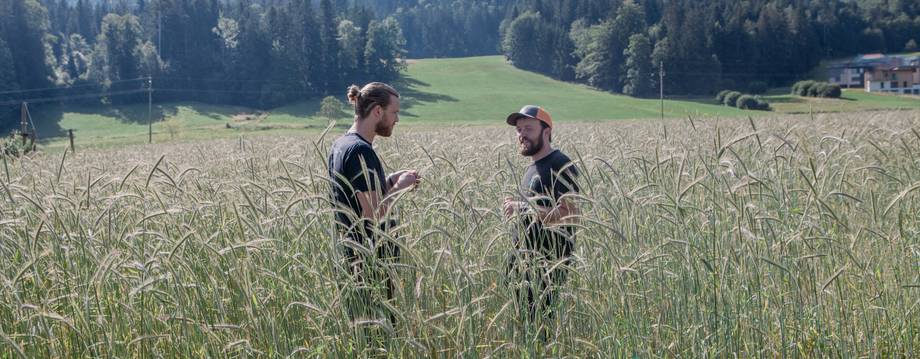
She and Chris connected with a local agronomist who helped them plant cereals for malting, and also cultivated a small but beautiful orchard. The fields don’t yet yield enough grain for Bierol to be self-sufficient, but year-on-year, the practice of farming is guiding the brewery towards a future where most of the ingredients used are grown in Tirol, if not on their own farm.
Lisa has recently really gone back to school, and is studying circular economies, while still steering the ship alongside Chris at Bierol. “Being circular is very important for us, because we have these wonderful mountains and woods around us. We even have our own spring that's just 100 metres away. So every day now, that’s what we’re working on; finding new partners, exploring new ways to collaborate.”
One of Bierol’s first forays into circular production was a collaboration with a local cheese maker. Lisa says her and Chris first took notes of this particular business because the two brothers running it specialised in making camembert — cheese is famous in Tirol, but camembert? Not so much. The four of them hit it off and naturally began mulling on ways to collaborate.
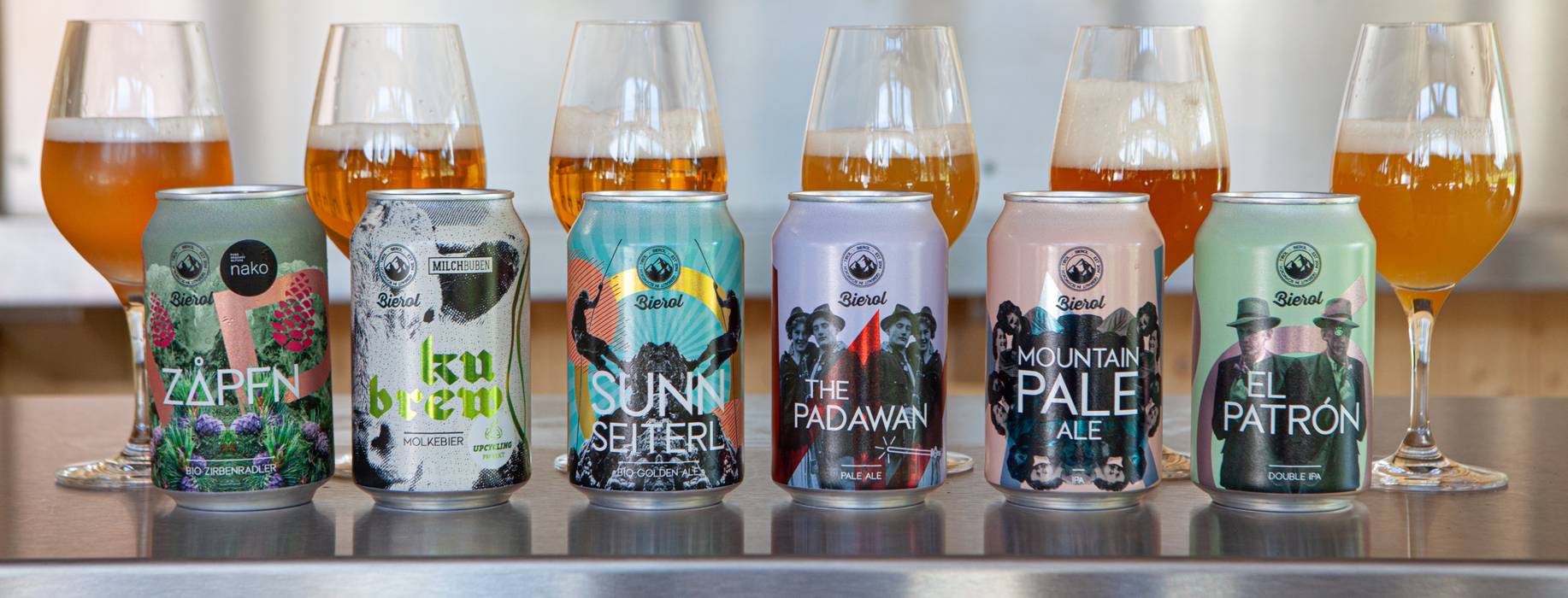
“At the beginning we thought about maybe doing a beer cheese, but no, a lot of people were doing this already,” Lisa begins. “Then Chris found this old story from the war times, when people brewed beer with whey because grain was prioritised for the bread and for food and things like that. So we started thinking, we have access to so much of this, and so much is thrown away, why not replace a percentage of our brewing water with whey when mashing in, to make a kind of upcycling beer?”
Lisa says their first few attempts were dreadful, but after pivoting their approach, and brewing more in the style of Belgian wit, with additions of orange and coriander, the beer started to taste really, really good. “About three months later, we won a regional food and innovation award for this upcycling beer,” says Lisa, citing the project as the kind of success that Bierol strives to see more of.
Though coming from a confluence of cultures, with a myriad of influences informing its journey to date, talking to Lisa makes me think that Bierol's story is only just beginning.
Share this article
You’ve reached your limit of 5 free articles this month.
Unlock unlimited access and more

Join Beer52 and get your first month half price
-
Get your first box for £13.50 (RRP £27).
-
8 beers & 2 snacks delivered monthly.
-
Printed Ferment magazine included.
-
Unlimited access to all online content.