The Elements of Beer: Hops
Robyn Gilmour charts the formative influence of New World hops, through four style-perfect beers.
Robyn Gilmour
Saturday 13 December 2025
This article is from
The Elements of Beer
issue 125
Share this article
Day to day, nothing changes, but looking back everything is different, or however the saying goes. Whether you’re making or drinking beer brewed with specific varieties, it’s easy to think about hops exclusively in terms of how they taste and smell. Of course, flavour and aroma is their raison d’être, but these small, green flowers are also superb storytelling tools.
“When Sawmill started over two decades ago, New Zealand hops like Motueka and Riwaka were valued for their uniqueness, but not always easy to express cleanly,” says Rory Taylor, production manager of the Matakana-based brewery. “The evolution since has been remarkable, from broad regional character to precision-driven varietal expression.
“Breeders now work closely with breweries on sensory targets, with new cultivars such as Nectaron and Superdelic designed for specific fruit spectrums and high oil intensity. Processing has also shifted; advanced T90 and amplified oil products let us fine-tune layering between whirlpool and biotransformative dry hops. Overall, NZ hops have moved from novelty to world-class definition, and our Alpha and Bravo beers are a small showcase of how far that evolution has come.”
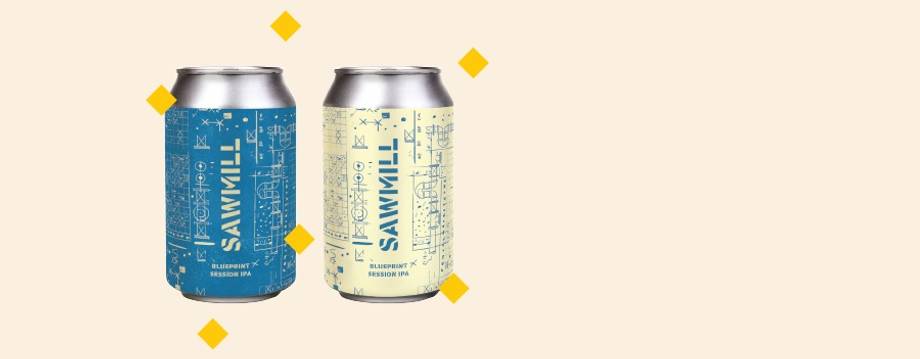
Rory goes on to outline how Alpha was designed to highlight bright, citrus-driven New Zealand hops, namely Riwaka, Wai-iti, Motueka, Superdelic, and Nectaron. Pacific Gem provides a restrained bitterness foundation at 15 IBU, with Wai-iti layering gentle lime and stonefruit while also adding low bitterness hop oils to aid in mouthfeel. The whirlpool features a trio of Riwaka, Wai-iti, and Motueka for lush, tropical aromatics, while dry hopping combines Superdelic at mid-ferment and a final charge of Riwaka and Nectaron for high-impact ripe fruit aromatics.
Bravo, on the other hand, “leans toward a more structured, West Coast-inspired profile, still at session strength,” he says. “Bitterness is a touch firmer (30–35 IBU), with Nelson Sauvin and Citra providing citrus and white-wine aromatics against a clean malt base. Mosaic contributes resin and dank tones, reinforcing structure and giving the beer more depth through fermentation.”
Such detailed layering of hop flavour and aroma is de rigeur in craft brewing. Indeed, it's easy to forget that over the past few decades hops have moved from a way of simply adding bitterness to become a multi-hued palette of flavour and aroma, which puts the modern brewer in control of their own increasingly ambitious, complex creations.
By virtue of the fact that New Zealand Hops, the country’s largest hop supplier, is a farmer-owned collective, hop growing in New Zealand has always been carried out with a unique understanding of agronomy and terroir. Building on that, the past decade has seen new, small-scale, local suppliers like Freestyle Hops come on the scene, and call into question hop processing practices that might be holding New Zealand Hops back.
By encouraging direct collaboration between breeder and brewer, in conjunction with targeted research and development from entities like the Hāpi Project, this new generation of suppliers has driven, as Rory points out, an emphasis on “sensory targets” and “precision-driven varietal expression” in turn.
This expression can best be experienced in Alpha, but the reach and influence of these varieties are alluded to in the composition of Bravo. You might have noticed that nestled among this beer’s American hop bill is Nelson Sauvin. It's easy to assume this inclusion is purely reflective of Sawmill’s pride in New Zealand hops, but Nelson Sauvin’s placement in Bravo also points towards a broader evolution in craft beer.
Over the last number of years, New Zealand hops have increasingly featured in the California IPA, an evolving style inspired by the West Coast IPA. I here say ‘evolving style’, because the Cali IPA is less an official style — by BJCP standards, at least — and more of a label that we attach to beers that build on the beloved bitterness of the WCIPA, but are lighter and more balanced. It’s worth reading Katie Mather’s feature on the Cali IPA, on page 22, for a deeper dive into the style.
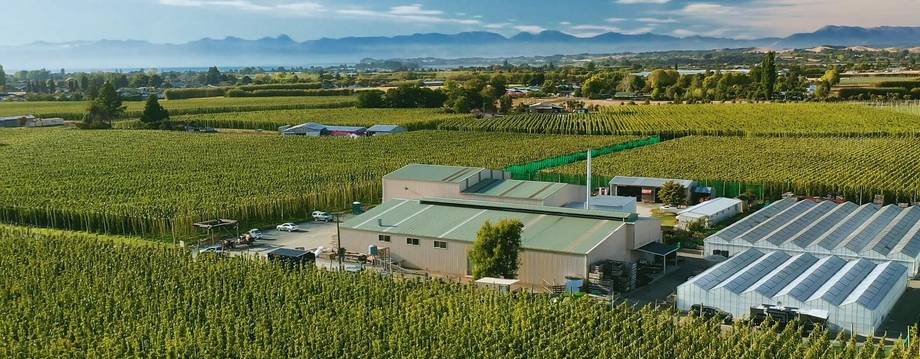
PHOTO: NZ Hops
Unprompted, Rory describes Alpha and Bravo as both sitting “under a ‘session IPA’ concept, but they diverge stylistically to explore contrast within the same framework. They were conceived as siblings rather than opposites, with the same malt and fermentation base, but different lenses on how hop selection and water balance shape perception.”
When I ask if Bravo has any relation to the Cali IPA, Rory says “yes that’s a pretty spot on comparison, I would say a cross between a California IPA and an Australian Extra Pale Ale. Half Acre Brewery in Chicago has a Cali IPA called Vallejo that I tried a couple of years ago that has a similar vibe, with heavy-hitting US hops and Nelson Sauvin to give it a boost.”
Introducing another set of beers here really puts into context where our penchant for modern hops has come from, and the global evolution that New Zealand hops are driving. Mikkeller’s Pale Bloom and Sun Bliss, an American pale ale and West Coast pale ale respectively, pay homage to the old-school American styles that tell the story of where craft beer came from.
Though American pale ale was brewed long before the release of Liberty Ale, this beer is widely regarded as the first modern example of the style. As the first beer to celebrate locally grown Cascade hops, San Francisco's Anchor Steam brewery unwittingly gave birth to the modern craft beer movement in 1975.
Liberty Ale represented a rejection of mass-produced American beer, European exports that reached the US in poor condition, and a hunger for local ingredients. It became a precursor to Sierra Nevada’s Pale Ale, the beer that really popularised the American Pale Ale and in turn gave rise to the WCIPA, the style which launched Chinook (commercially released in 1985), Centennial (1990) and Citra (2007) into craft beer superstardom.
Pale Bloom “has slightly more Munich malt, so will be a little bit darker in colour, and have a richer, more toasty body. Those caramel elements will work really well with the floral, citrus notes coming from the Cascade and Centennial,” says Mikkeller’s head of sales, Emil Sylvester Salomon.
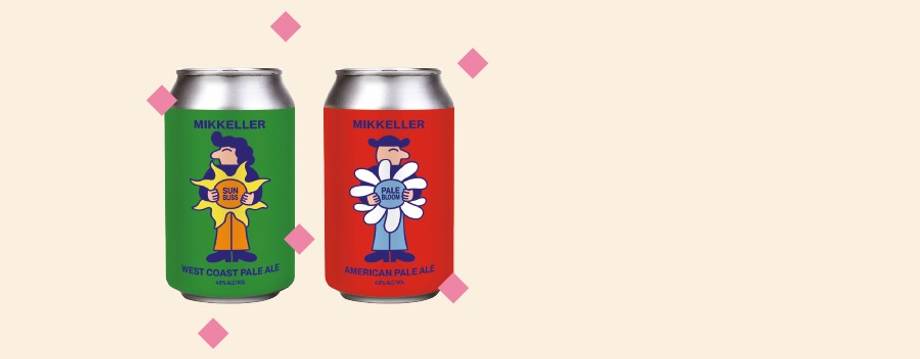
“Conversely for the West Coast Pale Ale, we’re using only pale ale malt so the beer is lighter, crisper, more neutral. The focus is on the Chinook, Centennial, and Columbus, so we can really experience that sharpness, dankness, and crisp, pine notes,” Emil continues. “The beers are true to style and the gimmick here is that the ingredients are actually quite similar.”
If you wanted to drink these beers in an order that reflects the dominant narrative of craft beer, you could taste Pale Bloom, then Sun Bliss, then Alpha and Bravo, a beer that points back to Pale Bloom, while also facing forward. What’s crucial to note though, is that this timeline represents an evolution of consumer tastes, not the timeline of the hops themselves. Nelson Sauvin (2000), Riwaka (1997) and Motueka (1998) aren’t new kids on the block, but hops we’ve gained better access to in recent years, and which have seen a massive uptick in quality since their commercial release, thanks to innovations in farming, breeding, and processing.
Hops lead the way in both sets of these beers, but Mikkeller’s tell the story of style, while Sawmill’s speak to the evolution of the ingredients themselves. So, crack a can, grab a glass, and see what version of this story you can taste for yourself.
Did you know?
IBU, or International Bittering Units, measure the bitterness of a beer. Some say that the IBU scale ends at 100, as that’s the limit of what the human palate can detect, others argue that it’s limitless, or at the very least stretches to 120. In the late ‘90s through the 2000s, West Coast Breweries like Russian River, Dogfish Head, Sierra Nevada and Stone Brewing, would compete amongst themselves to see who could brew the most bitter beer.
Share this article
You’ve reached your limit of 5 free articles this month.
Unlock unlimited access and more

Join Beer52 and get your first month half price
-
Get your first box for £13.50 (RRP £27).
-
8 beers & 2 snacks delivered monthly.
-
Printed Ferment magazine included.
-
Unlimited access to all online content.