The Elements of Beer: Water
It accounts for approximately 90% of your beer, but what do you know about water’s ability to shape and influence a brew? Join us as we dive deep into the most underrated element of beer.
Robyn Gilmour
Saturday 13 December 2025
This article is from
The Elements of Beer
issue 125
Share this article
Historically, water sources would dictate where breweries could be built, and institutions of brewing today — think Marston's Brewery in Burton Upon Trent, Augustiner-Bräu in Munich, and Guinness in Dublin — first gained acclaim because of how well they learned to work with their local water. Yet, as Beinat Gutierrez, head brewer at San Sebastian-based Gross Brewery, points out, “water is often the overlooked ingredient in brewing, especially by the final consumer but also by many brewers, even though it makes a huge difference in the final product. It changes everything: the body, the mouthfeel, the brightness, and how the hops will shine in that beer.” So, what do we mean when we talk about water profile, and how does this impact on the beer?
Depending on where in the world a brewery is based, it might use a mains water supply, carefully treated lake or river water, or spring water. Though it varies according to the geology, a good spring source can be tremendously pure and mineral rich, as it comprises rainwater which has filtered through soil and rock to collect in underground aquifers. Wells bring this water to the surface, giving us a taste of the surrounding area's geological makeup.
While the availability of spring water can certainly benefit a brewery — allowing it to brew beers as unique as the water’s mineral composition — using mains water doesn’t put it at a disadvantage. In fact, nowadays many craft breweries use on-site water treatment technology to strip the water of some minerals and compounds, so the desired profile can be built up in line with the brewer's preferences, usually through the addition of salts.
“Here at Gross, we adjust the water depending on the style we are brewing,” says Beinat. “Basically, we strip all the minerals from the base water and then add them back in depending on what we’re brewing. This gives us the flexibility to brew different styles, from Pilsners with really soft water to Stouts with a harder one.” We’re all familiar with what constitutes soft and hard water, but what effect does it have on the beer?
Small quantities of calcium and sulfates result in a softer water profile, and produces a smoother mouthfeel, with moderate bitterness. Chlorides will also contribute to a rounder and fuller mouthfeel. Higher sulfate accentuates bitterness and perceived dryness, while calcium mainly aids yeast performance. Many lagers favour low–moderate sulfate, and dry stouts benefit from higher alkalinity rather than sulfate.
There are countless other minerals in water, with elements like magnesium and zinc being important for yeast health, but calcium, sulfate, chloride and bicarbonate tend to have the most profound effect on beer’s flavour. The best way to get acquainted with these differences is to taste them for yourself.
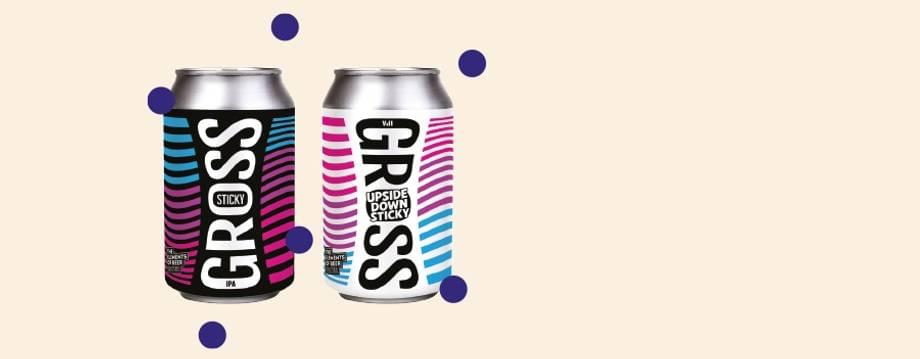
The basis for Gross’ pair of comparative beers is one of the brewery’s OG recipes. Sticky is a WCIPA, brewed with low levels of calcium and sulfates, which gives the beer a round, smooth mouthfeel. US05 yeast produces a clean neutral profile, while the use of dextrose (a fully fermentable sugar source, often added as a syrup during fermentation or at the end of the boil) ensures a lighter body with a cleaner finish, which contributes to soft beer with integrated hop character.
“This year marks 10 years of brewing this beer, and it is still our best seller,” says Beinat. “We wanted to celebrate Sticky's 10th anniversary by brewing different versions of it. We all love brewing and drinking lagers here at Gross, so creating a lager version was one of the first ideas that came to mind! We wanted to capture all the drinkability, body, and feel of a lager beer, but with the hoppiness and character that still connects it to the Sticky family.”
PHOTO: Gross Brewery
The Upside Down Sticky uses calcium sulfate additions to achieve a higher level of calcium and sulfates, resulting in crispness and dryness. To accentuate this, the beer also uses a lager yeast, which works in tandem with the water to achieve a clean finish. Would Beinat call this beer a lager? He’s not even sure of this himself, but just changing the water and yeast certainly exhibits how minerality can alter the character of a beer.
“There isn't a classic style for a lager beer that's hopped up to the IPA dimension,” says Beinat. “The craft beer industry has tried to create styles around it for years: IPL, West Coast Pilsner, Hoppy Lager… but we thought this beer doesn’t fit into any of them. That’s why we decided to call it Upside Down Sticky. Of course, I think that classic styles are often a good starting point for brewing beers and also help consumers know what they're buying, but with craft brewers constantly pushing these limits, sometimes it gets difficult to think of a given beer fitting into those styles. And this is one of those cases.”
Where Sticky and Upside Down Sticky are great examples of how water can integrate hop character or make its bitterness stand out, Brothers In Law uses chlorides in its Sweet Dark Lager as a way to enhance mouthfeel.
As we talk about in our malt and yeast features on page 34 and 48, a smooth, round mouthfeel often indicates the presence of residual sugar in a beer; this is sugar that has not been consumed by yeast, and which therefore contributes to the perceived sweetness and viscosity of a beer. This smooth, round mouthfeel can be enhanced by chloride-rich water, as is exhibited in Brothers in Law’s Sweet Dark Lager.

Here, a late addition of dextrin ensures a high final gravity (plenty of unfermented sugars), and round mouthfeel that is enhanced by chloride-rich water. This roundness and sweetness build out the mouthfeel which in turn supports the dark berry evoked by Brambling Cross. Conversely the brewery’s Bitter Dark Lager is brewed without the addition of chlorides, or additional sugar sources, allowing the yeast to achieve a lower final gravity, and emphasise drier, crisper, sharper roastiness, with a cleaner and thinner texture.
Interestingly, the same two hops are used in both of these beers but in different ratios, making this pair inversions of one another in more ways than one. In the Sweet Dark Lager (which has a rounder, chloride base) a ratio of 2/3 Brambling Cross is used, and 1/3 Hallertau, which will give more dark berry, which should work with the rounder mouthfeel. In the Bitter Dark Lager, 1/3 Brambling Cross is used, and 2/3 Hallertau, making the beer more herbal, with less fruity nuances.
“Hops are sexy, and understanding what a given malt or yeast does in the beer is easy, but water is more difficult,” says Beinat. “It's geeky, it’s hard chemistry, and it takes a lot of work to understand. But once you do, you see how important it is in brewing. In the end, always remember that around 90% of a beer is water, so it’s the base of everything.”
Did you know?
While calcium contributes to acidity, and bicarbonates build alkalinity, working with hard or soft water isn't necessarily a problem as long as the desired pH is achieved in the mash. For instance, alkaline water can be neutralised through the use of dark malt, which is acidic, or by sour mashing. While different styles are suited to certain pH levels, mineral composition is generally considered more important. Acclaimed author and homebrewer John Palmer refers to water profile as "seasoning" for a beer; "alone [it] will not make up for poor ingredients or a poor recipe" but marks the "difference between a good beer and a great beer".
Share this article
You’ve reached your limit of 5 free articles this month.
Unlock unlimited access and more

Join Beer52 and get your first month half price
-
Get your first box for £13.50 (RRP £27).
-
8 beers & 2 snacks delivered monthly.
-
Printed Ferment magazine included.
-
Unlimited access to all online content.