The Elements of Beer: Malt
Over the centuries, maltsters and brewers have learned to harness the natural lifecycle of grain, bringing us a trove of flavour and aroma, writes Robyn Gilmour.
Robyn Gilmour
Saturday 13 December 2025
This article is from
The Elements of Beer
issue 125
Share this article
In ye olde times, malt was a purely functional element of beer; its purpose was to provide sugar that yeast can turn into alcohol. Thankfully, innovation in malting technology and agronomy over the last several centuries has meant that increasingly, malt has been able to express character of its own. In this part of the world, malt is predominantly made of barley, though speciality malts made from other grains, like wheat and oats, are also common.
When barley starts to sprout, it activates the enzymes naturally present inside the grain. In nature, those enzymes break down the grain’s stored starch into sugars that feed the young plant as it grows, but they’re also vital in brewing, converting starch into fermentable sugars in the mash. The maltster stops the sprouting at just the right time by gently drying the barley in a kiln. That drying locks in flavour and colour while keeping enough enzyme activity for the brewer to use. Light kilning results in a neutral-to-delicately flavoured malt character, with a wider array of intact enzymes than more heavily roasted, darker malt, hence why most beers — even the dark ones — use a significant volume of base malt in their grain bill.
Caramelisation and the Maillard reaction — the chemical browning processes behind malt’s colour and roasted flavours — both take place during kilning and roasting. The higher the temperature, the more these reactions create deeper notes of toast, coffee and chocolate, but they also destroy the enzymes that enable starch conversion. As a result, very dark or roasted malts contribute more flavour and colour than fermentable sugar, so brewers use them sparingly alongside a larger proportion of paler base malt. Another kind of malt that tends to be used in small quantities because of the punch it packs, is rauchmalt. This pale malt is kilned over a beechwood-stoked fire, imbuing the beer it's used in with a smoky character.
When discussing his decision to use rauchmalt in Stormy, a tripel by Belgium-based Brasserie de Bellevaux, head brewer Tom Schuwer says “I kept in mind that I’d be adding a distinctive smoked malt touch in Stormy. It’s always a bit of a surprise how dominant that character will turn out to be — it depends on so many things: the maltster’s profile, yeast behaviour, residual sugars, even CO2 saturation. However the dice falls, my goal was to make sure the beer stays balanced, whether the smoke comes through strongly or remains more subtle. That tension between predictability and surprise is what makes brewing fun — you can plan everything on paper, but the beer always has the final say.”
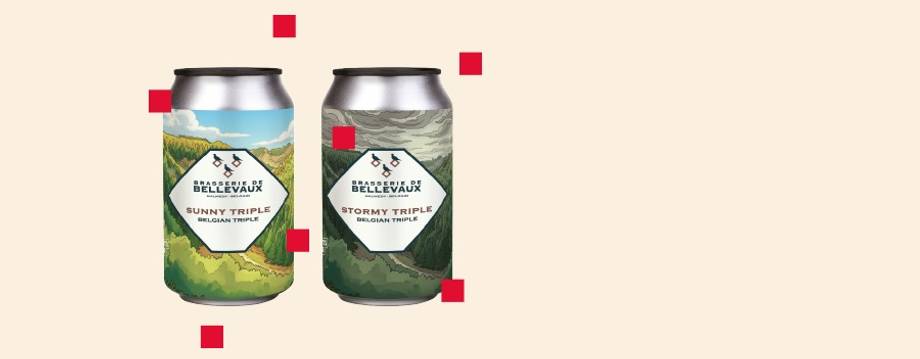
Interestingly, both Stormy and Sunny — Stormy’s counterpart — are tripels, a style that’s predominantly considered yeast-driven, but by introducing a rauchmalt, we get a real sense of how quickly malt can take over. “I wanted a clear contrast, something you could feel immediately,” says Tom. “Changing yeast or hops felt too gentle for me — I wanted something bold, almost visceral.”
Sunny is a more standard example of a tripel. “It’s a malty, simple, versatile blonde ale — honest and unpretentious,” says Tom. “I started from a tripel base [predominantly pilsner malt], and slightly adjusted the malt bill to increase drinkability while keeping a nice depth and structure. I wanted something bright and round, easy to drink but not lacking character — that kind of beer that makes you smile without trying too hard. Together, Sunny and Stormy tell a story of contrast: light and dark, clarity and smoke, two sides of the same coin.”
Supporting this distinction is also a difference in the hop varieties used. Sunny enjoys bright, fresh citrus notes, owing to Mandarina Bavaria and Hallertau Blanc, while Stormy’s smokiness is supported by the spice, resin and earthiness imbued by Styrian Golding and Columbus.
On the challenge of brewing malt-forward beers, Tom says that “malt gives you depth, comfort, and roundness, but it can also easily make a beer heavy or cloying if you’re not careful. The challenge is to keep that richness while maintaining flow and freshness. At Brasserie de Bellevaux, we work with soft water, which naturally gives smoothness and fullness, but it means we need to be precise with our mash profile and fermentation management to avoid sweetness building up. We keep things simple: small batches, fresh malt, clean fermentation. For me, it’s not about adding layers of complexity but about letting the malt express itself — the toast, the biscuit, the light honey notes — all in harmony.”
Interestingly, Barcelona Beer Company’s director Fredi Nuñez uses almost the exact same language to describe the challenge of brewing malt-forward beers. “For us, the biggest challenge is balance,” says Fredi. “We always aim to create beers that are flavourful, expressive, and character-driven, but without tipping into heaviness or becoming cloying. This is especially important in the Spanish market, where consumer preferences still lean toward drinkability and refreshment.”
Where Bellevaux is a Belgian brewery, here brewing a Belgian style [tripel] with a twist, Barcelona Beer Company is working within a lager-led country, and so it approaches brewing stout with accessibility in mind. Fredi is conscious of the circumstances in which the style is best enjoyed, and how malt can exhibit variety within style parameters.
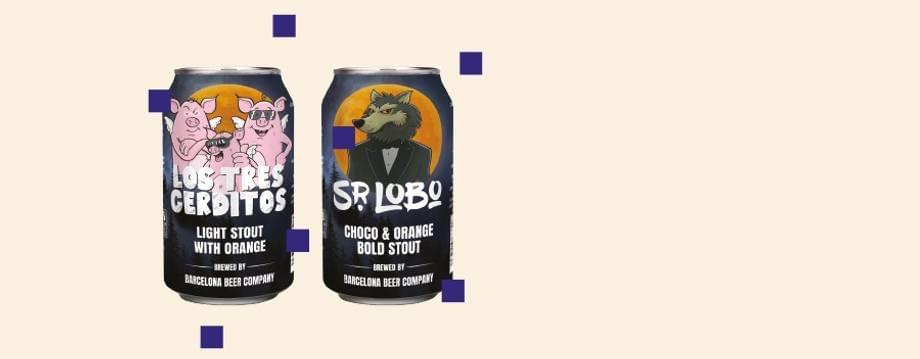
Señor Lobo [Mr Wolf, inspired by Harvey Keitel’s character in Pulp Fiction] and Los Tres Cerditos [The Three Little Pigs] are a duo designed to cast a wide net, and work the capabilities of the stout style to prove that there’s something for everyone in the dark beer category.
“Señor Lobo, is intense and flavour-forward, built on a base of carefully selected malts and enriched with Valrhona cocoa powder. On top of that, it includes subtle additions of orange and coffee, resulting in a complex, luxurious stout designed for slow enjoyment. To create contrast for this project, we decided to make only one change: removing the chocolate element entirely. That means: no chocolate malt, no cocoa powder, all other ingredients (water, hops, yeast, adjuncts) remained untouched.
“The resulting beer, Los Tres Cerditos, shares the exact same malt base and foundational structure but offers a completely different experience. Without the chocolate, the coffee and orange are allowed to shine in a softer, more rounded profile, and the result is a more social, approachable stout, suited to sharing, laughter, and lively conversation.
“These two beers illustrate how style definitions can — and should — be flexible. Do they both meet the classic stout profile? Technically yes. But they exist at two different emotional and sensory ends of the stout spectrum. We believe that’s where the magic lies: giving the drinker different experiences within the same family, rather than drawing hard lines between styles.
So, are style definitions useful? Absolutely. But rules are made to be challenged. After all, the story we’re telling here — of a wolf and three little pigs — is as much about contrast and duality as it is about balance and harmony.”
Did you know?
Roasting the grains for prolonged periods at higher temperatures can result in caramelisation (reducing the water content of the sugar) and a Maillard reaction (an interaction between sugar and the amino acids in the grain’s proteins), which produce sweet, caramel notes and bready, toasted notes respectively. When you walk past a brewery in action, the delicious savoury smell you detect is a result of a maillard reaction taking place; this browning can happen during malting and during brewing if the mash is made at very high temperatures.
Share this article
You’ve reached your limit of 5 free articles this month.
Unlock unlimited access and more

Join Beer52 and get your first month half price
-
Get your first box for £13.50 (RRP £27).
-
8 beers & 2 snacks delivered monthly.
-
Printed Ferment magazine included.
-
Unlimited access to all online content.