There's no smoke without fire
A lot has changed at Big Smoke Brew Co. over the last 12 years, but just as much has stayed the same.
Robyn Gilmour
Photos:
Big Smoke Brew Co.
Friday 10 January 2025
This article is from
Home Counties
issue 126
Share this article
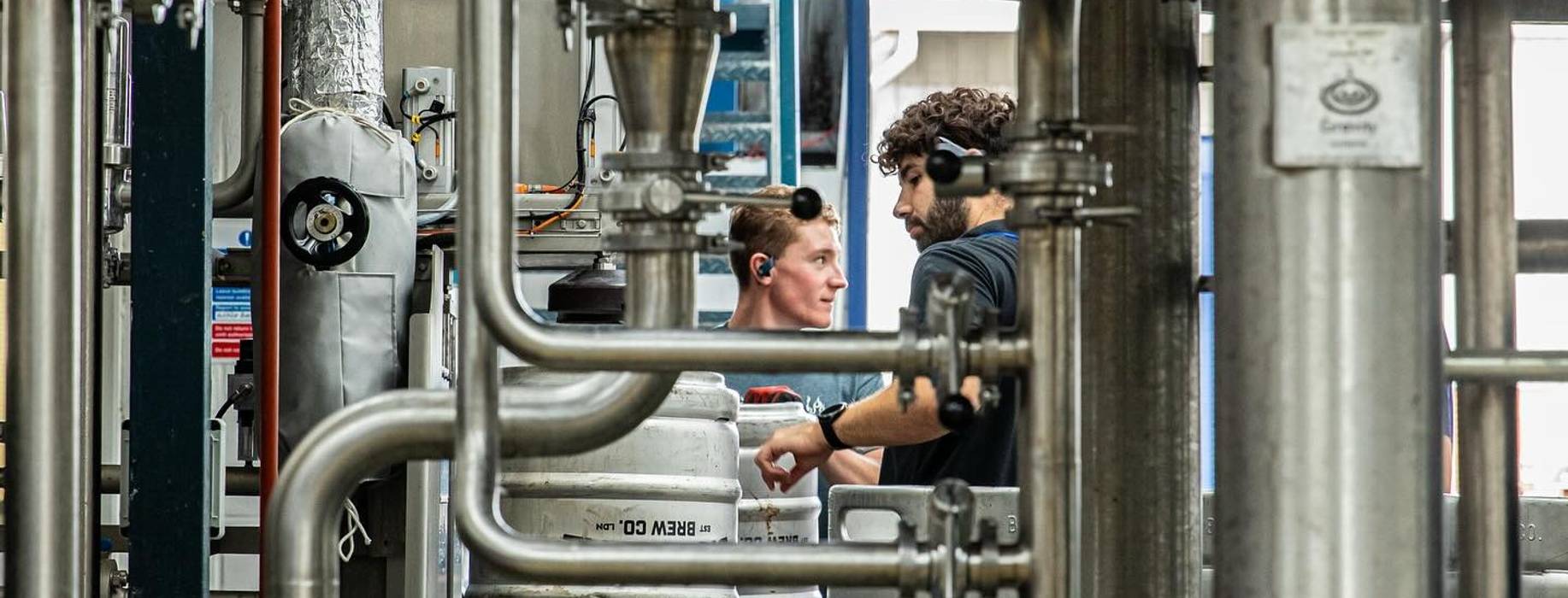
One gets the impression that co-founder Rich Craig, and operations director and head brewer Nick Blake don’t get the opportunity to reflect on the early days so much any more. “God, we’ve had The Antelope almost twelve years now, and Big Smoke started out in the back room as your classic five barrel Dave Porter kit that everyone seemed to have back then,” says Richard. “Except ours was the knock off version,” Nick adds. In their telling, the early years of Big Smoke were chaotic in a wonderful way — their memories softened by time no doubt, but ones they can laugh about now, given that Big Smoke is thriving.
Today, the brewery is supported by an estate of seven pubs, and four airport sites, but in the beginning, “operationally, it was a nightmare,” says Nick. “We’d get deliveries of grain on a big lorry that's parked on a street outside the pub. We’d then have to get that down a cobblestone drive, sometimes while we’re running lunch service. Then hundreds of kegs would turn up from Kegstar, or eKeg as it was at the time, and we’d have to manually walk those in from the roadside.” Rich concurs, saying “it was a proper DIY, old-school way of doing things. And you know, people would come and stick their heads in the brewery, pint in-hand, while Nick was trying to brew, and try to interrogate him or share their opinions.” Nick smiles and shakes his head.
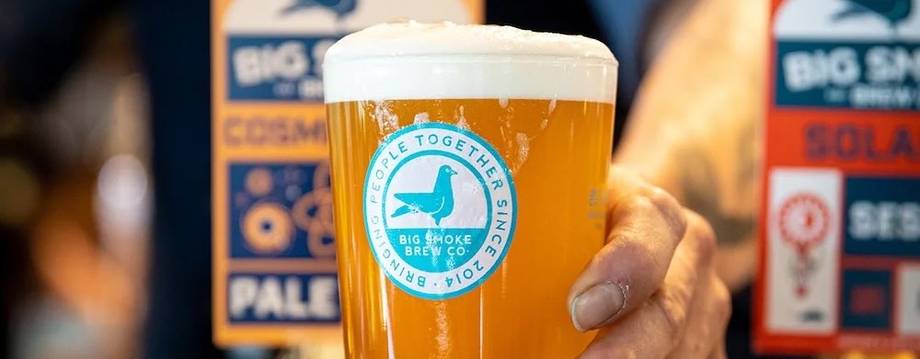
Logistical challenges are easier to put up with when focus is on the beer itself. From the moment Big Smoke launched, in 2014, its emphasis was on cask ale, a format that’s still central to the brewery today but which now sits alongside keg and can. “The Antelope is still a massively cask focused pub. It has 10 dedicated hand pumps for real ale, all from independent breweries, and we just get through a tonne of the stuff. From the outset, our aim was to just brew really good cask ale, and it was only later down the line, when we got some closed fermenters and conical fermenters that we had the opportunity to brew more modern styles. But aside from that, the brands haven’t really changed in a good long while. I think the beers still really hold up, being modern, flavourful, clean, with lots of aroma.”
Big Smoke continued to grow that way until 2019, by which time the pub estate had grown to four venues, when a bigger space became more of a need than a want. Operations moved from Surbiton, Greater London to the brewery’s current home in leafy Esher, Surrey, no more than 20 minutes’ drive from any of Big Smoke’s seven pubs. Some may see the timing of this move as bad luck — Covid was, after all, just around the corner — but Rich says that, in many ways, the move saved Big Smoke’s bacon. The expansion had involved the purchase of a canning line that allowed the team to start canning beer as soon as lockdown was announced, a time when breweries without in-house packaging facilities were left scrambling for ways to access the off-trade.
Still, it was a strange time. As a cask-led brewery, stay at home orders left a pub-shaped hole in Big Smoke operations. Left to their own devices, the team found other ways to meaningfully engage with the community. “We had all these empty kitchens in the pubs, and so around the time that the government stopped giving out a lot of free school meals, a bunch of our chefs, who were all on furlough, volunteered their time to come in,” says Rich.
“We basically set up a dedicated email address for anyone in need, particularly families who might ordinarily have been getting free school meals. So, chefs were cooking meals, they were all getting packaged up, and then people would either come down to the pub to pick them up, or we would drop them off, just to kind of keep things moving in the community at a time when the government should maybe have been doing more. I was personally responding to a lot of people's requests, and I definitely had a few reflective moments seeing these emails, which really puts a lot into perspective about your own situation, and, you know, the hardship that people were going through at the time.”
It was also around this time that Big Smoke started to work more extensively with now-managing director Jenn Merrick, who was then working as a freelance consultant, helping breweries out with the engineering side of operations. Jenn doesn’t strike me as the type to blow her own horn, but it would be remiss of me not to point out that she is brewing royalty, having previously worked for Dark Star, Meantime and Beavertown. If you were fond of Neck Oil in its heyday, you had Jenn to thank for it.
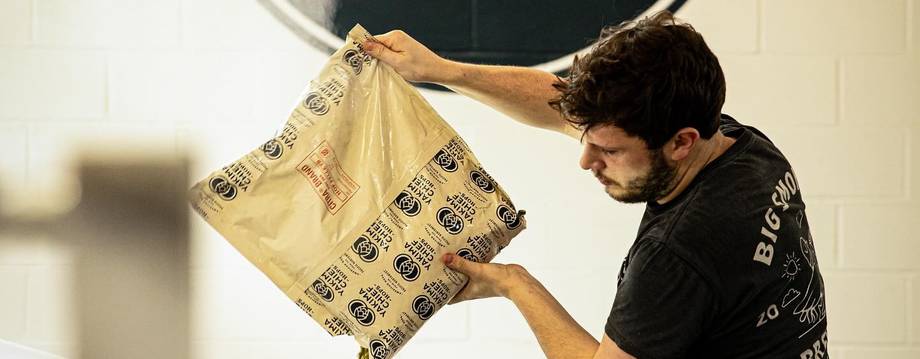
Jenn first started consulting for Big Smoke around the time they transitioned from The Antelope to their Esher site, first helping to get the brewery set up and dialled in, then supporting as and when needed. She still had a portfolio of other clients, but says that over time, she developed a real soft spot for Big Smoke. “Well, these guys are just the loveliest, and this is a very nice place to find yourself,” says Jenn. “As things really changed, and the team here identified a need to separate the pub company from the brewery, and run them as separate businesses, they wanted somebody that could just run the brewery and look after it, so that’s where I came in, three years ago now.”
Jenn says that, although the brewing world as a whole is experiencing a real ebb at our current point in time — with the market not really having anywhere to expand — she’s very grateful to work within an industry, and at a brewery, where beer traditions and sustainable business are inextricably linked. “I'm an American who wanted to study British brewing tradition, and came here thinking this setup of having pubs with a brewery to support them was a kind of virtuous circle, and a little bit magical,” says Jenn. “And so now to find myself here with this bunch of guys — who aren't even English, by the way [they all laugh, Rich and Nick are from New Zealand] — but who have a similar love and respect for this model, and traditional brewing methods, it’s really lovely.”
What Jenn’s referring to when she talks about “the virtuous circle” is the symbiosis between pub and brewery, the most pronounced link between which is cask. So much about cask counts on the reliability of brewery, pub, and drinker; the brewery needs the pub to properly care for this living, unhomogenised product, the pub needs a product of serviceable quality and to the taste of its drinkers, and finally, both pub and brewery need patrons to order and drink it quickly. Of course you could say the same of any beer, but with cask having a short shelf life and requiring care while it undergoes secondary fermentation in the pub cellar, the stakes are a little higher if that virtuous circle falters, or is interrupted. When it works, it is, as Jenn says, “magic”.
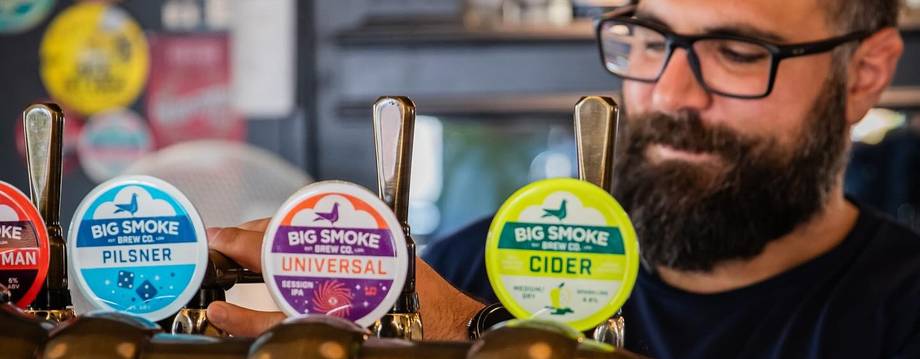
This is why reliability is such a key focus at Big Smoke. “The thing that keeps us afloat is that we have drinkers who come to our pubs, who drink our beers day in, day out. We roughly make the same beers as we've always made, and people expect us to have that reliable pint that’s not showy or spenny, though we do those too.”
Of course, innovation is still of interest at Big Smoke, it is a modern brewery after all, with research and development most recently focusing on low and no alcohol beer. Instead of using yeast strains that don’t produce alcohol, which Jenn points out, mostly originated in the wine industry and so aren’t perfectly adapted to producing beer, the Big Smoke team prefers to brew with high dextrin malts. These contain such complex sugars that the yeast can’t metabolise it into alcohol, and, in Big Smoke’s view, makes the closest thing to a normal beer, just without the alcohol. “We have some new alcohol free beers coming out in January,” says Richard. “We do an alcohol free Pale Ale called Pure Shores all year round, in can and on keg in all our pubs, but coming into dry January, we always try and have a couple of offerings. So, we’ll split a batch in half, and do half of our regular Pure Shores, and half that’s fruited, something like that.”
So, if you find yourself in South-West London this January, why not swing by The Antelope, where it all began, and enjoy a pint of Pure Shores for yourself.
Share this article
You’ve reached your limit of 5 free articles this month.
Unlock unlimited access and more

Join Beer52 and get your first month half price
-
Get your first box for £13.50 (RRP £27).
-
8 beers & 2 snacks delivered monthly.
-
Printed Ferment magazine included.
-
Unlimited access to all online content.