Coneheads
Robyn Gilmour catches up with the experts at Charles Faram, to learn what’s new in the dynamic world of British hop-growing.
Robyn Gilmour
Photos:
Charles Faram
Friday 10 January 2025

This article is from
Home Counties
issue 126
Share this article
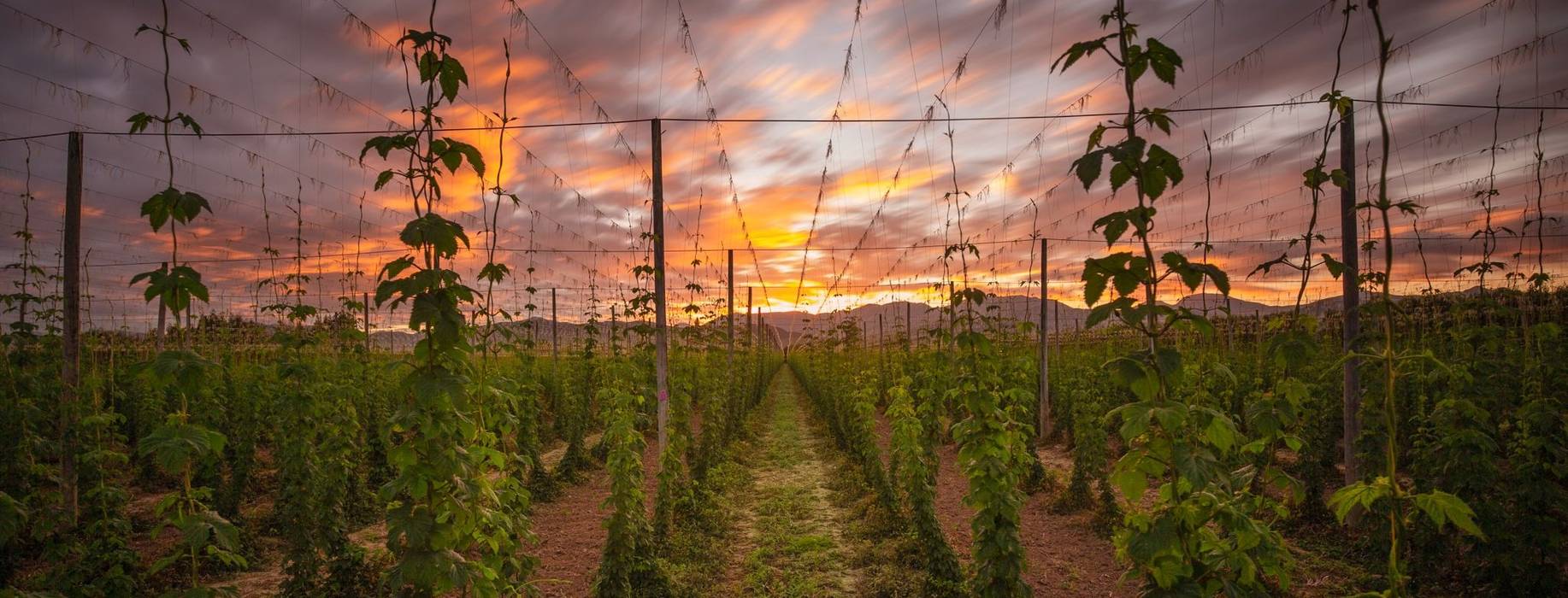
Kent, Sussex and Surrey, along with Herefordshire and Worcestershire, are historic and contemporary centres of hop growing in the UK, but they’re also “well placed to be a sustainable place to grow hops, probably the most sustainable place to”, according to Charles Faram’s technical director, Will Rogers. Innovation in the British hop growing industry isn’t limited to getting new, climate resistant varieties in the ground, but extends to seriously considering how these delicious, aromatic flowers can be grown in line with nature.
The past summer was a challenging season for hop growers to contend with. On one hand, the heat and drought created the perfect conditions in which to trial climate resistant hop varieties, but on the other they have called into question whether those conditions could even be repeated. After all, hot, dry weather may well be just one of many new weather patterns we’re likely to encounter with increased frequency in the future. “We're now not just talking about climate change as something that will happen in the future, it’s something that's happening now,” says Will. “It's too late to stop it, so what we need to work out now is how we can react to it better.”
This year, Charles Faram will be joined by two PhD candidates from the Royal Agricultural University, as part of a programme focused on sustainable hop growing practices. Both places will be funded by Asahi, the British Beer and Pub Association’s brewers research and education fund (BREF), and an unnamed UK supermarket. “Duncan Westbury, the dean of property and management at the Royal Agricultural University in Cirencester, came to see me. He — through another project he was doing — had been out to visit a hop farm and was surprised at the lack of biodiversity in the hop yards,” says Will. “We began discussing that as a possible project that we could look at together. But in the back of my mind, I was thinking about biochar.”
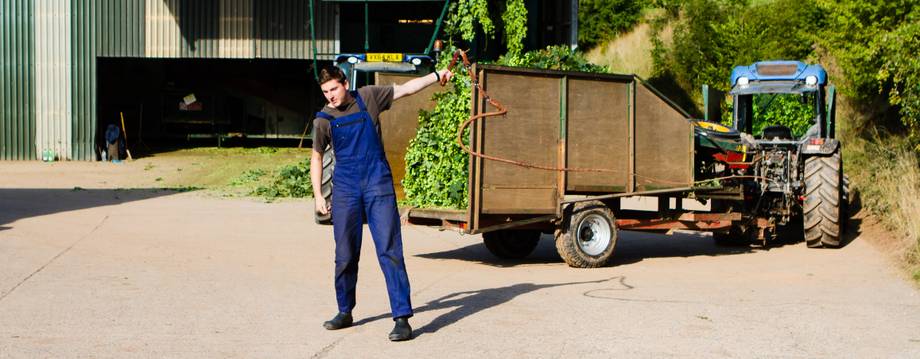
Biochar is a charcoal-based fertiliser with similar properties to terra preta, or Amazonian dark earth — a black soil, found in the Amazon, that developed as a result of indigenous communities adding charcoal to the soil. Terra preta is incredibly nutrient-rich thanks to properties that encourage a diverse microbiome in the soil, but its structure also gives this unique soil the ability to absorb and store nutrients in a way that prevents leaching into the surrounding earth. Of course, these soils are on the other side of the world, and take centuries to develop, but the properties that terra preta shares with biochar might just offer solutions to problems commonly experienced by hop growers.
“One of my issues with hop growing in general is that we tend to take away plant material and compost it, but we don't add it back onto the hops because we’re worried about spreading disease,” says Will. “Progressively over time, we're getting a reduction in the organic matter in the soil, and that actually creates disease problems in its own right. We call that root stress. So when I read about biochar, it made me wonder if there are ways we can re-incorporate organic matter into the soil, but without the risk of spreading disease.”
Primarily, Will is interested in the ability of biochar to absorb and store water — combatting drought — but also retain nitrogen and phosphates. All plants need nitrogen, but they tend to absorb it quite quickly and then release it slowly, when they die and break down into organic matter. Nitrogen fertilisers are a quick-fix solution if a plant is in dire need, but Will likens its application to hops as the equivalent of feeding a child a diet of pure sugar, and a multivitamin. “Yes, you’re giving them what they need, but they’re not healthy,” says Will. Biochar made him consider whether it would be possible to retain nitrogen that is added to the soil, and store the supply for when it’s needed by the plant.
“And, if you can encourage the right microfauna, in theory, we may even be able to create a microbiome that is antagonistic to some of the hop diseases,” Will continues. “So, you can see this is a really big project and we’re just the start of it, but the possibilities are really fascinating and potentially quite far reaching. We're looking at it specifically in hops, but it could potentially benefit a lot of other plants that need to be grown in a monoculture.”
In the meantime, Charles Faram has been encouraging the use of seaweed extract and molasses in place of nitrogen fertiliser, or, in an ideal world, cow manure. Neither are cheap, or logistically accessible to the majority of farmers, but these aren’t the only innovations that Charles Faram has been experimenting with.
“One of our growers in Herefordshire, Jimmy Barrett, has been working with a lot of biostimulants,” says Will, explaining that these are targeted mineral supplements that can support the health of the hop plant. “He had a field of Harlequin growing, and just before harvest, some highly localised hail swept across his yard, and the yard of a neighbouring grower. Harlequin plants are all cloned [taken from cuttings of a mother plant] meaning they’re genetically identical. They'd also been treated in very similar ways, apart from Jimmy’s use of this bio stimulant. Jimmy's Harlequin had no signs of bruising from this hail, yet on the other farm, the plants had a really hard time. He credits his use of this biostimulant which, in this instance, was a naturally occurring form of silicone, which the plant uses to strengthen its waxy cuticle on the outside of the hop. It’s really quite fascinating.”
Of course, all these innovations and technologies are only of help to adult plants, and can’t do much for seedlings — the focus of much of the brewing industry’s fervent interest. As mentioned above, all named hop varieties are clones of a mother plant, making them genetically identical, but their seeds are the product of a very intentional, structured, breeding process aimed at producing new varieties with the most desirable characteristics of both parent plants. To warrant being named, the resulting seedlings must meet a famously long list of criteria to get to the point of being planted, then trialled by brewers, then deployed in the fields at scale.
When last we spoke to Charles Faram, back in May of 2024, Buxton Brewery was brewing a series of single-hopped beers, all using experimental, yet-unnamed hop varieties on behalf of Faram’s. I ask Will if any of those varieties got any closer to being named, and he confirms that two of the hops used — CF321 and CF310 — will be planted at scale in spring of 2026. “We probably won't get much of a crop from the next harvest, but we'll get some more coming through fairly soon,” says Will. “These varieties will be named because we’ve planted up more acreage. But what I don't like to do is name them and then tell people they can't have them.
“We’ll leave hops as a numbered variety until we know we've got enough in the pipeline that everyone can have a go, because nothing knocks the confidence of the consumer like asking for something and being told they can't have it. We still have some brewers who don't think Harlequin is available to them, and actually, we've done a really big job of expanding that acreage pretty significantly so that everybody who wants to use it can. We still have people who ring up and say, ‘well, I know I can't have Harlequin, although I'd really like to use it’. And we have to say to them, ‘actually, you can have it if you want it. It's there. Please use it. We planted it. We need you to use it now.’”
That’s where you come in, dear reader. All this striving, experimenting, researching, propagating and planting depends on the end consumer asking for British-hopped beers at the bar. Immense effort, time, and resources have been poured into the production of a product that the British drinker enjoys and can be proud of.
“In the past, British hops were accused of being brown and twiggy with flavours to match, which I would dispute,” says Will. “However, we've now got these really intense, fruity flavours coming through that have more of a new world aroma and flavour profile, and it means we've really got something to shout about. It’s great to see that brewers seem to be excited about using British hops, and where previously we felt we were having to drive that change, now it feels like brewers, and indeed the end consumer, are wanting to see some of these products.”
Share this article
You’ve reached your limit of 5 free articles this month.
Unlock unlimited access and more

Join Beer52 and get your first month half price
-
Get your first box for £13.50 (RRP £27).
-
8 beers & 2 snacks delivered monthly.
-
Printed Ferment magazine included.
-
Unlimited access to all online content.