Ayrheads
Meet the Canadian master of making friends
Robyn Gilmour
Photos:
Willibald Farm Distillery & Brewery
Saturday 07 February 2026

This article is from
Faroe Beer Adventure
issue 127
Share this article
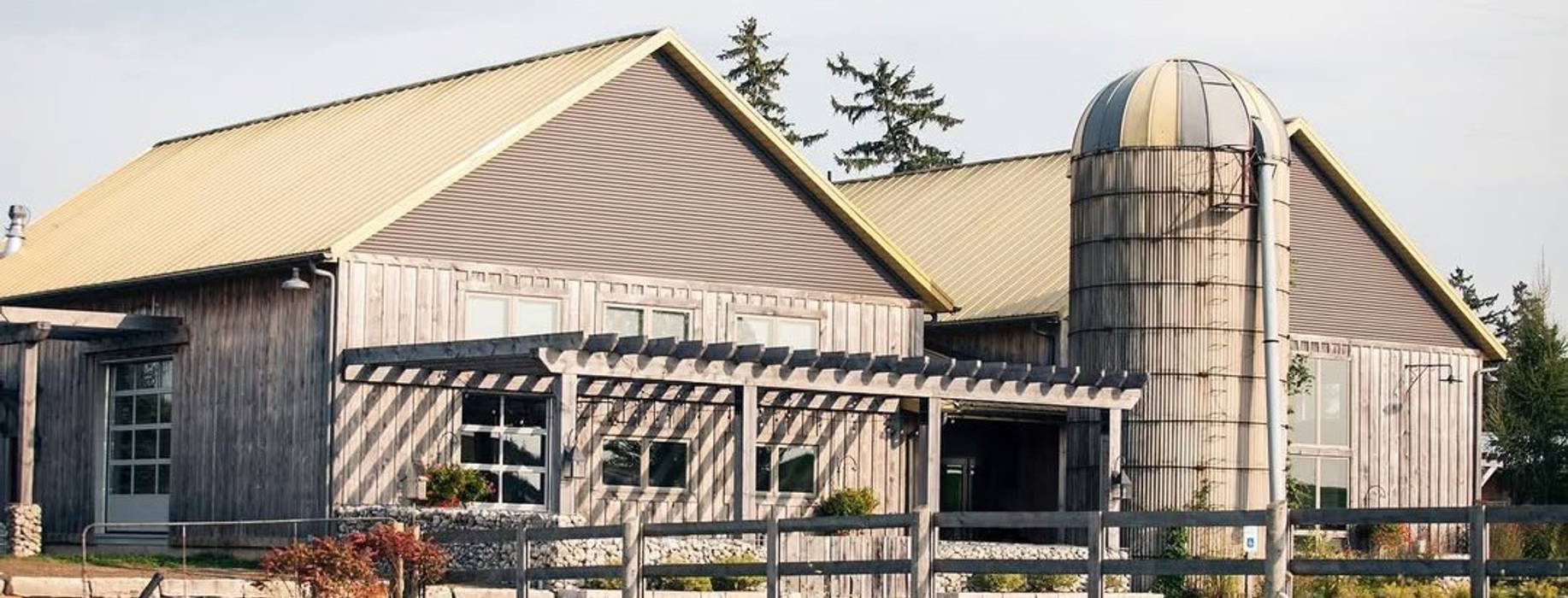
As head brewer Justin Clouthier tells it, Willibald Distillery, Brewery and Restaurant was opened by two brothers and a mutual friend — Nolan and Jordan Van der Heyden, and Cameron Formica — in 2017. The distillery came first, with plans to make whiskey being supplemented by gin production. Given its semi-rural location, in the small town of Ayr, Ontario — an hour-and-a-half’s drive from Toronto, on a 100-acre farm owned by the Van der Heyden family — the three founders added a restaurant to make the farm a destination for visitors. Like the gin, it was a roaring success, with folks making a day of visiting the distillery, taking on some local hikes, and picking up produce at neighbouring farms, before returning to the restaurant for something to eat and drink.
“There's also a conservation area just down the road,” says Justin. “A lot of people will head to town where there are lots of little boutique shops. Cambridge is only 10 minutes away, and it's an idyllic little town, with old churches, the river, all that jazz. But here at the brewery, we’re surrounded by beautiful farm fields and at this time of year the sun's still coming up when I get to work, which is so nice. And if you need a breath of fresh air when you're brewing, you can just step out into this beautiful setting.”
The brewery didn’t actually get going until 2019, when a good friend of the founding trio helped them establish that side of the business. In the years that followed, Willibald earned international acclaim as a master of hazy, hoppy, double and triple IPAs, which is the legacy that Justin inherited when he joined the business in early 2025. He’d previously been working at Escarpment yeast labs — a name you might know from its partnership with Lallemand on the Pomona yeast strain. Justin studied brewing in Toronto and worked in several local craft breweries before side-stepping to Escarpment, but as he tells it “I really missed brewing. I’d always held this brewery in high regard, so when this opportunity came up, I jumped at it.”
Justin says that “the yeast management side of brewing helps us kind of reduce costs and speed turnarounds a little bit quicker. We can get beer through a little faster, and just kind of help with a little bit more consistency. I used to think about those things before working for Escarpment, but I definitely thought about them a lot more while I was at the yeast lab.” What he doesn’t concede until later in our conversation, is that production has almost doubled since last year, and growth is forecast to continue. He doesn’t strike me as the type to sing his own praises, and so follows that statistic up with an appreciation for the talent and hard work of his colleagues.
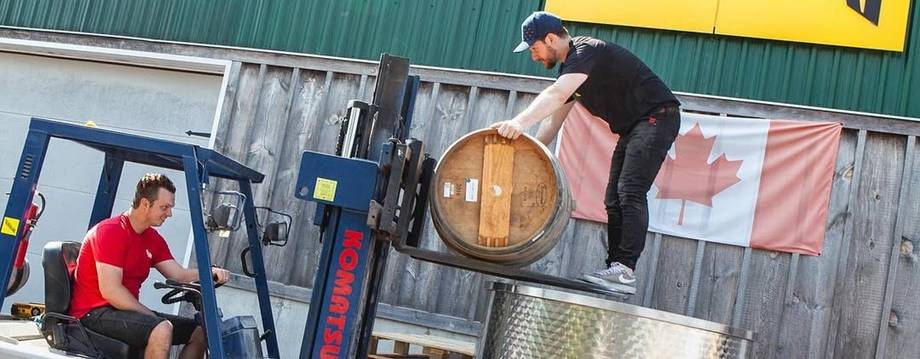
About 60% of production is still focused on the hazy, hoppy beers for which Willibald is best known, but a growing fraction of the remaining 40% has recently been in the field of lagers. Justin attributes this to the global craft beer market’s pivot towards more approachable, sessionable beers in recent years, but also credits Ayr’s proximity to Kitchener, Waterloo, which annually hosts one of the world’s biggest Oktoberfest celebrations outside of Germany. As such Willibald has started hosting its own Oktoberfest celebration, this year offering consumers an altbier, an Oktoberfestbeer, and a dortmunder, in addition to the helles and dark, malty lager that the brewery now offers year round.
“I think we've all been surprised by how well our malty lager has gone done,” says Justin. “When it was first around, people considered it something a little bit niche — people were really intrigued by the colour, and malty flavours — but now we're noticing a lot of people have started gravitating towards it as something easy-drinking but different. It's very approachable, so people are enjoying that.”
This 'brew it and they shall come' approach has served Willibald well on more than one occasion. The brewery started working with Freestyle Hops many moons ago, and over time has formed such a close relationship with New Zealand’s most esteemed hop supplier that on a couple of occasions it has helped trial its more experimental products. “I'd say they're a pretty good signature on most of our hazy beer,” says Justin, providing some backstory to Willibald’s decision to host a Freestyle Hops Festival, with some other prominent customers in the region.
“Some really exciting breweries that work with Freestyle came onto the farm and we had a big festival. It was pretty neat, and a number of people from Freestyle came out to be part of that, which was an amazing touch. One beer that we did was a dry hopped pilsner using Motueka hops from Freestyle, and it was such a cool beer. It tasted like a lemon lime lager, but in the best way. You still had that hop quality, but there was nothing artificial about the citrus character. Yeah, I think we'll probably be doing that one again.”
Justin says that New Zealand hops, alongside the likes of Citra and Mosaic, are probably the signature hops used by Willibald. As such, he decided to exclude these from Willibald’s recent take on a modern West Coast IPA, 519, which he wanted to stand alone from the rest of the range. Intrigued by the reinvention of this iconic style over the last number of years, I press Justin for more details.
“I think by the time West Coast IPAs reached their height and then eventually faded, they were kind of an extreme; very malty, quite sweet, really bitter, and just generally quite out of balance. I would argue that that’s not quite where the style started, even if early versions still had those components. And definitely in our province anyway, the style kind of stayed in that overly bitter category. But recently, I actually had an opportunity to travel to the West Coast of the United States and San Diego, and I was drinking the West Coast IPAs there, and I was blown away, because it was a completely different experience than what I’d had at home.
“That led me to kind of look at the style again and see what changes have been happening overall. The beers I drank in San Diego felt like everything had been pulled back a bit. I know a lot of brewers, including us, are now using pilsner malt instead of a two row malt to give the beer a nice, clean, light base, which means that when you do introduce the crystal malt, you need less of it to have an impact. It’s a little bit more subtle, but you do pick up the colour, you do pick up the flavours, it’s just not as aggressive, and it does allow for a lower finishing gravity, so it's a little drier than I'd say some styles were at one point.”
Where many modern takes and variations on the West Coast IPAs now include New Zealand hop additions, and incorporate more modern varieties into otherwise classic hop bills, Willibald’s rendition sticks to old-school, 'C-hop' additions: Centennial, Chinook and Cascade. These varieties, of course, are very much Yakima Chief territory, another hop supplier that Willibald works with closely. In fact, one of its listings with the regional retailer and distributor — the state-run Liquor Control Board of Ontario — is a 10% TIPA that was first brewed in collaboration with Yakima Chief to trial its new concentrated liquid hop product, Hyperboost, in Krush, a hop variety released just last year.
For now, innovation comes from Willibald’s relationships with its peers, growth is taking the form of a growing interest in lager, but additionally, the brewery has been working with a European distributor, to bring a little taste of Canada to other parts of the world. It’s hoping to export more in the future, but if you can’t wait until then, you can catch Willibald pouring at Mikkeller’s Craft Beer Celebration Copenhagen, in 2026.
Share this article
You’ve reached your limit of 5 free articles this month.
Unlock unlimited access and more

Join Beer52 and get your first month half price
-
Get your first box for £13.50 (RRP £27).
-
8 beers & 2 snacks delivered monthly.
-
Printed Ferment magazine included.
-
Unlimited access to all online content.