Life and death
Bringing a slice of grungy Americana to a German UNESCO heritage town, Sudden Death is driven by community spirit.
Richard Croasdale
Photos:
Sudden Death Brewing
Saturday 07 February 2026
This article is from
Faroe Beer Adventure
issue 127
Share this article
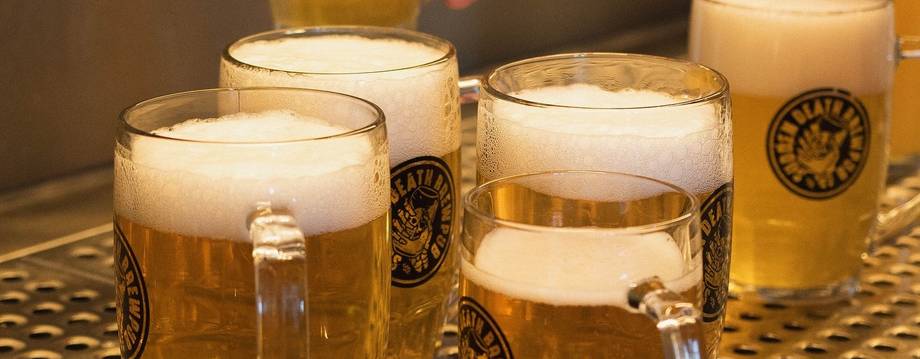
The Hanseatic city of Lübeck is a pretty imposing place, aesthetically, with Gothic steeples, stepped gables, and centuries of maritime culture worn very much on its sleeve. It’s also a bona-fide UNESCO World Heritage site, so a certain amount of historical fetishisation is probably fair play. In short though, Lübeck is the last place you would expect to find a brewery whose logo is a skull wearing a 1970s ice hockey goalie mask, á la Jason Voorhees from the Friday the 13th franchise. Yet here we are.
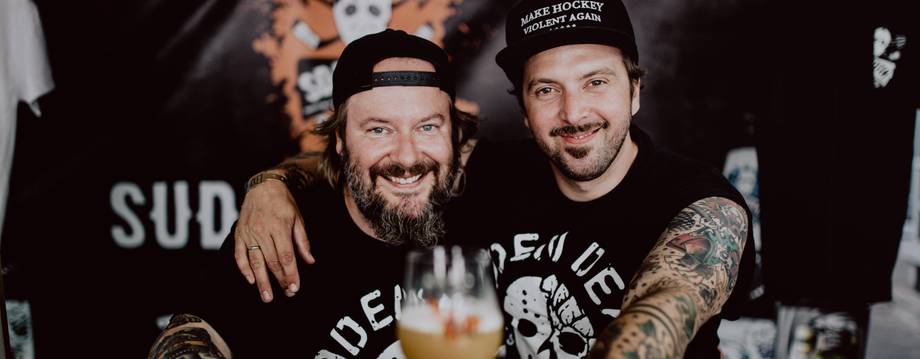
“People often don’t catch the hockey reference,” admits Marian Reed, General Manager & Head of Business Development at Sudden Death Brewing. “They still kind of figure out the brand though, because no matter how you slice it, Sudden Death fits into a variety of categories: rock and roll, hardcore, grimy cultural nostalgia…”
This dissonance between the brewery and its robustly Germanic home is intentional. Sudden Death wants you to know from the offset that it does not worship at the altar of the Reinheitsgebot, but belongs to quite another philosophical tribe. Founded by Olli Schmökel and Jan Eric ‘Ricky’ Nagel, two ice hockey fanatics from Timmendorfer Strand, the brewery was born not from the infamous German brewing purity rules, but from the penalty box.
In fact, Sudden Death’s origin story is practically American in its trajectory. In the mid-2010s, Olli and Jan Eric were making regular pilgrimages to the United States, largely to watch their beloved Boston Bruins play in the NHL. But between periods and post-game celebrations, they experienced a different kind of culture shock: the American craft beer explosion. In a tale as old as time, they returned home with a thirst their local beer traditions simply couldn’t quench, so took matters into their own hands.
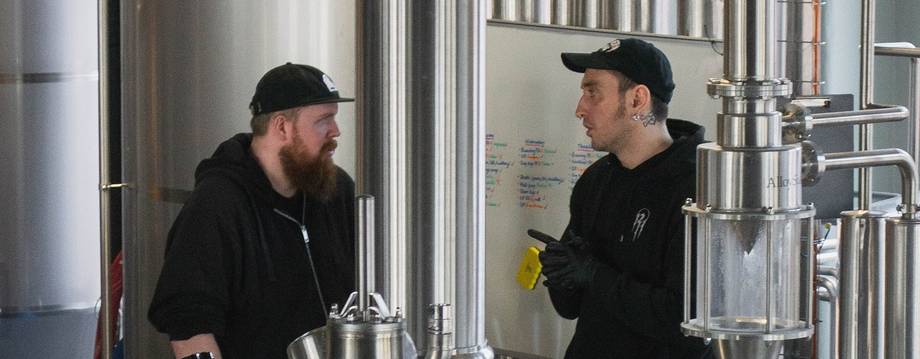
The pair started small, cuckoo brewing at various facilities across Europe, building a reputation for hop-forward, haze-heavy IPAs that were at the time quite alien to the German beer palate. The brand was fully realised by 2017, but it wasn't until 2022 that the pair were ready to open their own bricks-and-mortar facility.
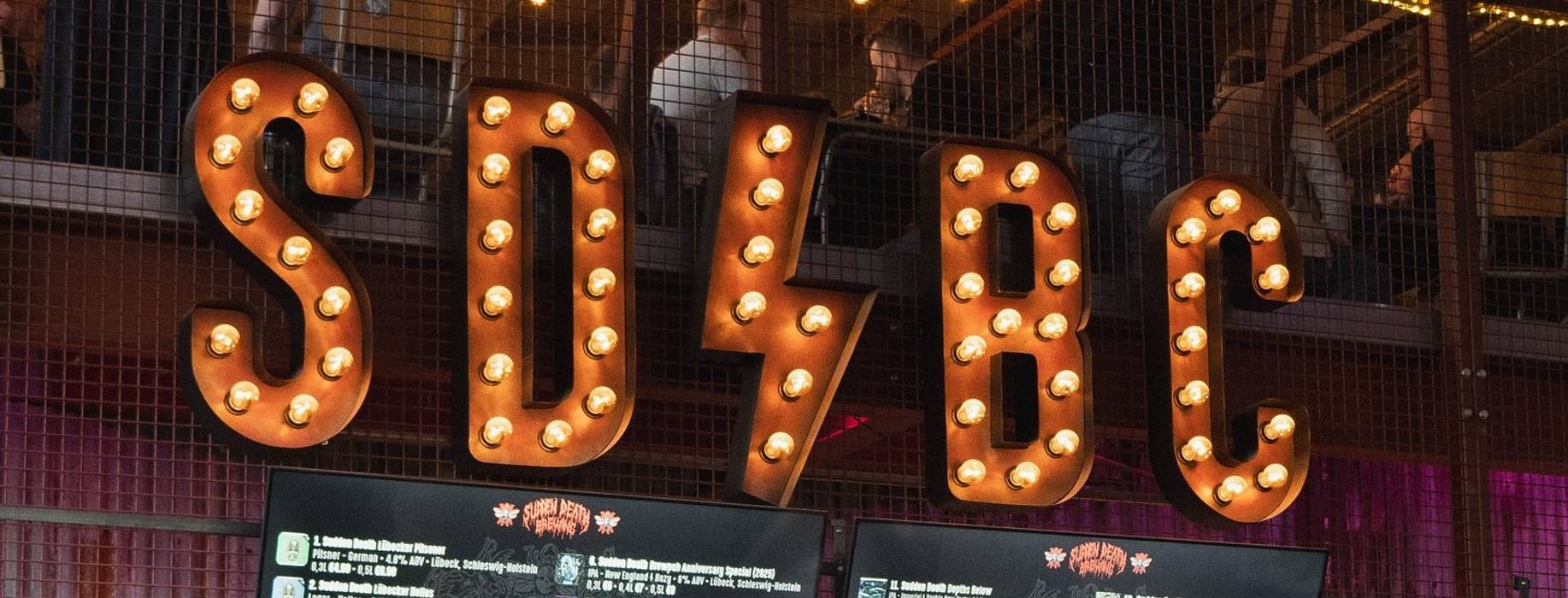
Sudden Death’s new site matched its ballsy branding: Hall 48 at the Kulturwerft Gollan. Located in Lübeck’s historic shipyard district, the venue is a cathedral of red brick and steel, formerly used for heavy industrial manufacturing. Today, it houses a gleaming brewkit, rows of fermentation vessels, and a taproom that serves New York-style pizza alongside double dry-hopped IPAs. Its roots couldn’t be clearer if they pinned a stars-and-stripes to the brewkit gantry.
THE DOUBLE LIFE
To survive as a modern craft brewery in Germany requires a kind of double life. On one hand, you have the domestic market; conservative, price-sensitive, and deeply loyal to traditional styles like helles and pilsner. On the other, you have the international scene; hungry for novelty, willing to pay for premium craft trappings like cold-chain distribution, and constantly chasing the next fashionable style.
Sudden Death has done well playing both sides of the ice, so to speak. Locally, it brews the Lübecker line – a Pilsner, a Helles, and a Zwickel – crisp, accessible beers that allow it to function as a ‘normal’ brewery for the locals who wander into the shipyard looking for a drink.
“The Gastropub in Lübeck, which opened in 2022, is a great connection to the city,” Marian explains. “Lübeck is a relatively small city, around 220,000 people. Everyone comes in, and even less traditional craft beer drinkers are still delighted that there is a brewery in town.”
But to feed their creative ambition, and their bottom line, Olli and Jan Eric have always taken an international outlook, both in terms of their brewing and their target customers.
“If we went too far into traditional German styles… other breweries do those things really well,” Marian says. “That was never the ambition of the owners. Running a craft brewery in Germany is a challenge. If you’re looking at who drinks your beer… it’s going to be very well connected to your local community, but we have to look internationally for our place in the landscape.”
For example, this international outlook recently took Marian and head brewer Nathan (a Montreal native) to China, for the Mikkeler Beer Celebration Beijing. It was a stark reminder of how different the energy is outside of Europe’s heritage-heavy beer culture, even on the craft side of the fence.
“I think Europe, generally, tends to be a bit less of an experimental market,” Marian observes. “You have these gorgeous, entrenched beer communities in the UK, Belgium, Czech Republic, Germany, and they’ll all experiment within certain parameters. But when it comes to really aggressively pushing the boundaries of what craft beer means, Europe is largely not at the forefront.”
In Asia, she found a scene reminiscent of the US in the early 2000s, in that it is a little chaotic, but endlessly enthusiastic, and completely unburdened by tradition. Marian cites Sudden Death’s collaboration with Heroes Beer Co in Hong Kong as a prime example, involving salted fish and fermented mead. “It tasted like a minerally biodynamic white wine. It was delicious,” she laughs. “For our head brewer, coming from Montreal, and me from Philadelphia, this was what we miss about North America. That you have these completely radical approaches.”
Back in Lübeck, Sudden Death channels this energy into releases like We Only Come Out At Night, a collaboration with Indiana’s 450 North Brewing. It’s a fruited smoothie sour packed with coconut, orange, guava, strawberry, and lime; a beer that is technically audacious, visually opaque, and about as far from the Reinheitsgebot as you can get without being chased through those appropriately gothic streets with torches and pitchforks.
A MORE SETTLED CRAFT
For all this hunger for experimentation though, Marian recognises the global craft brewing movement has undergone a subtle but profound shift during the five years that took in Covid.
“The rock star era is pretty much over,” she says with a shrug. “Now it’s really back to its roots of being a community-driven culture. Having the brewpub really helps to get your feet in the ground, which is exactly where we want to be.
“The owners aren’t interested in building a brewery to sell; this is their life. It’s very German of them in that regard. They are brewery owners, and that’s what they see themselves doing until they can’t work anymore. So when you have that in mind as your end goal, you’re not looking to dash into things, and you value stability and community over hype.”
It’s nurturing this local community that is set to shape the coming years at Sudden Death. After the chaos of navigating supply chains through wars, pandemics and the ripples of Brexit, the goal is to cement the brewery’s status not just as a cool export brand, but as a Lübeck institution.
“It’s our fourth year of having the venue, and that feels like a milestone in itself,” says Marian. “First two years are a wild ride. Third year, you take stock. Fourth year is where we really want to entrench ourselves here… I was the general manager of a Danish brewery through COVID, and the one lesson emblazoned in my brain is that you have to take care of your home market. That is who you are. That is where you’re from.”
It turns out that even for a brewery named after a hockey game’s most brutal climax, the long game is the only one that matters. The branding might be a little on-the-nose, even for a US-style craft outfit in a traditional German town, but the ethos here is utterly grounded. Sudden Death is building a community, one pint of pilsner – and one can of smoothie sour – at a time.
Share this article
You’ve reached your limit of 5 free articles this month.
Unlock unlimited access and more

Join Beer52 and get your first month half price
-
Get your first box for £13.50 (RRP £27).
-
8 beers & 2 snacks delivered monthly.
-
Printed Ferment magazine included.
-
Unlimited access to all online content.