Not with haste
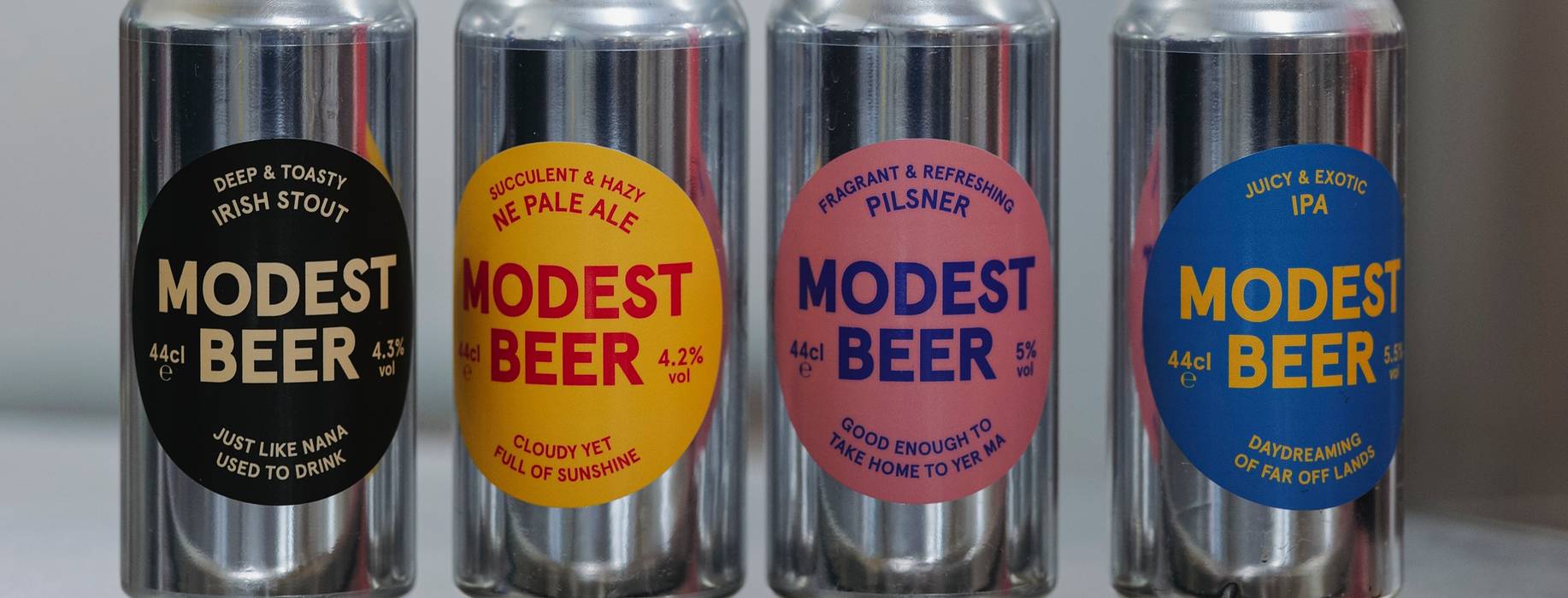
Meet Modest Beer, a relatively new addition to Northern Ireland’s burgeoning beer scene, but one which punches above its weight.
Robyn Gilmour
Photos:
Modest Beer
Saturday 04 April 2026
This article is from
Northern Ireland
issue 129
Share this article
“I was the sort of homebrewer who, rather than jumping between styles and ingredients, was more into tweaking,” says Chris Morris, founder, director, and head brewer of Modest Beer. “You can look back through my old notebooks and find a recipe for ‘Bohemian Pilsner Version 19’. Playing around with water chemistry and hop profile, and really honing in on a recipe then trying to perfect it was the sort of thing I enjoyed.”
This tells you a lot of what you need to know about Chris, and indeed Modest Beer, the Bangor-based brewery, born in 2019, which Chris and his wife Lauren run between just the two of them. His meticulous, consistent approach to most things meant that when Chris graduated from homebrewer of ten years, to commercial brewer, he knew what he was getting into. By this I mean, he was well aware of the challenges of brewing beer in Northern Ireland.
Once introduced to independent beer, Chris — then an accountant — pretty quickly started homebrewing, with the only gap in his homebrewing resume being when he moved to London for a year, in 2014. It was there Chris experienced taproom culture for the first time, and indeed what an independent beer scene looked like. He wondered why there weren’t more small, independent breweries in Northern Ireland and, in his own words, "naively" returned home with a view to filling that gap in the market.
It didn’t take him long to identify the many obstacles to operating as an independent brewery in Northern Ireland. With new eyes, Chris could see that most pubs were either tied to bigger breweries or stocked only international, macro brands, and that these often predatory partnerships were needed to patch holes in the pockets of publicans who had exorbitant sums tied up in inaccessibly expensive alcohol licenses. With these license holders being the only route to market for independent breweries, revenue streams for the latter were precarious.
“I put the idea of ever opening a brewery on the back burner once I looked into what opening a craft or microbrewery in Northern Ireland might look like,” says Chris, whose impetus to open a brewery, or at least do something more substantial with his love of brewing, was such that it could be discouraged but not quelled.
I think a big part of my inspiration, and motivation to open a brewery, actually had nothing to do with beer or brewing
“The longer winded back-story of all this is partially that my brother is a chef and, in 2016, he started his own restaurant,” says Chris. “I think a big part of my inspiration, and motivation to open a brewery, actually had nothing to do with beer or brewing — it was seeing him take a passion of his, and bring his own personality and offering to the market. He put the seed in my mind that it's always possible.”
Chris kept homebrewing, eventually earning a reputation as the beer-guy among friends. It was his infectious passion for beer that made a childhood friend — then a graphic designer in Bristol — reach out to ask if Chris would brew some beer for a restaurant he was helping to open. The 60L order — Chris’ first commercial deal — was just about manageable from his garden shed setup; the only barrier to fulfilment was the paperwork.
“That's when I had to register my garage with HMRC as a brewery,” he says. “To pay the beer duty, I had to inform environmental health that there was going to be a food business operating. I was basically going through the same amount of red tape that I had to do when we moved here to a proper commercial brewery. It was horrendous and I thought to myself ‘I'm never doing that again’.” Spoiler alert; he had to do it again. Thankfully, the brewery’s most recent move to the 1200 square foot site where it now produces 180,000 litres a year should be home for the foreseeable. But that’s getting ahead of ourselves.The registration of the garage as a brewery in 2019 — the official birth of Modest Beer — coincided with the Northern Irish government announcing that, after years of campaigning by small independent breweries, it would create a new category of license that would allow for alcohol producers to sell direct to consumers. Until then, a brewery’s route to market had to be through a third-party license holder, meaning breweries couldn’t operate taprooms as an extension of their business, conduct on-site tastings, or operate a webshop.
“The promise of that producer's licence sort of lit my eyes up a little bit and I thought, ‘well, it might take a year or two to get going, but if I can sort of get a brand out there and start building the customer base, when the producer's license does come into effect, I'll be able to hit the ground running’,” says Chris. “As it happens, the process of creating that new license ended up taking nearly three years, and when it did come into effect, in 2021, it was a very watered down version of what we had hoped for as breweries.”
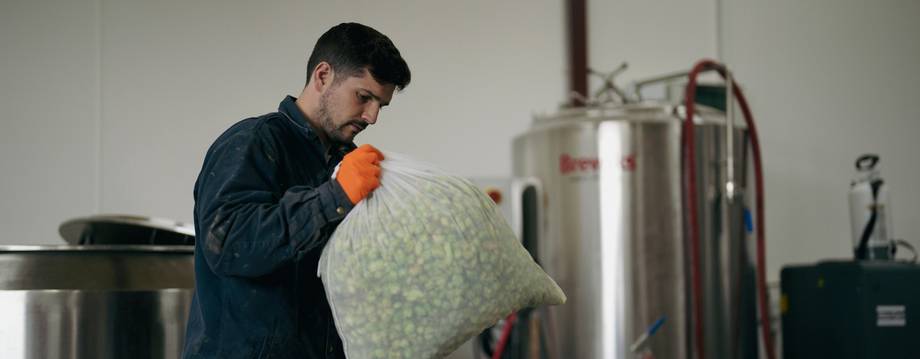
PHOTO: Chris Morris, founder of Modest Beer
The conflict that delayed the release of producer licenses essentially unfolded between producers and Hospitality Ulster, a trade body representing the hospitality sector in Northern Ireland. Yes, that’s the hospitality sector entrenched in the politics of international, macro brands, and for which, according to Hospitality Ulster, brewery taprooms would be a threat to business. The resulting producer’s licence did not allow for the unrestricted operation of a taproom; instead producers can operate for 12 hours a week, between the hours of 4pm and 10pm, on 104 occasions per year, all of which have to be outlined and submitted to the courts for approval at the beginning of each year.
That essentially allows breweries to operate temporary taprooms two days a week over the summer, if they close in quiet winter months, and get their operating schedule approved by the courts a year in advance. For many small independent breweries, these restrictions mean any taproom would make a loss if opened, so most can only use aspects of the producer's license that pertains to e-commerce and on-site tastings. You can see why Chris was reluctant to take the plunge. But take the plunge he did. Today, Chris co-chairs the newly-formed Northern Irish chapter of SIBA with Bullhouse Brew Co director William Mayne.
The most recent development in the evolution of Northern Irish licensing came in 2023, when the Department for Communities was legally required to commission an independent review into licensing laws. This mandate was part of an amendment made to Northern Ireland's Licensing and Registration of Clubs Act in 2021 after extensive lobbying by SIBA (representing producers), CAMRA (representing consumers) and Free the Night (a charitable organisation campaigning for nightlife in Belfast), among others. The review was conducted by the University of Stirling, and outlines ways in which Northern Ireland’s licensing laws fail to reflect modern social, economic, and public health needs. It was submitted to Minister for Communities, Gordon Lyons, in late 2025, but its findings and recommendations were essentially disregarded. At the time of writing, Free the Night has submitted a notice of intent to seek judicial review of how these findings were handled.
“It's part of the fun of it,” Chris says drily, after I acknowledge how exasperating the situation sounds. “I hate complaining about licensing, but you find yourself there all the time. We all love making great beer. It's a cool industry to be part of. Is it restrictive and does that make it difficult to operate? Yes, but at the same time we're still here. Nothing happens quickly or overnight. In 2019 I was hoping for something that still hasn't arrived, seven years later, but at the same time, there's been enough change that maybe, if we keep at it, it's something that our grandkids can enjoy.”
Share this article
You’ve reached your limit of 5 free articles this month.
Unlock unlimited access and more

Join Beer52 and get your first month half price
-
Get your first box for £13.50 (RRP £27).
-
8 beers & 2 snacks delivered monthly.
-
Printed Ferment magazine included.
-
Unlimited access to all online content.