The mother superior
In celebration of this month’s theme, Siren Craft Brew has brewed its Time Hops Simcoe 2.0 beer with 2025 Simcoe that head brewer Sean Knight personally selected in Washington state.
Robyn Gilmour
Photos:
Yakima Chief Ranches
Saturday 02 May 2026
This article is from
Siren Time Hops
issue 130
Share this article
"I think at the time, given what they were doing here at YCR, Simcoe was looked at as being a bit disruptive,” says Mikaela Perrault, brand identity manager at Yakima Chief Ranches. She’s also the daughter of Jason Perrault, head breeder at Yakima Chief Ranches.
When Simcoe was released, in 2000, the target clientele of Yakima Chief Incorporated was global, macro breweries like Heineken and AB InBev. At that time, smaller, independent breweries were catered to by a company called Hop Union. These two companies merged in 2014, becoming the grower-owned entity now globally known as Yakima Chief Hops, but in 2000 Yakima Chief Incorporated was primarily interested in alpha (bittering) hops that were best suited to classic categories, predominantly lager.
It therefore wasn't completely unreasonable that Simcoe was bred to be a dual-purpose variety — a hop that can effectively be used to bitter beer but also carries some aroma. Its breeder, Chuck Zimmerman had worked for the USDA as a Hop Research Scientist for many years prior to branching off and starting his own private breeding program in his backyard. Chuck’s path first crossed with the Perraults’ when Steve Perrault — Mikaela’s grandfather and the current owner of Perrault Farms — offered him ten acres of land to expand his breeding program.
“Chuck planted the first field of Simcoe at Perrault Farms on row two, hill 56, here in the Yakima Valley,” says Mikaela. “Simcoe was bred to be a dual-purpose hop with a high-alpha contents and unique aroma profile, but that aroma was too powerful for many macro lager breweries and so Simcoe was rejected by many of them,” Mickaela continues. “This was prior to the craft beer boom, when the market for flavour forward beers was almost non-existent. Once West Coast IPAs took off, and Vinnie [Cilurzo of Russian River Brewing Company] started using Simcoe in Pliny the Elder, it really started to see success. Looking back now, Simcoe was simply before its time.”
This neat summary, while accurate, doesn't quite do justice to how precarious Simcoe's future was at one point. “Simcoe wasn't like a European landrace variety; it wasn’t that classic floral, spicy, grassy-type hop that was so widely accepted,” says Joe Catron, global brand ambassador at Yakima Chief Ranches. “It was a little bit more intense and a little bit more like in your face… we basically couldn’t give it away. Nobody wanted it, and they ended up destroying a lot of the crop.” Simcoe steadily dwindled from 12 acres, to five acres, to three acres.
“I think they were down to one acre from ten when a couple of pretty influential craft brewers picked it up and started using it in some pretty famous beers,” says Joe. “It really established that West Coast IPA profile, which at the time was being led by those piney, pungent, fruit-forward hops like Simcoe. So, while Simcoe isn’t solely responsible for the West Coast IPA style, it's definitely one of the early contributors to a beer that still dominates craft today.”
Simcoe was not only saved from extinction, but launched into stratospheric success, becoming one of the beer world’s most ubiquitous hops. But behind its odds-defying turnaround was a team pounding pavements and going door-to-door for Simcoe. In a short documentary-style video made last year by Yakima Chief Ranches in celebration of Simcoe’s 25th birthday, Lagunitas head brewer Jeremy Marshall can be heard saying; “Simcoe was being marketed as an unusual, new-age hop. When you got that around traditional lager brewers, they couldn’t get past the smell. So what we were being told is, ‘all the reasons that you dislike it should be the reasons that you like it.’”
That, needless to say, is a very hard sell, but it worked, not only at drumming up market demand for Simcoe but opening brewers’ minds up to how they might use it, and by extension, how growers treated it in the field. “Alpha varieties are typically left to hang on the bine until the end of harvest because you're really not focused on flavour, and alpha acid production continues to increase as the hops continue to hang. So with Simcoe, it has really gone from being a mid-to-late harvest hop to now being oftentimes one of the first or second hops picked when harvest starts. These days, Simcoe is almost being treated more as an aroma hop and that has changed how we interact with the plant itself.”
Simcoe is so versatile in so many different recipes, because it does change
Now, strap in for this part, and think about how Simcoe’s story compares to Jester’s, which is outlined on page 20. Joe goes on to say that where Citra and Mosaic have a picking window of roughly six to eight days and can go from optimum ripeness (bright, tropical, citrusy) to overripe (cat pee, onion and garlic) over the course of a weekend, this doesn’t really happen to Simcoe.
“Simcoe doesn't really fall off a cliff like that,” he begins. “It doesn't really go OG (onion, garlic). It definitely evolves, so our picking window for Simcoe is actually 10 or 11 days, as opposed to most varieties, which need to be harvested within six days to eight days. The profile of Simcoe does change throughout harvest, but we've done a really good job of tracking brewers’ preferences when they come to do selection in the last few years, so we can connect them with the profile they like. Simcoe is so versatile in so many different recipes, because it does change, but it's a monitored change.”
Simcoe’s versatility has been embraced to the extent that breeders chose to preserve this characteristic in the genetics of Mosaic, Simcoe’s daughter — another hop that has found incredible success since its commercial release in 2012. Motherhood, however, has by no means marked the end of Simcoe’s story. Just prior to its 25th anniversary, Yakima Chief Ranches began an ambitious, long-term project to refresh the rootstocks of all 3000 acres of Simcoe currently being grown across Washington, Oregon and Idaho.
Joe explains that when hops are left to their own devices, perennial roots put out shoots, grow bines, sprout leaves, bloom, then draw all carbohydrates in the plant back into the roots for the winter, causing the portion of the plant above ground to die off. When hops are farmed, the portion of the plant that’s above ground is harvested before the plant can draw those sugars back down into the roots, and so over time, the roots will tire and become more susceptible to disease and pests, all of which affects yield.
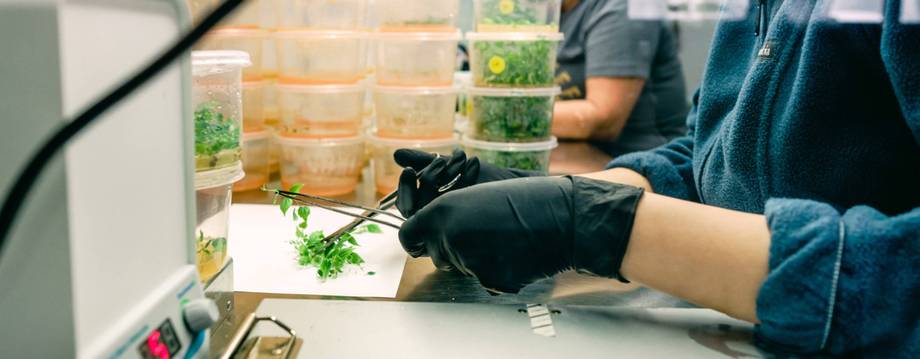
Compounding this; in Simcoe’s heyday, demand was such that growers needed to deploy plants in the field quickly, and the most efficient and cost effective way to do this was to take root cuttings — meaning small portions of the roots are cut away from the main plant and encouraged to grow as an independent plant. This technique can also facilitate the spread of disease, owing to the fact that the same plant material, with the same genetics, is being cloned over and over again. Joe says that YCR is aware of how vulnerable this leaves Simcoe and its growers, so a refresh of root stocks feels like an investment that will pay dividends over time.
“One of the few silver linings of the brewing market slowing down these days, is that it’s allowing us to get our ducks in a row when it comes to propagation and using our relatively recent capacity of doing viral therapy in-house,” says Joe. “That looks like our lab experts using a technique called meristemming to create virus-free plants and the best planting material you can get. So instead of just trying to chase our tail and keep up with demand, we're able to be more systematic and be more methodical in ensuring that we're giving the best plants possible to our growers and helping them get the best start in their new fields.”
Throughout our conversation, Joe continuously refers back to the hard work of growers — the true owners of Yakima Chief Hops — and how the work carried out by Yakima Chief Ranches is always intended to support them. “I like to say that YCR is the house that Simcoe built,” Joe begins. “Our impact in the industry is something we're really proud of. That's not just speaking as a hop breeding company, but as contributors to the overall health of the industry. Our work supports so many family farms in the Pacific North West and thousands of breweries across the globe. Seeing the impact that we've made for our growers and our brewers is inspiring. It's still fun to come to work every day.”
Share this article
You’ve reached your limit of 5 free articles this month.
Unlock unlimited access and more

Join Beer52 and get your first month half price
-
Get your first box for £13.50 (RRP £27).
-
8 beers & 2 snacks delivered monthly.
-
Printed Ferment magazine included.
-
Unlimited access to all online content.