Old dog new tricks
Siren’s Time Hops series has taken drinkers back in time and around the world, but the project is also an exercise in imagining different histories and new futures.
Robyn Gilmour
Saturday 02 May 2026
This article is from
Siren Time Hops
issue 130
Share this article
The stories of so many varieties in the Time Hops series detail false starts, near misses, and rediscovery. Cascade was commercially released in 1972, but was considered to have too ‘wild’ a character for effective use in ales until 1980, when Ken Grossman began using it in Sierra Nevada Pale Ale. When Simcoe was released in 2000, brewers didn’t know what to do with its bold grapefruit aroma, resulting in a reduction in acreage within its first few years of life. A dip in the quality of Galaxy in 2019 almost tanked the Australian hop industry but major investment and the decision to homogenise crops has more-or-less restored the hop to its former glory. Today, we regard these hops as having stood the test of time, but at various points in history, it looked like they wouldn’t.
You’d think that with the time and distance to appreciate the stories of these hops, we’d be a little less inclined to take it as axiom that if something hasn’t worked before, it’s unlikely to work now. How often do we revisit hops released long ago and consider how we might use them differently now? What varieties might we look back on, in a decade’s time, and think of as having had a false start, a near miss?
“Jester is very dear to us here. I would say the market hasn't always loved Jester, but we have a real fondness for it,” says Will Rogers, technical director at Charles Faram, reflecting on the origins of this integral variety in modern British hop breeding. Commercially released in 2013, Jester straddles the old guard of traditional British hops — known and loved across the world for their spicy, herbal and floral contributions to classic ales — and its newest generation, which strives for the big, punchy, tropical character popularised by New World hops. Unfortunately, while Jester plants also exhibited qualities that may well be imperative to the future of hop growing, we didn’t quite know how to work with it at the time of release. “In some ways, its strength was also its downfall,” says Will.
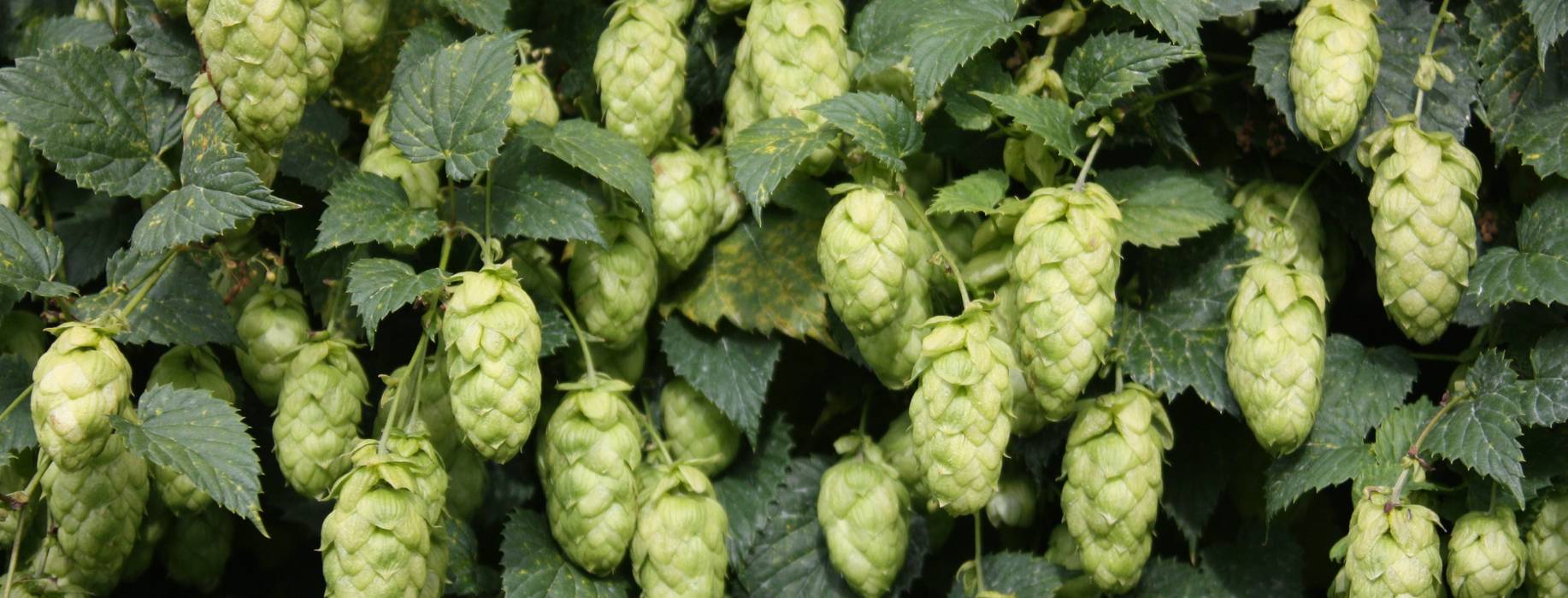
But before we get to why that is; some context. Though Cascade found fame on account of its piney, resinous, citrusy presentation in beer, it was developed by the USDA in part to resist downy mildew, a fungal disease that can affect a variety of plants grown in cool, wet climates. Coincidentally, Cascade also inherited a partial resistance to powdery mildew from its British ancestor, Fuggle. In fact, being the product of Fuggle and a Fuggle Serebrianka cross, Cascade is two-thirds British, which is why it grows with relative ease in the UK. It’s mainly the difference in latitude that makes US and UK varieties of Cascade more sisters than twins.
We'd be doing Jester, and indeed British hop growers, a massive disservice if we let that be the end of its story
“Cascade likes our climate, but it ripens extremely late here,” says Will. “It’s quite an early variety in the US, usually being picked in September, but because we're further north than Yakima, our daylight length means that Cascade should be ripe in mid-October. We really can't guarantee good weather for picking and drying by then so although we do grow some Cascade here, one of the reasons why it is milder in character is because we are picking it right at the earliest point in its picking window.”
So, the focus of Charles Faram’s breeding program, back in the early 2000s, became producing a variety that would express the characteristics of Cascade but mature within the UK’s regular picking window. “We took a male that ripens early — it's actually a hedgerow, low trellis male with really good disease resistance, and I mean class leading disease resistance — and we made the cross,” says Will. From seeds of the resulting plant came Jester, Olicana, and the Czech variety Most — an unheard of hat trick in the world of hop growing — and it had the desired effect. Jester ripens towards the end of September, carries a distinctive citrus, blackcurrant, and subtly tropical note, but crucially to its story, it maintains all its parents’ disease-resistance characteristics.
“Jester’s cones are so firm, and the plant so strong, that the hops show no sign of deterioration for a three week period,” says Will. “For context, Sovereign has a picking window of two or three days — if you pick it too early you get almost no aroma, and if you pick it too late all the cones shatter in the picking machine. Most varieties have a picking window of about a week, but what we found with Jester is that you can harvest a crop that looks and smells brilliant over a three week period. So, when we first started growing it, we planted it all up, the growers did their best, but because the cones were so robust for so long, they were picked around other varieties. So growers would pick some Jester, then spend the next day picking Goldings, then pick some Jester, then harvest Challenger. What we know now is that although Jester cones exhibit no signs of stress or deterioration for a three week period, its flavour and aroma profile — as it exhibits itself in the brew — changes over that time.”
PHOTO: Pellicle
Will says that Jester’s release was met with great enthusiasm from the British brewing world, but that excitement surrounding the new variety soon deteriorated into confusion; some breweries reported the desired citrus and blackcurrant in brews using Jester, while others claimed a more herbal character came through strongest, or even that a dank, rubber tire quality, could be detected. “The acreage had grown exponentially by that point, but we had to start pulling it back,” says Will. “We've reduced the acreage again since, but have also learned more about how to treat the plant and when to pick it. It is far more consistent now, growing on a smaller acreage, it's not being squeezed in between other varieties, so it is more consistent and has sort of stabilised its position in the market.”
That is Jester’s story; as Will tells it, we needed more time than we could have anticipated to fully understand Jester, it didn’t meet brewers’ expectations and fell from grace accordingly. Issues with Jester have since been corrected by essentially disregarding how long the hops look good for, and instead picking Jester at a point that yields predictable outcomes, namely blackcurrant and grapefruit aromas. He places no blame on brewer, grower, or drinker, instead viewing Jester — at one point in time — as having been in the right place at the wrong time. Jester’s story is by no means a tragic tale, its strengths live on in the likes of Mystic, Harlequin and Godiva, all of which are daughters of Jester, but it didn’t get the flowers it deserved. Pun intended.
That said, we’d be doing Jester, and indeed British hop growers, a massive disservice if we let that be the end of its story, or at least didn’t probe at this narrative with new perspectives. For instance, if we saddle Jester up next to American variety Mosaic, striking similarities and differences emerge that offer a new lens through which to view Jester. Mosaic was commercially released in 2012, just a year before Jester, and was lauded as a hop that everyone could detect something different in — it was a mosaic of flavour and aroma, hence the name.
“Mosaic has always been variable, but blueberry and bubblegum used to come up a lot in what you should expect,” says Sean Knight, head brewer at Siren Craft Brew. “You can also get a lot of dankness, some sweaty gym sock, and a bit of what’s called OG — meaning onion and garlic. With Mosaic, if that OG is detectable at a low level, it's usually a good thing, as it tends to correlate with elevated levels of other oils. You almost want a little bit of that OG as long as it's not overpowering because it means you’re also going to get that blueberry and bubblegum character.”
For him, Mosaic's versatility and understatedness has never been a weakness
Mosaic unquestionably had a sustained period in the spotlight and is still going strong, but Elusive Brew’s Andy Parker points out that since 2012, other hop varieties have come up around Mosaic that have highlighted what it’s not. “Mosaic has always been there, and has always been a steady hand, but it’s not high impact,” he says. “It’s slightly citrusy, slightly everything really, but it's not high impact.” Andy, for the record, is a great champion of Mosaic, using it alongside Citra and Cascade as a core hop in Elusive’s range. For him, Mosaic’s versatility and understatedness has never been a weakness, but a strength to be played to and utilised in clever ways.
Where most breweries tend to layer Mosaic on top of other hops, Andy has found that dark malt can also provide Mosaic with a stage upon which its citrus and blueberry character can shine. You can see this in the Black IPA — a style beloved by Andy — that Siren, Elusive, Bearwood and Double Barrelled have collaborated on for their Time Hops Mosaic beer. This is the only dark beer in the Time Hops series, and the sister of Time Hops Jester, the other beer in Siren’s Time Hops III range.
In Siren’s first Time Hops series, back in 2022, the brewery told the story of Citra and Mosaic together in a 7% IPA, precisely for the reason that Mosaic works best in partnership with another hop. Now, in 2026, Time Hops Citra and Time Hops Mosaic are separate beers, precisely because time has moved on, drinker tastes have changed, and Siren is older, wiser, and well positioned to experiment with new ways in which to play to the strengths of established hop varieties. (read more about Time Hops series from Siren)
In 2013, brewers were willing to roll up their sleeves and experiment with Mosaic in a way they weren’t for Jester. The difference, of course, is that Mosaic was marketed as a versatile hop, where that capability in Jester was yet to be discovered. As a result, brewers knew what to expect from Mosaic, the growers knew how important selection would be in connecting brewers with the kind of Mosaic they’d enjoy best, and hop merchants were on hand to support and advise on the best way to get the desired characteristics out of the brew. This couldn’t have been replicated in the first few years of Jester’s life, but if we could travel back in time with the knowledge we have now, could Jester’s story have been more like Mosaic’s? Can we better play to Jester’s strength, even today?
For better or worse, the tastes and trends that drive change within the beer world are all about timing, and what sticks or slides with drinkers, brewers, or hop growers at any given moment. Hindsight is 20/20, and it’s impossible to recognise and appreciate change as it's happening, but somewhere between those two truths, there’s space for us to rediscover hops that have been growing under our nose all along.
Share this article
You’ve reached your limit of 5 free articles this month.
Unlock unlimited access and more

Join Beer52 and get your first month half price
-
Get your first box for £13.50 (RRP £27).
-
8 beers & 2 snacks delivered monthly.
-
Printed Ferment magazine included.
-
Unlimited access to all online content.