Interstellar Brewery: Worlds apart
At Toluca-based Interstellar Brewery, ingredients are everything.
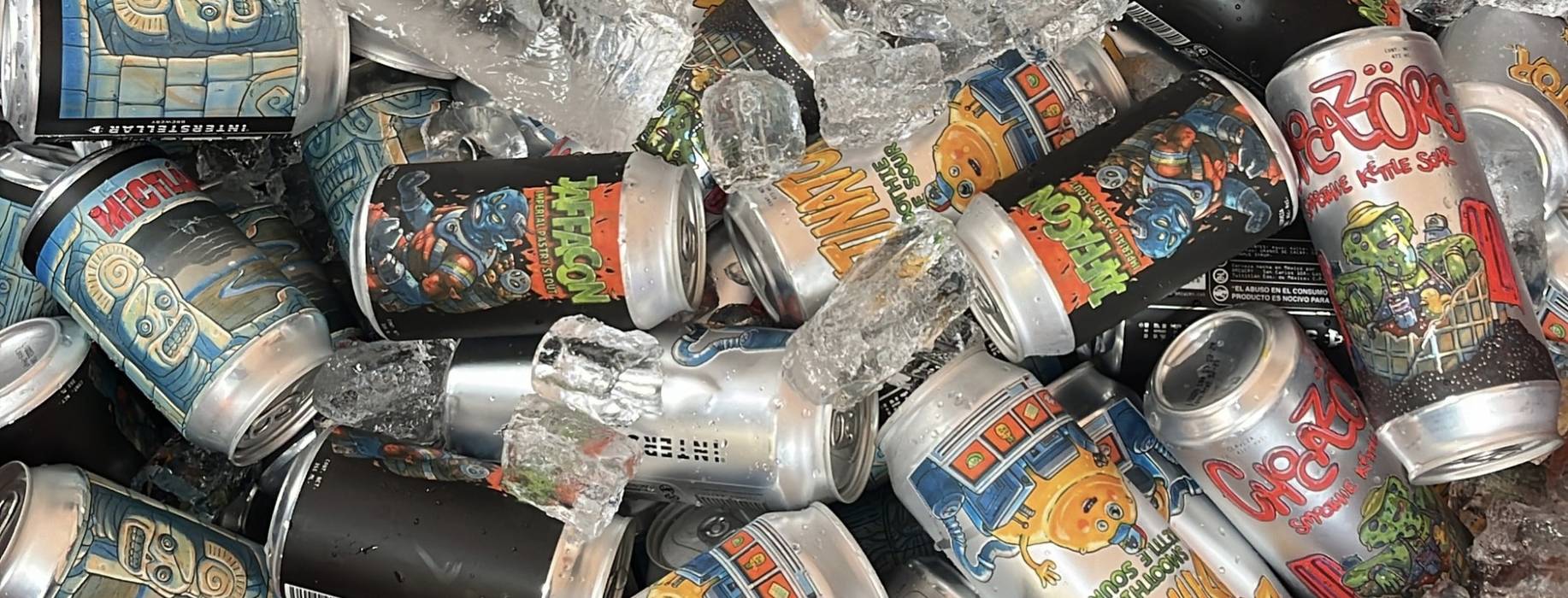
Robyn Gilmour
Photos:
Interstellar Brewery
Saturday 30 May 2026

This article is from
Mexico
issue 131
Share this article
It’s refreshing to speak to Glen Brumby, co-founder and head brewer at Toluca’s own Interstellar Brewery. As a New Zealand native who just landed in Mexico City in 2017, the novelty of the country’s abundance has not worn off — he doesn’t take it for granted that he can source domestically-grown cacao, coffee and vanilla for brewing. As a mechanical engineer by training, Glen thinks a lot about the practice and processes that will get the best out of raw ingredients, so having fresh, high-quality building blocks to begin with feels like a real advantage. “I have a foreigner's perspective, so I see life here for what it is, and what it has that I didn’t have elsewhere in the world,” says Glen. “People here grow up eating the most beautiful mangoes and I’m like ‘man, I used to pay $5 for a mango and it was pretty shitty.’”
In Glen’s own words, he got a couple of engineering degrees before he realised it just wasn’t exciting enough for him. “I came here working as an engineer in remote marine navigation for a Finnish company, and was travelling between Finland and Mexico for a while,” he says. “Beer and brewing has elements of all engineering disciplines, and so tends to be something that engineers gravitate to, and enjoy getting their teeth into. I knew I loved craft beer from back home in New Zealand, but in 2017, the market there was so saturated with amazing breweries, and there was so much bureaucratic red-tape involved in setting up a brewery. I realized that for the cost involved in just getting through the paperwork in New Zealand, I could set up something small here in Mexico.”
Glen’s dream took one step closer to reality when he met his now-business partner, Yenítzia González. “She started to talk about the business like it could be something,” he says. “We were both still doing our other jobs, but she created the brand, the website — she works on a huge amount of projects across the business, and manages the business side of Interstellar while I focus on production”. With a name and face, all Interstellar needed was a brewery.
In its infancy, that brewery looked like a residential three story house on the outskirts of Mexico City. “It was so stupid,” says Glen. “The brew house was on the third floor, and fermentation tanks were on the bottom floor, so we’d run sterile transfer tubes out the window and into the bottom story, and would have to use walkie-talkies to coordinate opening and closing valves.” At that time the brewery consisted of a one vessel brewhouse, and a couple of 60 litre tanks — just enough to knock out 300 odd cans at a time. When the brewery’s first release, in 2019, sold out in just two hours, Glen and Yeni realised they were destined to outgrow the space sooner than they'd anticipated.

PHOTO: Glen Brumby, co-founder & head brewer
Interstellar has since procured a five vessel kit and moved operations out of Mexico City to a 250m2 warehouse in Toluca, which remains Interstellar’s home today. “We still need a lot of equipment, but we're quite proud that we don't have huge debts hanging over us from the banks, or private loans,” says Glen. “What we've created, we've bought it piece by piece. Working this way means we’re always on the edge of crippling the business financially, but we make it happen”.
Procuring and growing a brewery isn’t the only thing Glen has had to “make happen” since Interstellar opened its doors. Turns out, the ability to problem-solve and reverse engineer is not an asset but a requirement when operating a brewery at 2700 metres above sea level. For context, that’s almost exactly twice the height of Ben Nevis, the UK’s highest mountain, and 500 meters above Mexico City. As such, Glen takes an approach to brewing that is unique because it has to be.
“Most breweries are boiling their wort at around 100°C, but for us, water boils at 91.5°C, which makes quite a significant difference when it comes to hop isomerization,” says Glen. “We're right on the knee of the drop off at that temperature, so you're not really getting any bitterness. The bitterness we do get is a soft, gentle bitterness, rather than a strong, aggressive one, which is good for making hazy IPAs, but maybe not so good for making West Coast IPAs. If we want to achieve that level of bitterness, we end up needing around 60% more hops for the same level of bitterness, than we would if brewing at sea level. That increases the cost, and because things are expensive in Mexico, it's even more expensive to brew those kinds of beers.”
Glen also notes that altitude has an effect on packaging — cans can look a little squashed or dented when they move to areas of lower altitude and higher atmospheric pressure. Interstellar has poured at Billy's Beer Fest in Antwerp several times now, and on the first few occasions Glen noted that cans looked a little worse for wear, even though the beer inside was perfectly delicious. “Our cans are actually very soft at sea level because the atmospheric pressure is pushing harder on them, and therefore you don't need as much force to collapse,” he explains. “That is a rather interesting problem. Once you get to around 2 v/v [units used to measure the volume of CO2 in liquids], it's okay, but if you're on 1.8 or 1.6v/v, it looks as though your cans have no pressure in them. So yeah, how to manage altitude has been an interesting discovery for us.”
With the bare basics of brewing requiring that Glen gets experimental, it’s little surprise that innovation has become such a key part of everyday operations at Interstellar, and indeed that Glen now thinks critically of operational axioms in the brewing world. “We're pretty much known throughout the country for quite extreme beers with lots of ingredients, but particularly our sours and pastry stouts,” he begins. “Sometimes I think there should be some kind of book released on how-to pastry stout, because everything you read in traditional brewing literature is almost irrelevant when it comes to making this style,” he says. “You really have to throw away most of what you know and start to experiment.”
In his view, drinkers have an expectation that pastry stouts will have a viscosity and mouthfeel that make the beer feel creamy. In most cases, brewers will add lactose — a form of unfermentable sugar that comes from dairy — to create this silky texture. “I've never really met anybody who can honestly say ‘I just love how lactose sugar feels in your mouth’ — they want the effect rather than the cause,” says Glen who is himself vegan, and therefore goes to great lengths to ensure Interstellar’s range is plant based. “Lactose is a good cheat code if you want to get residual sugar into a beer, but lactose itself isn’t what people are looking for.” So, what’s the alternative? An awful lot of trouble, one might say.
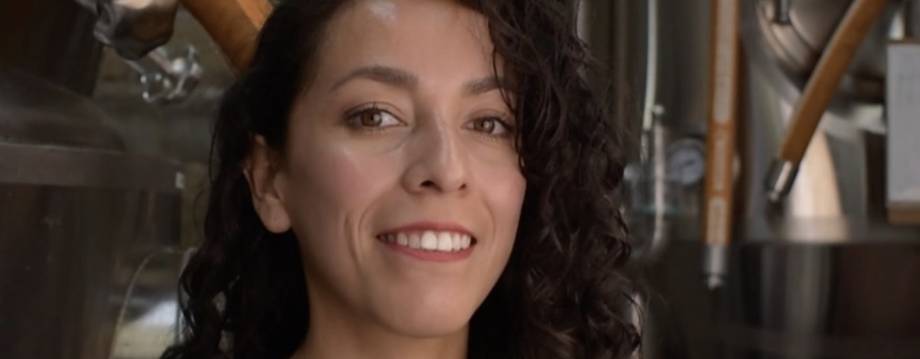
PHOTO: Yenítzia González, co-founder & business director
“Essentially, our approach is to build complexity using speciality malt, and create two types of sugar in the mash — one comes from the malt itself, and the other is added sugar. Sometimes we even use 100% speciality malt,” Glen begins. He can’t be accused of making things easy for himself. Speciality malt is usually kilned, smoked, or treated in such a way that adds flavour to a beer, but kills most naturally occurring enzymes in the process. This is why the majority of your average grain bill is made up of base malt — which is abundant in enzymes that convert starch into fermentable sugars — and contains only a small amount of speciality malt. To get the best extraction of sugars from his speciality malt bill, Glen also mashes at a hotter-than-usual temperature.
“Most brewing literature would say 78°C is your mash-out temperature because that builds your enzymatic activity, any hotter and there’s no conversion. Well, I strongly disagree, because we mash at 80-84°C okay and that does two things; it activates alpha-amylase, which is quite happy up to 90 degrees [and breaks down starch into dextrins and maltose], so you get a lot of complex sugar chains that the yeast just don't like to eat at all. That’s your final gravity. The other thing with that high temperature is that the viscosity is very low, so the malt is very fluid. If you’re trying to recirculate or run off mash that has a gravity of more than 1.1, you're basically recirculating syrup and if it gets too cold, it becomes really like honey. So if you keep it super hot, you get a better runoff into the kettle. We then top up the gravity that we're missing by adding brown sugars. Piconcillo is the most popular variety here in Mexico.”
By adding piconcillo, Glen is providing sugars that can be easily metabolised by the yeast during fermentation, to produce alcohol. This would usually come from the mash, but in the case of Interstellar’s pastry stouts, the mash is all about building flavour and mouthfeel and doesn’t concern itself with producing fermentable sugar. “Of course, we then have troubles with fermentation, and need to inject extra oxygen to try expand the exponential growth phase of the yeast, and get some more biomass in there,” Glen says, sounding almost weary. “Fermentation starts slowly but because we add simple sugars in the boil, that creates a snowball effect that builds up speed until the yeast hits a wall of unfermentable sugars and starts to die off and ramp down. You know, typically, these beers ferment for almost a month.”
Glen is the first person to say this process is a nightmare. It’s expensive and time consuming; nothing about Interstellar’s best known beers is practical, but that doesn’t stop Glen making them, or drinkers from demanding more of them. After all, brewing with sours and pastry stouts, in a country with such ready availability of fresh, locally grown adjuncts, is a recipe for success.
Explore Toluca city guide according to Interstellar Brewery CEO, Yenítzia González.
Share this article
You’ve reached your limit of 5 free articles this month.
Unlock unlimited access and more

Join Beer52 and get your first month half price
-
Get your first box for £13.50 (RRP £27).
-
8 beers & 2 snacks delivered monthly.
-
Printed Ferment magazine included.
-
Unlimited access to all online content.