Je ne sais quoi
Is rusticity becoming a trend among small British breweries? And what, exactly, does “rustic” mean in terms of beer anyway? Matthew Curtis investigates…

Matthew Curtis
Photos:
Matthew Curtis
Saturday 30 May 2026

This article is from
Mexico
issue 131
Share this article
There’s something about the beer I’m drinking I can’t quite put my finger on.
It's an export pilsner from Theremin, a new side-project from Mills Brewing of Stroud, Gloucestershire, which is best known for its wild and funky spontaneously fermented beers. This lager is quite a departure for them, given that it’s ‘clean’ fermented. Soft and bready, buoyed by the fierce snap of noble hops and a hefty ABV of 6.5%, it’s a wonderfully quixotic take on the style, with a curious, lemon-zest-meets-yoghurt note that’s so delicate it’s almost not there. I enjoyed it so much that I couldn’t stop thinking about it, so decided to pull on that thread, and find out what’s going on.
“Since the Mills name is associated with mixed culture and barrel fermented beers, we wanted to create a second focal point where Theremin equals lagers,” says Jonny Mills, who co-founded his brewery in 2015 with his wife, Gen. “We moved the whole operation to Stroud last year, and have finally installed our first brew kit, which has allowed us to start making these beers.”
As it turns out, that slightly lactic, tangy flavour I picked up on is due to the addition of a small amount of Mills’ spontaneous fermented beer during the brewing process. This 'spon' beer is added to the kettle pre-boil, which allows it to contribute flavour and character to Theremin beers while the boil process kills off any lactobacillus bacteria (and friends) that might cause spoilage after fermentation.
Using their own spon beer adds flavour and character, but also has the benefit of lowering the beer’s pH, which helps improve the efficiency of hops, and the flavour and bitterness they in turn imbue the beer with. Jonny explains how he uses the first and last portions of a spon brew when transferring it into barrels — “beer that would otherwise go down the drain” — which not only prevents wastage but also provides extra yeast nutrients for Theremin fermentations.
This is how the export pilsner's more esoteric quality came to be, but also how Theremin beers more broadly carry a unique character that's inherently connected to the brewery that produced them. Over the past few months this is something I’ve detected in several beers brewed by small, independent breweries – in particular within their lagers. But are brewers like Jonny intentionally attempting to give their beers “rusticity”?

“We didn't aim for rusticity itself, so it couldn't really be called intentional,” he tells me. “But, if rusticity is defined by the production and character of the finished product, rather than our motivations, then I’d say it could be intentional. If indeed it is possible to have had that intent without considering this particular word at all.”
Mills’ technique of using sour beer or wort as an acidifying agent is not a new invention. Far from it, in fact. Known as “sauergut” the technique leans heavily on historic German brewing traditions. Not unlike Mills' use of spon beer, sauergut is made by souring a portion of fresh wort with lactobacillus, which is then continually topped up, keeping the sauergut 'alive'.
Several breweries in the UK use this technique, in particular when it comes to lager production. These include Bristol’s Lost and Grounded, and Donzoko Brewing of Newcastle upon Tyne. At the latter, founder and brewer Reece Hugill refers to his flagship beer, Big Foam, as a “rustic” lager. Indeed, it possesses that curious, lactic character not unlike that found in Theremin’s export pilsner, albeit with a fingerprint that's unique to the brewery that produces it.
Another brewery invested in the use of sauergut is Sheffield’s St. Mars of the Desert. Dann Paquette, who co-founded the brewery in 2018 with his wife, Martha Holley-Paquette, is a big believer in how it positively influences the beers St. Mars creates.
“Sauergut completely changes the texture of all beer, and makes all beer more drinkable and complex,” he tells me. “Those are things that I want in my beer.”
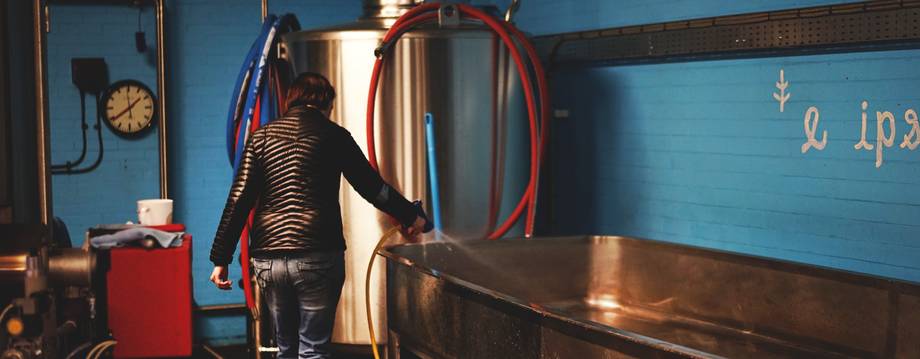
Dann also agrees that this technique is a “presentation of rusticity”. As he explains, the techniques he employs are no longer popular in the southern regions of Germany from where they originated. In fact, the use of sauergut is considered by many brewers in the region to be deeply unfashionable. If you think about it, however, one of the founding precepts of 'craft beer' was taking historical techniques that were nearly erased by the mass industrialisation of beer production and in turn re-employing them to produce flavour and character in beer that is as unexpected as it is delicious. At St. Mars, this is just one of a series of methods used to give its beers an old-world, rustic character of their own.
“Another perhaps old fashioned, or ‘rustic’ thing we do is bitter with low alpha acid whole cone hops — lots of them,” Paquette says. “It's not an efficient way to bitter at all, but I used to read [about] brewers in Europe swearing by that.”
They also employ the use of a coolship (sometimes spelled ‘koelschip’) which has lots of practical applications, in spite of it being a tool of brewing in ages past. When wort is applied to the long, slender, flat container pre-fermentation, as it cools it will take on oxygen, which in turn will help ensure a healthy environment that helps yeast do its job. It also reduces off flavours, such as dimethyl sulfide (DMS) which can cause beers, especially lagers, to taste vegetal. There is no denying that St. Mars beers have a flavour and character all of their own, and somehow “rustic” just feels like the best way to describe them.
“My friend Brian, who is a Trappist monk and chooses his words carefully, heard St. Mars beers being referred to as ‘rustic’ and thought it was an insult; as if to say ‘not professional’,” Dann says. “But it's ok with me even if they meant that!”
When 'rustic' is typically used to describe a beer, it’s often applied to wild and sour beers, or perhaps a saison or 'farmhouse' beer. It’s relatively simple to point to the spontaneously fermented beers produced by, say, Cantillon or Boon of Belgium and to declare them to have rusticity. In the UK, Burning Sky brewery occasionally produces a beer with 'rustic' in its name, typically inferring that it contains – either in part or in whole – a portion of barrel aged beer that will imbue it with tartness and acidity.

PHOTO: Theremin Beer
If we once again consider the industrialisation of beer, which involved cleaning up brewhouses, refining yeast strains, and locking away fermentation into closed vessels to avoid spoilage, we can also logically assume that 'rusticity' is, in practise, the act of regressing to brewing techniques that existed before said modernisation. If a beer presents a character that could be considered rustic, it has to possess some hidden complexities, imbued by using brewing techniques that eschew the contemporary. As I see more breweries play around with sauergut, heritage grains, whole cone hops, and coolships, I see brewers who are invested in the alchemy of brewing, not just the science.
One brewer who has openly used the term 'rustic' to describe a recently produced, cask-only lager is Mark Welsby of Runaway Brewery in Stockport, Greater Manchester. He believes the term helps to express that a beer has, “something of the farmhouse tradition about it, but not in a funky mixed-ferm way.”
“[It’s] rustic in the sense that the process has an element of pragmatism about it too — a use-the-ingredients-you-have-to-hand, rather than buying in ingredients specially and then adjusting your process to make it work type approach,” he continues. “A beer with a deliberate lack of polish, an unfiltered charm, a rawness to it — something with more character than might be expected for the style in classical terms.”
It makes sense, really. If you’re a small brewery competing with mass-produced beers, and even larger-scale independents who — lets be honest with ourselves for a second — are producing a lot of very similar tasting beers, then leaning on something a bit more traditional, and a little bit weirder, is going to make your beers stand out.
But is 'rusticity' in brewing a genuine trend? Well, when speaking to Dann at St. Mars of the Desert I was given some deeper context to consider: (insert meme) perhaps it always has been.
“I remember reading Michael Jackson early in my beer education, and the story of Orval always stuck with me,” he says. “Brettanomyces was added in the bottle to give the beer a taste of the much-loved beers people drank long ago in that region. I think it's very much relevant to this idea of 'rusticity' — it was a simpler time, and we always look back on beers we loved nostalgically. Nostalgia is a powerful feeling.”
Share this article
You’ve reached your limit of 5 free articles this month.
Unlock unlimited access and more

Join Beer52 and get your first month half price
-
Get your first box for £13.50 (RRP £27).
-
8 beers & 2 snacks delivered monthly.
-
Printed Ferment magazine included.
-
Unlimited access to all online content.