The curious case of Corona
Fred Garratt-Stanley explores how Mexico's premier macro lager became the world's most valuable beer brand.
Fred Garratt-Stanley
Illustrations:
Phoebe Wilman
Saturday 30 May 2026
This article is from
Mexico
issue 131
Share this article
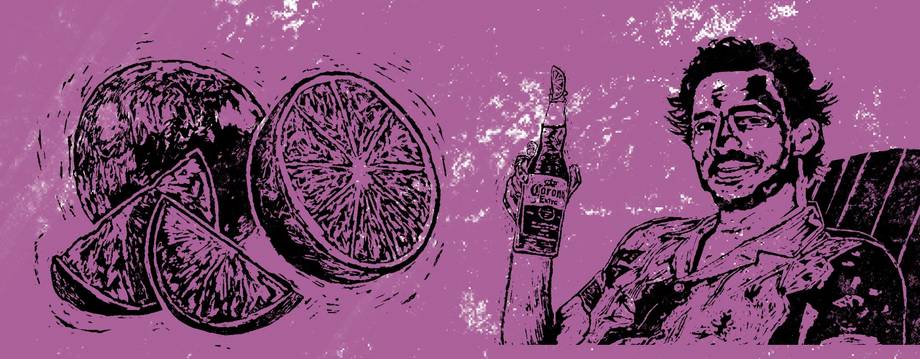
"Even if you leave the beach, it never leaves you," narrates Hollywood A-lister Pedro Pascal, emerging from the tropical undergrowth onto a shoreline of pristine white sand, a cold bottle of Corona in his eyeline, dripping with condensation beside a reclined wooden deckchair. Settled in, he delivers the old tagline: "La Vida Más Fina" (meaning "the finest life"). These few short seconds — from a 2024 commercial broadcast to both English and Spanish-speaking audiences — perfectly capture the effortlessly classy sun-drenched lifestyle that Corona has been selling to consumers for decades. It's their positioning as a beachside companion, an advocate of the finest life, that has made them such a success. The company's status was proven last May, when the Drinks Business reported that Corona had retained its title as the world's most valuable beer brand for the second year running, with double-digit growth outside its native Mexico in 2024.
This is remarkable for several reasons. Firstly, Corona's unusual preference for clear glass bottles puts the beer at constant risk of sunstrike, making it objectively one of the lowest-quality lagers on the market. Speaking on the Moon Under Water podcast, beer expert Pete Brown explains: "They get you to drink it ice cold from the bottle because 80% of the flavour is actually aroma, so drinking from the bottle is the equivalent of holding your nose. The first aroma you get is wet cardboard and wet dog, because it's in clean glass bottles, so it gets this thing called sunstrike: the ultraviolet rays cause a reaction in the hops that creates these off flavours… every single bottle of Corona you ever see anywhere is off".
Hardly a glowing review. Still, it hasn't stopped Corona from becoming hugely popular worldwide, even if this global success is a relatively new development. Mexico's biggest commercial lager didn't even reach the US market until 1979, and remained rare in Europe until the 1990s. Its draught presence in the UK has increased dramatically in recent years, but the kegged product has only been available here since 2019. Around the same time, at the outbreak of the Covid-19 pandemic, the brand's unfortunate name even led to a brief dip in sales (I remember crates of Corona being left on the otherwise empty shelves of Sainsbury's in the spring of 2020).
This was, however, followed by a period of significant growth. Aided by the vast funds of AB InBev – which took over Grupo Modelo, the company that produces beers like Corona, Modelo and Pacífico, in 2013 – Corona has navigated a series of challenges to rise to the top of the commercial beer landscape, becoming the defining Mexican beer brand for many European drinkers.
According to Guillermo Ysusi, founder of leading Mexican craft beer distributor Cebada Malteada, "Corona is just an international pale adjunct lager, so there are a large bunch of contenders that could replace it. The reason it has stood out is marketing: the lime-in-the-bottle ritual, the clear bottle, and the idea of Mexico as an exotic culture." It's not just about slick adverts and alignment with cool, zeitgeisty celebrities like Pascal. It's the creation of myths and legends, the building of stories and talking points that help a brand push its head above the parapet.
Take the lime-in-the-bottle routine, for example. There are various theories about how it became commonplace, but the general consensus is that this trend sprang up in parts of Mexico with lots of US tourism, like Cancún, and that when those same Americans went back to the States, they adopted the technique to project a more cultured, worldly image of themselves. It's rare that you'd see a Mexican drinker indulging in this practice. "The first time I saw anyone stuff the wedge into the bottle I was in Edinburgh, [and] I was shocked," Mexican brewer Mariana Dominguez told Pellicle magazine in 2023. "If you go to the beach, you will get given a lime, but you just squeeze the juice into the beer. It's the only way to make [Corona and Sol] drinkable."
It's true that the addition of lime has a practical purpose, helping to mask the skunky aromas and mild off flavours created by the clear glass bottle. Some say the bottleneck wedge also works to sterilise and remove rust marks left on the rim by metal caps. But the combination of lime and lager as a broader practice isn't seen as strange in Mexico.
"It's not that we don't have lime with beer," says Guillermo. "We put lime over everything: tacos, soups, fish, beer. It's just the way of presenting it: the lime ritual isn't a thing we do outside of the more touristy destinations. But what we have that's quite similar is micheladas [a cocktail of beer, lime juice, and assorted spices and sauces]. Micheladas have existed since I was little, but I don't know if they predate the lime wedge trend. The lime in the bottle isn't something we would reject, it's just 'why do you put the lime wedge in the bottle?' and not beside it."
It's the creation of myths and legends, the building of stories and talking points that help a brand push its head above the parapet
The simple answer is image. It might be billed commercially (and somewhat brazenly) as La Cerveza Más Fina, aka "the finest beer", but Corona's whole relaxation and refreshment-centred brand strategy, and the lime wedge trend at its core, is essentially about distracting from the actual flavour as much as possible. More robust, golden Mexican lagers that don't quite muster the same image of simple, unthinking refreshment have failed to cut through to the masses in quite the same way.
In Corona, this smooth, easy-drinking experience is boosted by the use of adjuncts like corn and rice. As Kevin Kain writes on his blog Casket Beer, "the type of adjuncts used in typical lager brewing don't often contribute a significant impression in terms of flavour themselves… However, they replace fermentables that do. This can result in a less flavourful beer than one made solely with barley. Sometimes less is more though." Fans of Corona have certainly found that to be the case.
"Corona appeals to the people who have visited sunny beach places like Cancún or Acapulco, where people mostly drink light beers as refreshment," explains Guillermo. Evidently, this particular image of beer-drinking in Mexico is far from the full story. "We also have darker lagers, which are more on the malty, caramelly side," he adds. "But if you've tried both those types of lager, you could say that you know Mexican beer, because that's 99% of the culture. Craft beer only represents about 1% of beer sales in Mexico. Corona, Sol, Modelo Especial, Negro Modelo, Victoria, Pacifico: those beers are what we grew up drinking."
Today, Corona's global presence is at an all-time high. One of several myths perpetuated about the beer is that its name (meaning "crown" in Spanish) was inspired by the Cathedral of Our Lady of Guadalupe in the Mexican city of Puerto Vallarta. The spread of this romantic notion is just another example of Corona living up to that lofty title; thanks to a steadfast belief in its own stories and a commitment to projecting the vision of "La Vida Más Fina" at every opportunity, we've become accustomed to that distinctive golden crest adorning bottles, cans, and draught line-ups all over the globe.
Share this article
You’ve reached your limit of 5 free articles this month.
Unlock unlimited access and more

Join Beer52 and get your first month half price
-
Get your first box for £13.50 (RRP £27).
-
8 beers & 2 snacks delivered monthly.
-
Printed Ferment magazine included.
-
Unlimited access to all online content.