Visit Malta: Salt and sunshine
In partnership with Visit Malta.
Promotional feature
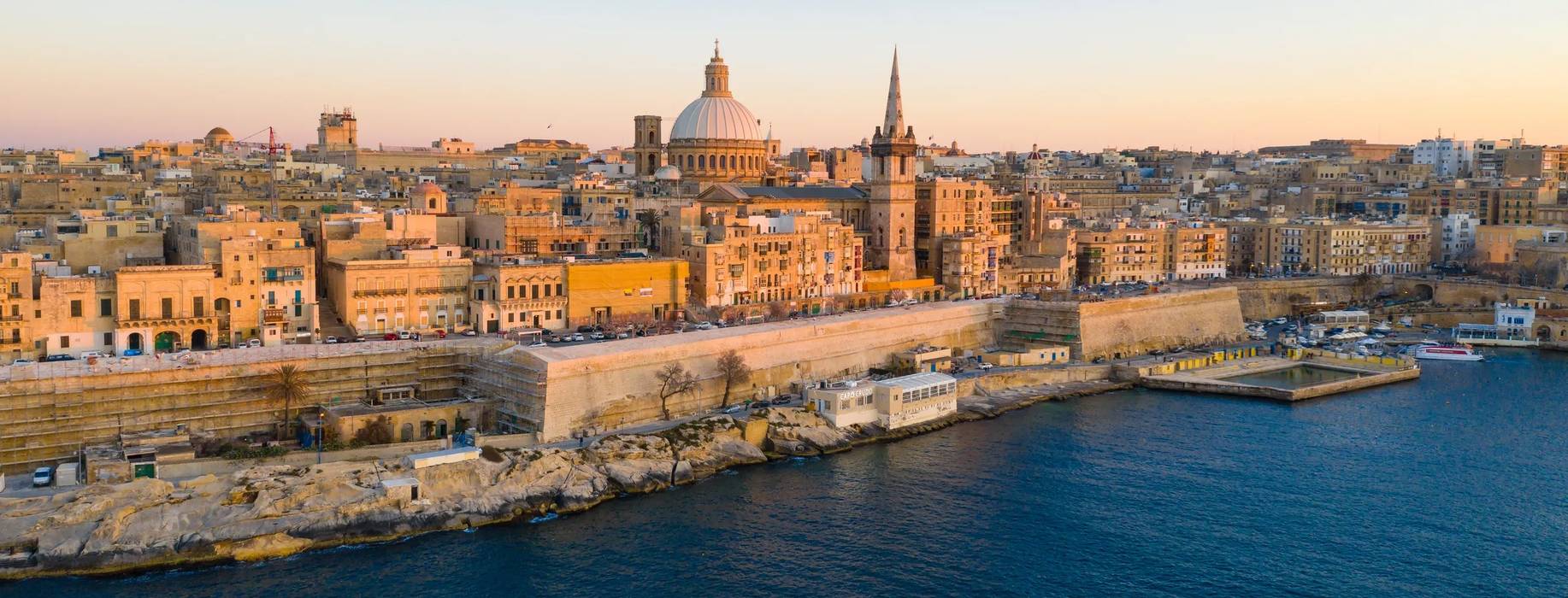
Header photo:
CN Traveller
Saturday 27 June 2026
This article is from
British Summer Time
issue 132
Share this article
It takes about as long to fly from Manchester to Valletta as it does to drive from London to Leeds. Three and a half hours from most UK airports, and you step off the plane into 300 days a year of sunshine, on an archipelago where ‘off-season’ isn't really a thing. Spring is wildflower-heavy and warm enough for shirtsleeves at lunch, while summer is all about harbour swims and shaded courtyards. Autumn brings the lampuki shoals close to shore and the village festas reach full volume. Winter is when the rest of the Mediterranean shuts down and Malta carries on – fifteen degrees in January, restaurants open, brewery taprooms pouring.
What's harder to convey from a distance is how much food and drink Malta packs into 316 square kilometres. The country has seven Michelin-starred restaurants for a population of just over half a million, and the only two-star kitchen in the country is run by a British chef working almost entirely with Maltese growers and fishermen. At the other end of the scale you can buy a pastizz – a piping hot, ricotta-stuffed pastry – for less than a euro from a corner kiosk that's been doing it the same way for half a century. Between the two, a craft beer scene that didn't exist a decade ago now exports to the rest of Europe. This is what makes Malta a serious eating and drinking destination rather than just a reliable go-to for winter-sun.
Inheriting the Mediterranean
Maltese food carries the fingerprints of everyone who has ruled the islands, and that's a long list: Phoenicians, Romans, Arabs, Normans, the Knights of St John, the French, and the British. The result is a slow accretion of culinary influence; dishes that have absorbed a North African spice habit, an Italian devotion to pasta and pork, a British soft spot for tea and mushy peas, all ironed out under the weight of a Mediterranean sun.
Malta’s street food calling card is the pastizz, a diamond-shaped filo-like pastry, traditionally stuffed with ricotta or curried peas, and sold for next to nothing from bakery counters across the country. Almost as ubiquitous is hobż biż-żejt, the open sandwich on dense Maltese bread, loaded with crushed tomato, capers, olives, tuna and ġbejna; the small, palm-sized sheep's cheeses from Gozo that come fresh, peppered, sun-dried or steeped in white wine vinegar. The same bread, in a flatter form called ftira, gets the picnic treatment and travels well to the beach.
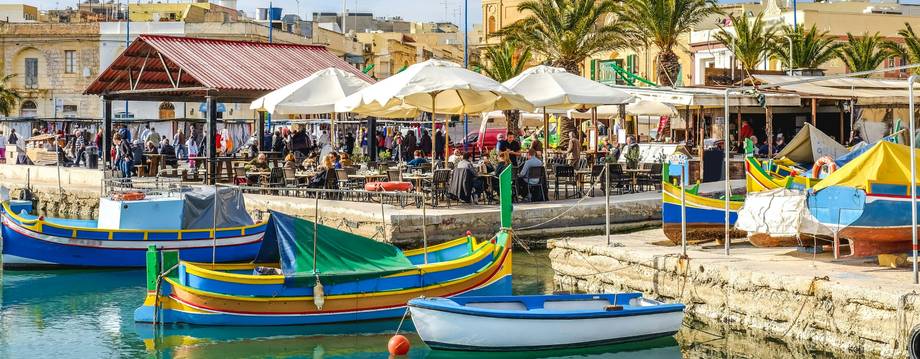
Marsaxlokk fish market
Sit down for something hot and the cooking turns to slow-cooked protein. Stuffat tal-fenek – rabbit braised in red wine, garlic and tomato until the meat slips off the bone – is the national dish, traditionally eaten as a fenkata. In this long, communal meal, the rabbit is first served with spaghetti dressed in the sauce, then the meat itself with vegetables. Bragioli are beef olives, thin steak rolled around hard-boiled egg, bacon and parsley and braised in wine. Zalzett tal-Malti is a coarse pork sausage shot through with black pepper, coriander seed and garlic, eaten fried with chips or sliced cold on a plate of bread and pickles.
The sea contributes plenty. Lampuki – the dolphinfish or mahi-mahi – run from late August into November, and torta tal-lampuki, the lampuki pie with capers, olives and spinach wrapped in shortcrust, is the fixture of pretty much every autumn menu. Grilled swordfish, tuna tartare: the catch defines the calendar. The same goes for produce. Malta's high-summer tomatoes are some of the best you'll taste in Europe, dense and sun-thickened. Capers grow wild on the limestone walls, while the indigenous Bidni olive yields a monovarietal oil with a profile distinct enough to register on the radar of the Michelin Guide.
To finish, there's imqaret, deep-fried diamonds of date-stuffed pastry sold from kiosks at bus stations and best taken still warm. And a glass of Kinnie, the bittersweet soft drink made from bitter oranges and wormwood, which the Maltese drink the way the British consume Marmite – polarising, and not really a sensible topic for friendly debate.
Cisk, and what came after
Order "a beer" in Malta without specifying further and you'll get a Cisk. Pronounced chisk, the country's flagship lager has been brewed by Farsons on the outskirts of Valletta since 1928, still in copper vessels kept polished by daily use. It's a clean, well-carbonated, classic European lager; the holiday-default beer that does the job cleanly, alongside its IPA, lactose stout, amber ale and (in non-alcoholic form) the famous Kinnie. Farsons also operates The Brewhouse in the Central Business District, where the rooftop garden is the most relaxed way to drink Cisk fresh from source.
What's changed since 2014 is everything around Cisk. That year, the Italian D'Imperio family launched Lord Chambray on Gozo, the first Maltese craft brewery, working out of an industrial unit in Xewkija with a taproom of twelve taps. The range is wide and the quality excellent: San Blas English IPA, Blue Lagoon witbier with coriander and orange peel, Grand Harbour best bitter, Fungus Rock American stout, plus regular sours, barley wines and a steady stream of one-offs. The beer has won international attention while remaining largely a domestic concern.
Sliema's brewpub The Brew, opened in 2016 by Dmitriy Tolok and his family, takes the marriage-of-food-and-beer approach. A core range of Dark, Golden Ale, Honey Mead and Maltese Ale sits alongside fourteen-and-counting seasonal experiments, including cherry beer, Belgian honey beer, Mandarina IPA with fresh citrus peel. Across the harbour in Valletta, Stretta Craft Beer is the project of John Borg, named for the city's old vice district of Strait Street. Its Transatlantic Pale Ale, made with floor-malted Maris Otter and Mosaic hops, has become one of the most picked-up cans on the island.
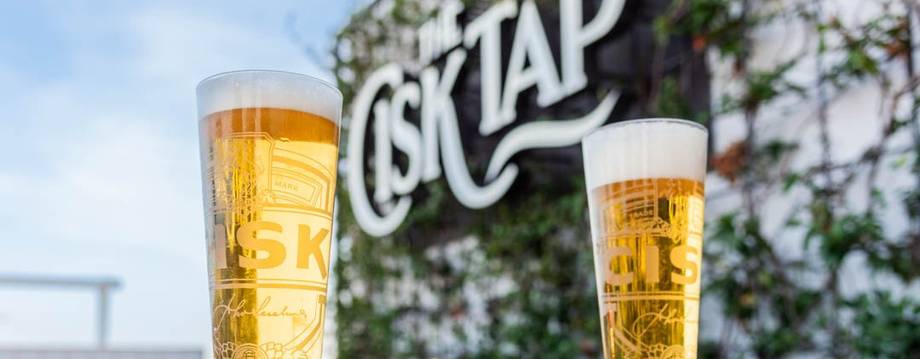
PHOTO: The Cisk Tap
The newer wave includes Phoenix Brewers, whose Raw Beer line includes a Blonde Flora Ale fermented with wild Maltese honey and a Rust Rabat Ale with cinnamon and citrus notes; and Huskie Craft Beer, founded in 2019 by Jean Mikhail Bickle and Miguel Camilleri, which focuses on precision brewing of classic styles. Between them, these five breweries have built a domestic craft scene from scratch in just over a decade, supplying the country's better bars and shipping international orders out of harbour. The conversation among Maltese brewers is already turning to ingredient sovereignty, with the long-term project of growing malt and hops on Maltese soil, of brewing a beer that's not just made in Malta but of it. Lord Chambray's seasonal Flinders Rose Gose, salted lightly and flavoured with the wild caper flowers that cover Gozo in summer, is a hint of where that might end up.
The word on the grapevine
Malta produces around three million litres of wine each year from two indigenous grapes – Ġellewża, a soft, low-tannin red, and Girgentina, a crisp white with a lemony lift – alongside international varieties grown on terraced limestone vineyards in Mġarr and on Gozo. The limestone gives the wines a distinct minerality, while the climate gives them weight. The two biggest producers, Marsovin and Meridiana, run cellar-door visits and tastings, and smaller estates like Tal-Massar and Ta' Mena are the place to seek out low-intervention bottles that don't tend to leave the islands.
Plan your own Maltese adventure
The natural place to start a luxury gastronomic odyssey is ION Harbour by Simon Rogan, set on the roof of Iniala Harbour House in Valletta, with the Grand Harbour and the Three Cities laid out beneath. The Lake District chef behind L'Enclume has held two Michelin stars here for three consecutive years – the only restaurant in Malta at that level – working a tight farm-to-table line with Maltese producers. Red Earth farm in Naxxar grows for the kitchen, forager Keith Abela brings in the wild stuff, and The Brew's stout gets reduced into a glaze for a truffle pudding with aged Maltese pecorino. The fourteen-course tasting is the headline.
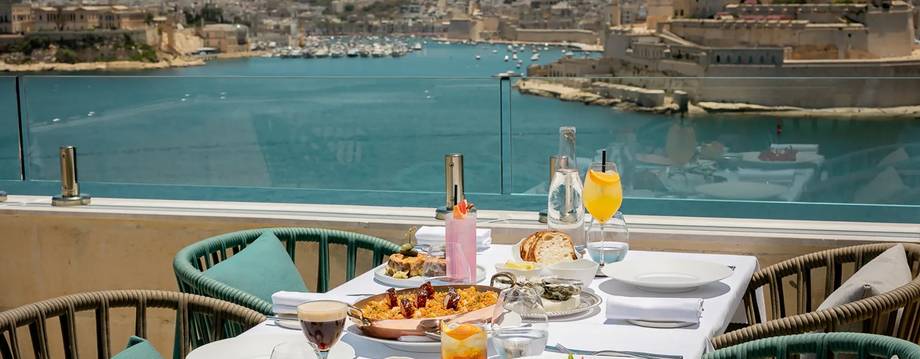
ION Harbour © Inialla Group
Among the country's six one-star kitchens, Noni in Valletta is chef Jonathan Brincat's loosely Maltese fine-diner, all clean flavours and occasional sleight of hand. De Mondion sits at the top of the Xara Palace inside the walls of Mdina, the silent city, with terrace dining at golden hour. Under Grain, flagship of the Grain group, occupies a vaulted cellar beneath the Rosselli Hotel and runs a modern French line through Mediterranean produce. Fernandõ Gastrotheque in Sliema reads more loosely Asian; Rosamí, in St Julian's, draws on Balluta Bay views and is now under new chef Davide Marcon.
A tier down – and in many ways more interesting for a regular dinner – sit the Bib Gourmands. Grain Street is the casual sibling to Under Grain and arguably the better-value evening out in Valletta. Rubino, also in Valletta, is the place locals send you for a proper plate of stuffat tal-fenek. Terrone in Birżebbuġa and Commando in Mellieħa round out the value-led picks, both worth booking ahead.
For the food first and the room second, the traditional spots still earn their reputations. Tal-Petut in Birgu is the rabbit-stew destination, with chef Donald Caruana presiding over what feels like his home for a set-menu dinner that runs to five or six Maltese courses. Is-Serkin (Crystal Palace Bar) in Rabat does pastizzi round the clock for under a euro a piece, including a chicken filling worth crossing the island for. Ta' Kris in Sliema serves the definitive lampuki pie in season, while down at Marsaxlokk harbour, the Sunday market spreads out around boats painted in the colours of the Phoenician eye, and Tartarun plates the day's catch straight off them.
For drinking specifically, head to 67 Kapitali in Valletta, a buzzy craft beer bar with eleven taps, a decent spritz list and shareable platters. Wild Honey, also Valletta, features a 120-strong Belgian-and-Scandi bottle list and pizza in a homey live-music room. Hole in the Wall in Sliema, in former stables, has a credible claim to be the town's oldest bar, while The Crafty Cat Pub in St Julian's boasts rotating Maltese and European taps, including Polish brewery AleBroWar's Mela Mela, brewed specifically for the Maltese beer-bar circuit.
Find out more at https://www.visitmalta.com/en/
Share this article
You’ve reached your limit of 5 free articles this month.
Unlock unlimited access and more

Join Beer52 and get your first month half price
-
Get your first box for £13.50 (RRP £27).
-
8 beers & 2 snacks delivered monthly.
-
Printed Ferment magazine included.
-
Unlimited access to all online content.