Trouble at t'mill
Let Laura Hadland take you to Tadcaster, and tell you the story of a family that forged two brewing dynasties.
Laura Hadland
Saturday 25 July 2026
This article is from
Yorkshire
issue 133
Share this article
In 1883, a Yorkshireman named William Smith built an entire brewery on the back of a familial grudge. Juicy enough, but the full story also gives us the surprising origins of two of Britain’s best known beer brands, as well as its best-selling ale.
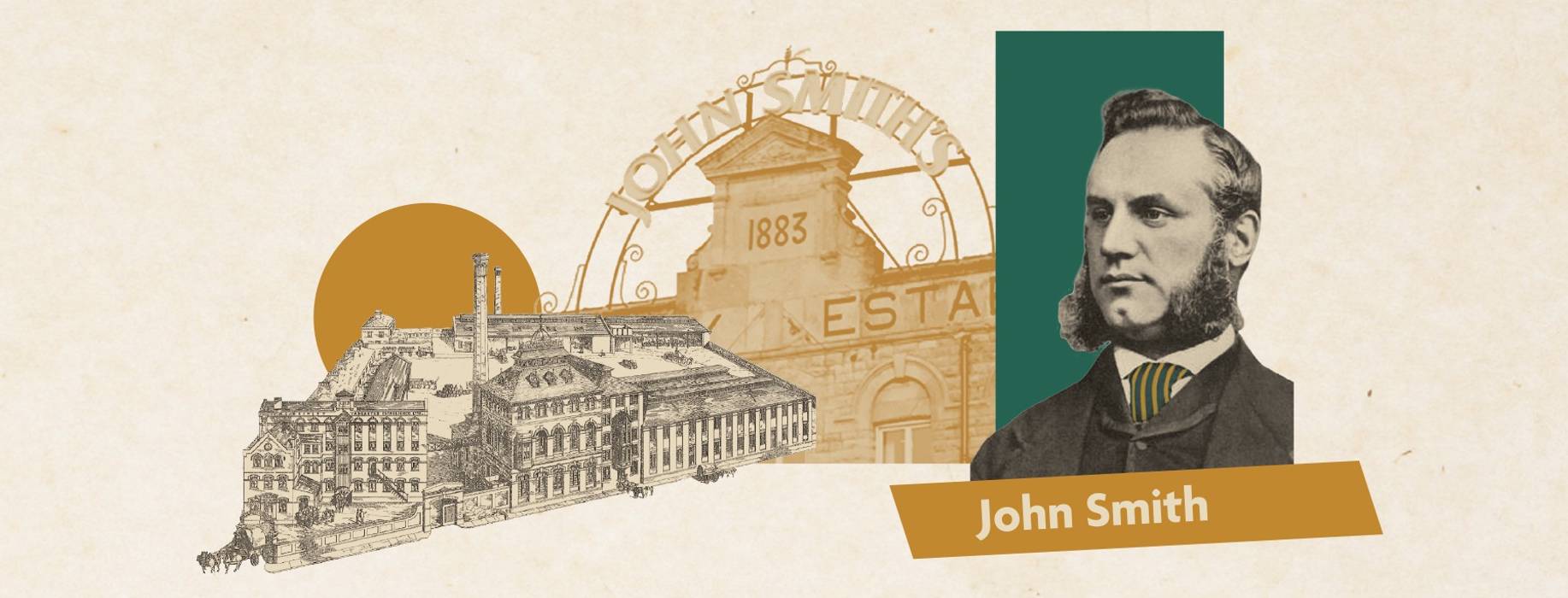
The soap opera starts a generation earlier, in Tadcaster, 1852, when a local tanner named Samuel Smith purchased a venerable local brewery that had fallen on hard times. With two of Samuel’s sons put in charge, John and William Smith, the family set out to capitalise on what they hoped would be the brewery’s saving grace; the water in Tadcaster was so hard and so mineral-rich that one commentator rated it superior even to Burton’s.
By the time John Smith (yes, that John Smith) died unexpectedly in 1879, the business was in good shape. His will, sadly, was not. By leaving his estate to the childless William and their younger brother Samuel (who had gone into the family tanning business), John had ensured everything would ultimately pass on to Samuel’s son, also maddeningly called Samuel.
The major wrinkle: a younger sister, Sarah, and her two children – named Frank and Henry, thank goodness – were cut out completely, despite the fact both were already working at the brewery. William was incensed at what he saw as a grave injustice, and hatched an audacious plan to sidestep John’s will, ensuring Sarah’s children got their share of the family business.
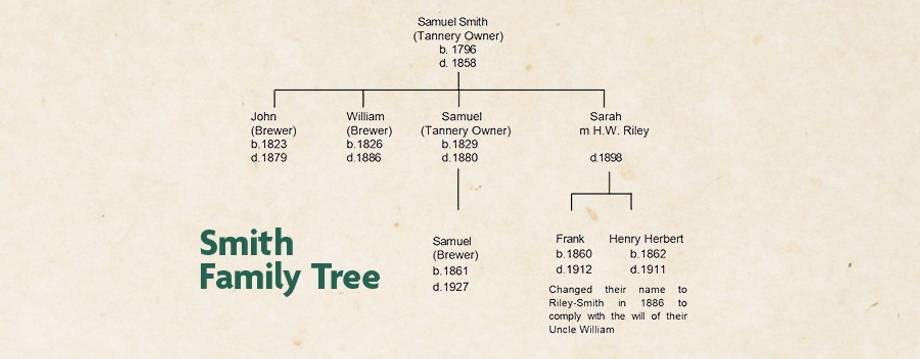
IMAGE: Tadcaster Historical Society
His solution was to build an entirely new brewery, at the cost of £100,000 (around £11 million in today’s money) right next door to the one he’d been co-running for years. When it was finished, he moved every member of staff, every barrel of stock and every piece of equipment up the road, along with all his trade customers. As a final flourish, William also took the original brewery’s trading name: John Smith’s. It’s hard not to see that as a middle finger to the man who had caused all this mess.
Crucially, John’s will only covered the Old Brewery on New Street, so the new building and the thriving business it housed became the inheritance of Sarah’s children, Frank and Henry. Samuel the younger – Frank and Henry’s cousin – was left with the shell of a brewery and whatever sense of grievance he chose to fill it with.
A tale of two Smiths
Predictably, this schism set the two sides of the family on very different paths. The Riley-Smiths – Frank and Henry, who changed their surname at Uncle William’s request – ran the new John Smith’s brewery through a long and steady expansion; by 1890 it was already producing an estimated 120,000 barrels a year.
Samuel, meanwhile, relaunched the Old Brewery in 1887 with capital raised from his inheritance. His advertisements in the local press were models of barely suppressed fury, each one signed off with a small but pointed addition: “please note the Old Brewery.”
His descendant Humphrey runs it now. The Old Brewery is still coal-fired. The only remaining cask ale – a traditional bitter – still goes into wooden casks built by an in-house cooper. Local deliveries are still made by horse-drawn drays; one of the last working teams in the country.
John Smith's Extra Smooth, backed by serious marketing spend, overtook Tetley's as the UK's biggest selling ale almost immediately and has essentially held that position since
The brewery was made into a private unlimited company in 1982, so it is under no obligation to release any data publicly. Best guesses are, then, that its estate consists of somewhere between 200 and 300 pubs. They operate under strict rules, including no swearing and no mobile phones. It has also earned a reputation for allegedly turfing out managing couples and closing pubs on short notice when those rules are held to be broken.
It’s a curious sort of success. Samuel Smith’s has survived in no small part on the strength of its US export market. Whether the brewery is commercially viable probably doesn’t matter enormously, given the family’s wider land and property interests. Make of that what you will.
John Smith’s had a rather different century. In 1970, Courage – by then a major regional – agreed a merger that brought John Smith’s two breweries and 2600 tied pubs into its portfolio. Courage was itself swallowed by Scottish & Newcastle in 1995. John Smith’s Extra Smooth, backed by serious marketing spend, overtook Tetley’s as the UK’s biggest selling ale almost immediately and has essentially held that position since. In 2008, Scottish & Newcastle was in turn acquired by Heineken.
John Smith’s is now one of Heineken UK’s biggest brands, shifting 165 million pints a year. It is still brewed in Tadcaster, on Centre Lane, where William built his brewery in 1883.
Both sides of the Smith family, in their way, got exactly what they wanted.
Share this article
You’ve reached your limit of 5 free articles this month.
Unlock unlimited access and more

Join Beer52 and get your first month half price
-
Get your first box for £13.50 (RRP £27).
-
8 beers & 2 snacks delivered monthly.
-
Printed Ferment magazine included.
-
Unlimited access to all online content.