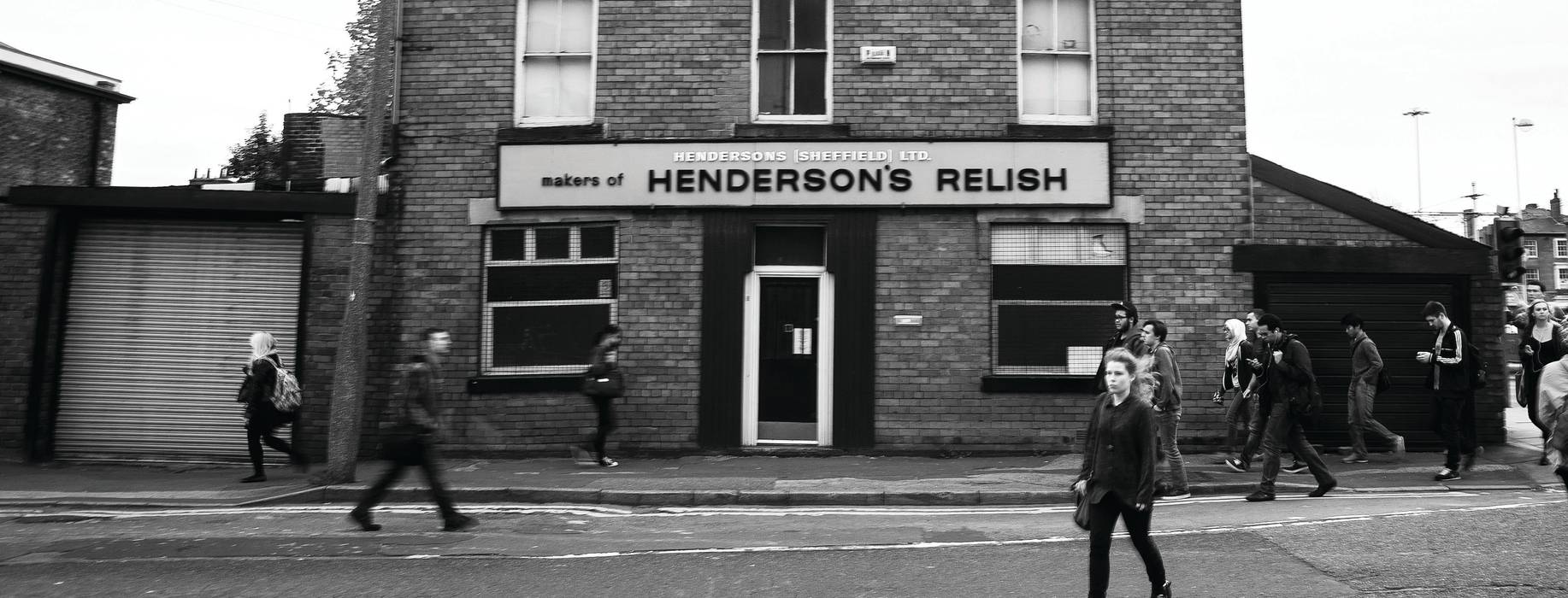
Henderson's Relish: A one sauce
Melissa Cole indulges her fascination with 'secret sauce', through one of Sheffield's proudest exports: Henderson's Relish.
Melissa Cole
Photos:
Henderson's Relish
Saturday 25 July 2026
This article is from
Yorkshire
issue 133
Share this article
I am somewhat obsessed with secret recipes; it’s like journalistic catnip, and I think it all started on my honeymoon in Trinidad & Tobago, as I was attempting to distract myself from another woeful England cricket performance.
As we were en-route to the ground, our minibus was held up by an enormous cavalcade of presidential-style armoured Cadillacs, complete with police outriders, that disappeared into an underground car park just ahead of us. It wasn’t, as I first assumed, a high-ranking political figure, but one of the three people at the time who knew the recipe for Angostura bitters. This also happens to be the same number of family members who know the secret recipe to Henderson’s Relish, Yorkshire’s superior version of Worcestershire Sauce (I said what I said).
“I don’t tell people what I do when I first meet them.” says general manager of Henderson’s, Matt Davies. Naturally, my mind races ahead to a world of international intrigue and high security. Why don't you tell people, Matt? Would you have to kill them?
“I’d never stop talking about work if I did," he continues with a smile. "People are really interested in the business; it’s an institution, it’s a badge of belonging here. If you are from or moved to Sheffield, or even just have a friend who lives there, you most definitely will have heard of it.”
In some ways it’s a disappointment; I was rather looking forward to some strange shenanigans in the Steel City but, honestly, it’s also a relief. Sheffield is one of the most fun and unpretentious places you can visit in the UK (especially as a beer lover as it’s officially the ‘Real Ale Capital’).
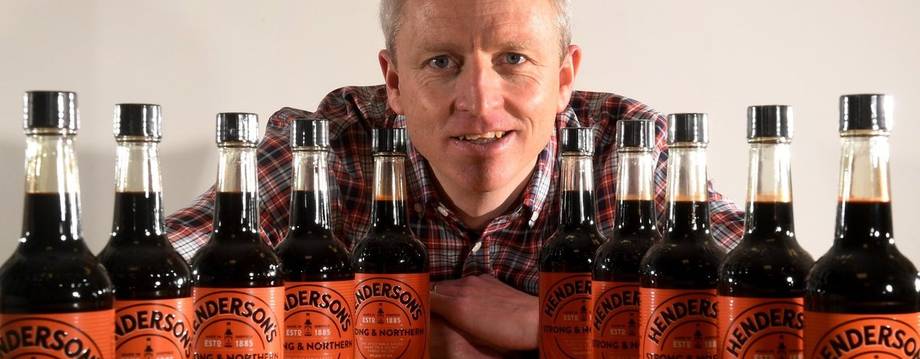
PHOTO: Matt Davies, general manager © Simon Hulme
To understand Henderson's today – and its place in the collective psyche of its home city – it’s probably important to understand the brand's history. For this, we'll turn to food historian Mark Dawson and his book on the origins of Sheffield’s favourite condiment, and the socio-economic stories that go along with it.
When I ask about his fascination with the brand, the enthusiasm in his voice is absolutely infectious. “It comes from this quite obscure place, the back of a grocer’s shop, and even up until fairly recently it was made in a little house in Sheffield. Even now it’s in a proper factory, it’s still only one unit on an industrial estate.
“One of the most endearing things is that, even though it’s been round for all this time, I think the company is still surprised about the depth of support for them, how many celebs talk about their love for it and how passionate people are when it comes to Hendo’s,” says Dawson.
Give us a flavour
So what sparked this enduring brand’s inception? It was all the rage in the 1800s to have a ‘catchup’ (taken from the Chinese Amoy dialect word for fish sauce) on middle class tables, to ensure a piquancy to dishes that didn’t require lengthy preparation by a fleet of servants, and brands such as Harvey’s Sauce, Cock’s Reading Sauce, and in 1837 Lea & Perrin’s met that need. Worcestershire Sauce entered the fray just at the point when branding was becoming an important marker of quality in an age of food adulteration.
As the British Empire expanded, and we set about nicking as much as we could, certain things really caught people’s fancy. Tamarind for example was a huge hit, partly because it was easy to process and transport, providing fruity sharpness to things like brown sauce, the most famous remaining of which is, of course, HP.
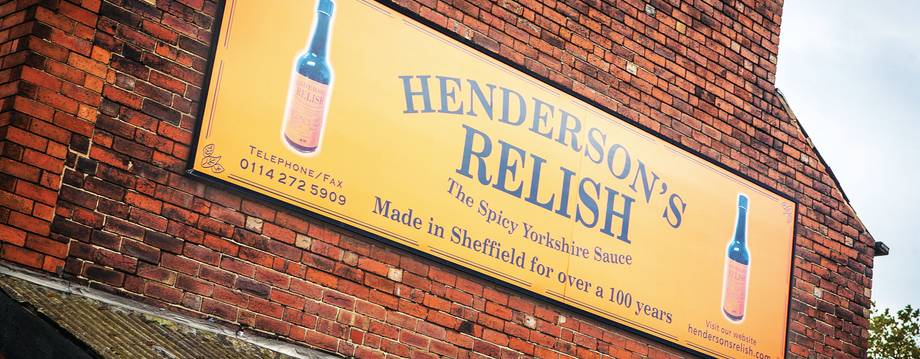
In Yorkshire in 1858 however, there was a behemoth in the making, called Yorkshire Relish, founded in the same year as its famous Worcestershire rival. It was the brainchild of Leeds chemist, Robert Goodall, who started bottling and selling his wife’s relish, which quickly took off, to the extent that by 1872 the company was selling 670,000 bottles annually. “Two years later, they built the then largest factory in the world in Leeds and by 1885 they were selling eight million bottles a year worldwide," continues Dawson. “Sauces like Yorkshire Relish sold not just to the middle class, but to the working class. British agriculture suffered an economic depression in the 1870s and 1880s in the face of cheap food imports, encouraging many like Henry Henderson to look for work in industrial towns and cities.
“Cooking facilities were limited in many working class homes, and cheap and filling takeaway foods such as hot pies and fish and chips became established by the end of the nineteenth century. Sauces were a quick way of making cheap food tasty, both important considerations if not always appreciated at the official level. A government report produced by the Inter-Departmental Committee on Physical Deterioration in 1904 bemoaned ‘desire for some sort of sensation … dietary of pickles and vinegar’."
Enter Hendo's
Henry Henderson’s journey from a large farming family to the city was a fairly normal one of the time. He soon found love, as well as work, in Sheffield and moved from the trade of miller to grocer in 1882. Although his first partnership was dissolved, he carried on alone and in 1883, was listed in the Sheffield trade directories for the first time, with a premises in the Kelham Island district. According to Dawson’s research, he was probably offering the same fare as his competition at the time: "food colourings, spices and preservatives and also a growing range of ready-made pickles and sauces".
According to legend, this was stored in a barrel and was BYO bottle. It obviously proved popular though, as in 1890 Henry advertised for a girl to take over the role of filling bottles and, just before the turn of the century, advertised again for a shop assistant, giving his title as ‘relish manufacturer’. Just over a decade later, at the then ripe age of 60, Henry decided to retire and sold the whole business to jam and pickle makers, Shaws of Huddersfield (another Yorkshire food dynasty that still survives today). He finally passed away while on holiday in Skegness, at the age of 80, nearly double the life expectancy of the time (a finger in the eye to all the "dietary of pickles and vinegar" haters).
New owner George Shaw’s son-in-law Charles Hinksman – a former travelling salesman from Worcestershire of all places – was installed as manager, and Henderson’s Relish moved to its first factory, 66 Leavygreave Road. The business boomed; records show that in 1925 the factory advertised a tender for one million printed labels for its hand-filled, corked and wax-sealed bottles.
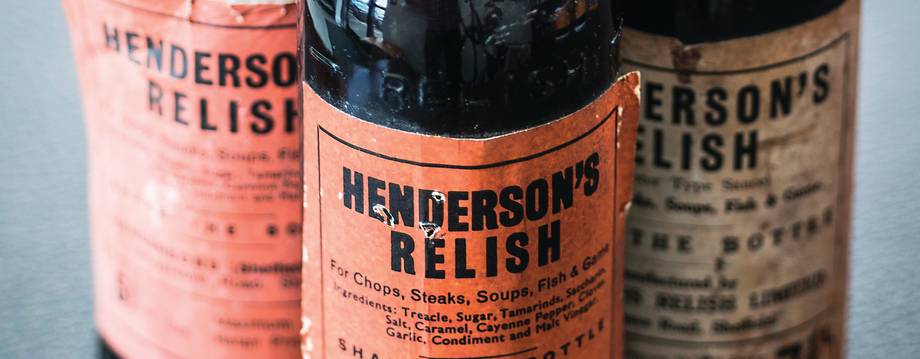
Hinksman eventually bought the business out from Shaw’s and a new family dynasty began, weathering the upheaval caused by the closure of small shops and the rise of big supermarket chains, as well as being forced to move by the expanding Sheffield University in 1958. Henderson's has remained in the family ever since, becoming a case study in how a brand can embody the multi-generational stewardship of something that means so much to the local population.
Just recently, the company launched some new brand extensions, in the form of crisps and coated peanuts, and it exports all over the globe. But the real focus remains on ensuring Henderson’s Relish remains core to its local audience, concludes Matt Davies.
“In many ways, the people of Sheffield are the owners, and the family are just the custodians," he says. "And that’s not an exaggeration, because the culture of the city is very much in favour of independence and we are very proud of things that are made here. Henderson’s hasn’t sold out and that’s worth something in this city.”
Words to live by because, in case you are wondering what happened to Yorkshire Relish, they did sell out and sadly, in 2001, ceased to be.
I don’t think it’s any exaggeration to say that that in the eyes of the people of Sheffield, Hendo’s is priceless.
Share this article
You’ve reached your limit of 5 free articles this month.
Unlock unlimited access and more

Join Beer52 and get your first month half price
-
Get your first box for £13.50 (RRP £27).
-
8 beers & 2 snacks delivered monthly.
-
Printed Ferment magazine included.
-
Unlimited access to all online content.