On the map: Masham
Colin Drury's monthly tour of the UK’s small-scale ale jewels continues in a small North Yorkshire town with a big beer heritage...
Colin Drury
Saturday 25 July 2026
This article is from
Yorkshire
issue 133
Share this article
When I ask Simon Theakston if he’s heard of the Adidas-Puma feud, he sighs. “Yes, I have,” he says. “You’re not the first to see a similarity, I’m afraid.”
Such a question may, strictly speaking, be an unusual one for the boss of one of the UK’s great family-run breweries. It may seem rather off-topic for On The Map. And so, to be clear, this is not a piece about German sportswear giants.
It is, rather, a tale of a tiny North Yorkshire town with an almost unrivalled beer heritage – and a unique beer rivalry. It is a tale of families, fallouts and finding redemption. And, above all else, it is a tale of how this small patch of the Dales has become home to a raft of independent, forward-thinking breweries: Theakston, Black Sheep, Pennine and Hambleton among them.
It is all true but, like all the best truths, it has the ring of myth. “Everyone knows the story round here,” says Tim Butler, head brewer with Pennine and something of an amateur beer historian. “It’s local folklore.”
Theakston was set up by Robert Theakston behind a pub in 1827 and quickly expanded into larger premises a minute or so from Market Place, where it remains to this day. However, in 1984 Matthew Brown and Co — a now defunct Lancashire brewery — executed what was effectively a hostile take-over. While Simon (who opposed the buy-out) continued to work for the new owners, his second-cousin Paul Theakston (who had advocated for the take-over) left to set up his own brewery two minutes away in Wellgarth Court. Famously, he called it Black Sheep because that’s what he said he was considered by the rest of the family. Beers like the delicious Best bitter and, later, the Respire IPA won them fans.
Yet there was a further twist. In 2003, Simon fulfilled his own personal redemptive dream and, along with his three brothers, bought Theakston back again. “I’d been working for Scottish and Newcastle [who had taken over Matthew Brown] in Edinburgh but I always hoped that one day there would be a chance for Theakston to be independent again,” he remembers. “I’d been very disappointed when it had been sold because it had been in the family five generations and I’d dearly wanted to keep it that way. To be able to buy it back again had been a dream ever since it was sold, really.” The move meant Masham had two much-loved breweries owned by different wings of the same family. The Daily Telegraph described the situation as “a brewing civil war”.
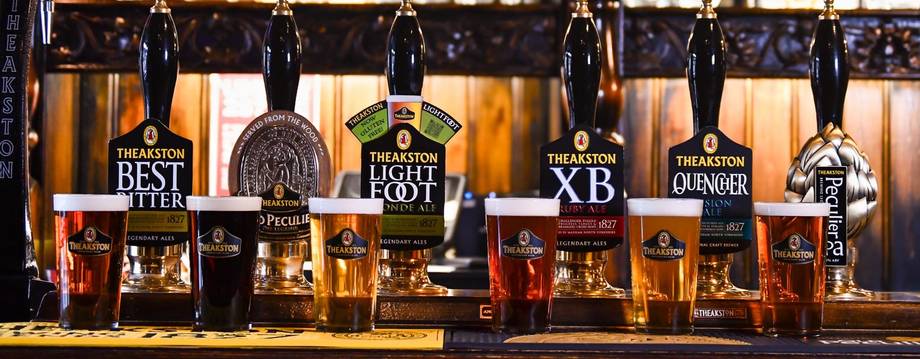
PHOTO © Theakston
So, come again (you may be thinking), what’s this got to do with Gazelles and Classics?
Allow us to explain. In 1920's Germany, two brothers – Adi and Rudi Dassler –set up an all-conquering trainer company in the Bavarian town of Herzogenaurach. Yet, shortly after the Second World War, the pair fell out and the business was closed. On one side of their hometown’s river, Adi set up Adidas. On the other, Rudi created Puma. Their factories stared at each other across the water. So fierce was the subsequent rivalry, it divided the area. Employees for one company were ordered not to mix with staff from the other. Who you worked for determined where you drank and shopped. “There was a time when you'd have risked wrath if, as an employee of one company, you married the employee of the other," Klaus-Peter Gäbelein, of the local Heritage Association, once told The Guardian.
And yet. There was a happy ending of sorts. While Adi and Rudi are thought never to have spoke again (not even when a priest called one to the other’s deathbed), the rivalry inspired both companies to greatness. Puma and Adidas became globe-straddling giants.
Which brings us here, back to Simon Theakston in Masham, a small market town of just 1,200 people across which two outstanding breweries stare at each other.For a while in the '90s and '00s, Masham had somewhat of a Herzogenaurach-like feel to it: you tended not to drink one brewery’s beer if you worked in the other.
“Whether through loyalty or preference, people did have a sense of supporting one or the other,” says Tim. “They took sides.”
"Well, I'm a Theakston man," he laughs. "How can you taste their Old Peculier and not be?"
Did he? “Well, I’m a Theakston man,” he laughs. “How can you taste their Old Peculiar and not be?”
Simon Theakston himself is keen not to get embroiled in the story. “The only relationship we care about,” the 69-year-old says, “is with the customer holding their pint of beer.
“We’re very proud of how loyal our customers are,” he says. “But the wonderful thing [about Masham] is that it has some very good pubs and they all have a wide selection,” he says.
This is certainly true. A good stumble here might see one sink an Old Peculiar ruby ale at the White Bear, a Black Sheep Best bitter at the King’s Arms, a Hair of the Dog blonde by Pennine at the Bay Horse, and then circle back to Theakston with a Quencher pale at the Bruce Arms. All within a two or three-minute totter of each other. It’s wonderful in other words.
“The thing with this town is everyone knows good beer,” says Joe Watson, shift manager at the Bay Horse. “So, the pubs have to make sure they not only have proper variety but they’re all in top condition.”
He himself is 24 and grew up in Masham. “You learn about the history pretty young,” he says. “It’s a good education.”
PHOTO: Masham © Countrylife
Today, Black Sheep is not the independent brewery it once was. It was rescued from administration by the Great British Drinks Company (owners of Saltaire Brewery) in January 2026, having previously been acquired by Keystone Brewing Group in 2003.
Which sort of brings us back to Tim Butler at Pennine Brewing Co five minutes away in the village of Well. His operation, along with Hambleton in nearby Melmerby, and Wensleydale Brewery in Hawes, are part of a newer generation of beer-makers here. They were set up in 2013, 1991 and 2003 respectively.
“I don’t think you can brew here and not be inspired by the heritage,” says Tim. “You think about Theakston and it is a gold-standard really.”
Today, Pennine itself remains a relatively small operation, producing about 1,600 pints a week, but it too has become synonymous with quality. Beers like the Pacific pale ale and Schwarz Clipper black IPA have won it a reputation for small-scale brilliance. Simon Theakston himself has praised and helped the brewery, much to Tim’s delight.
“We’re lucky enough to be based in a legendary beer area,” he says. “What we want is to be part of that reputation continuing into the future.”
Share this article
You’ve reached your limit of 5 free articles this month.
Unlock unlimited access and more

Join Beer52 and get your first month half price
-
Get your first box for £13.50 (RRP £27).
-
8 beers & 2 snacks delivered monthly.
-
Printed Ferment magazine included.
-
Unlimited access to all online content.