The strength of Slow Food
In the aftermath of Carlo Petrini’s death, Laura Hadland reflects on the remarkable achievements of the global movement he founded 40 years ago in Piedmont, Italy.
Laura Hadland
Photos: Slow Food
Saturday 22 August 2026
This article is from
Italy
issue 134
Share this article
In May 2026, the global food community was saddened to hear of the death of Carlo Petrini, founder of the Slow Food movement. This global non-profit, advocating for good, clean and fair food for all was founded by Carlo in Piedmont, Italy, 1986 in response to the rise of fast food. Ever since, Slow Food’s mission has been to grow an international network of people — from farmers to artisan manufacturers, researchers to activists, chefs to supply chain managers and conscientious consumers — who share its belief that everyone on the planet has the right to nourishing food that honours the earth and supports local economies. Carlo’s death has prompted many to reflect on the reach, achievements and influence of Slow Food, forty years on.
The most obvious achievement of Slow Food to date is the vast, global network it has created — comprising more than 2000 communities across 160 countries — and the positive social outcomes it has brought about, through work with these communities. These local networks focus on a suite of goals, such as defending cultural and biological diversity, promoting food education and assisting with the transference of traditional knowledge and skills.
The urgent need to change contemporary food systems has also given rise to a number of thematic networks (as opposed to geographic networks) that deal with specific issues. Slow Beans, for example, promotes the cultivation and use of good, clean and fair legumes all over the world, while the Slow Wine Coalition similarly advocates for these values among the world’s winemakers, viticulturists, farmers, sommeliers and distributors. Most recently founded was the Slow Food Farms Network, which launched in 2024 and aims to amplify the voices of farmers who care both about the environment and public health issues, and provide them with access to a global community of activists, chefs and consumers.
Slow Food’s collaborative work has also included the development of the Ark of Taste; a catalogue of traditional production methods, heritage breeds of livestock, heirloom plant varieties and other aspects of food and agriculture that preserve local culture and biodiversity, but are at risk of being forgotten. The purpose of cataloguing these products and practices is to educate consumers, policy makers and institutions about the importance of protecting them.
There are currently more than 6700 listings in the Ark of Taste, with 209 recorded in the UK, including Wiltshire Lardy Cake, Yorkshire forced rhubarb and the Papa Stour Shetland hen. Cask conditioned ale joined the Ark of Taste in September 2025, in a moment of huge significance for the global recognition of the significance and uniqueness of Britain’s brewing traditions.
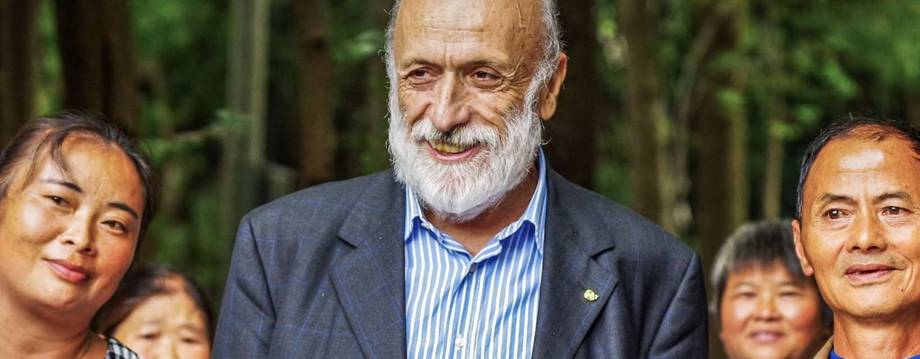
PHOTO: Carlo Petrini, Slow Food founder
Slow Food in the UK has more than 100,000 members and many more people offer their time voluntarily to Slow Food projects. It offers virtual activity for those who do not have ready access to one of the 20 local groups, and its in-person community programmes are many and varied.
“We run programmes aimed at teaching kids to cook and grow, and projects around communal eating,” says Shane Holland, the Executive Chair of Slow Food in the UK. “We even have a new project for older men who have lost their wives, so they can learn how to cook. Through these programmes we promote joy, a shared moment of happiness around the table with plate or glass, and the belief that everyone — regardless of income — deserves something good.”
This attitude extends to Slow Food UK’s political campaigning. Some of its current actions include calling for unlabelled Gene Edited foods (similar to GMO foods) to be taken off supermarket shelves. In June of this year, a high profile victory after five years of campaigning saw the High Court rule that DEFRA’s decision to deregulate certain gene-edited organisms (PBOs) was unlawful, as the impact of removing safeguards like traceability and labelling had not been properly investigated.
For most people though, the real impact of Slow Food comes through rubbing shoulders with their local group. Tish Dockerty is the co-chair of Slow Food Ludlow Marches, the UK’s largest and arguably most active group.
“In Ludlow, people can take it for granted slightly that they’re blessed with great quality local produce,” Tish says. “But that’s not typical, so our group is putting the producer back on a pedestal, because if we don’t support them they can disappear overnight.
“We put on a lot of events. We’re finding that people are enjoying tasting and interacting with producers. The tastings we run at bigger events like Ludlow Food Fair are great because they reach a broader audience. We keep them free where we can to make them more accessible. The Slow Food bar we run at festivals subsidises our other activities.
“We don’t want to be seen as a bunch of food snobs. Everyone eats, so what we do is relevant to everyone. Deciding where we buy our food and drink is possibly the most political thing most people do. We just want people to know more about what their choices are.”
As a producer herself, running a natural apple juice business called appleTeme, Tish also finds Slow Food gives her a sense of belonging and offers welcome support.
“The life of a food producer can be quite lonely, so being part of a larger group helps you to realise the importance of what you do. Financially, working for yourself can be a challenge, but it can be done. Having the confidence to try it and finding support is important. Now I love nurturing the next generation of producers, helping young people who are just starting up their own business.”
With a well established cycle of annual events, Slow Food Ludlow Marches is now looking to expand more into education, aiming to offer clear information about the value of eating well. Steve Guy — better known as The Hungry Guy — is the group’s Education Officer and he has set up a collaboration with Ludlow & Area Community Partnership to offer kitchen skills and hospitality experience to the young people who live at the Ludlow Foyer housing project.
“It’s jointly funded by Shropshire Community Foundation and our group,” Steve explains. “We’re giving workshops on cooking, budgeting and how to phase cooking into their life a bit more. They’re all on universal credit so it’s extremely difficult for many of the residents to manage.
“But the main aim is to give these kids some tangible work experience and help them find a role so they can be in full time employment. What I’ve found so far is that these kids just need a bit of self belief. They need someone to back them a little bit. The next generation are the people we need to inspire to eat better — to value themselves more as well as their local community.”
The tangible impact Slow Food has made in preserving food heritage and democratising access to nutritious food is undeniable. However, it feels like there is still a long way to go to get its point heard by the general public in the UK. The movement is relatively unknown to most people, despite the large number of activities it engages in.
While those who campaign for, and volunteer with, Slow Food tend to be welcoming and down-to-earth, it feels like they are pushing against the tide. Too often, locally sourced, good quality food is discussed with overtones of elitism and exclusivity in the media, and that can discourage people from discovering Slow Food principles for themselves. Producers are written off as expensive and bougie, rather than the passionate, hardworking people they really are.
It doesn’t help that Slow Food International is founded on an intricate web of unfamiliar vocabulary. For example, it uses ‘Presidium’ to describe a community of producers that protects a specific product, plant, species or technique that is under threat. To the outsider, this can make accessing Slow Food feel daunting, or come across as snobbish or sneering. What is the difference between the ‘Convivia’ and a Slow Food ‘Community’? I have no idea, and I’ve been working alongside the movement for a decade now.
Using clear, approachable language would, I think, help more new people at least to get to grips with Slow Food principles without being put off from the get go. Perhaps the next step for Slow Food, as it finds its way into this new chapter without Carlo Petrini, is to work on making itself more accessible, not just the food and drink it champions. After all, Slow Food’s aims are laudable and have a track record of being realised all over the world — there’s no need to embellish or overcomplicate a story that’s already inspiring, relatable, and can stand on its own two feet.
Share this article
You’ve reached your limit of 5 free articles this month.
Unlock unlimited access and more

Join Beer52 and get your first month half price
-
Get your first box for £13.50 (RRP £27).
-
8 beers & 2 snacks delivered monthly.
-
Printed Ferment magazine included.
-
Unlimited access to all online content.