Bière of the people
Allow Anaïs Lacoq to introduce you to a drink that is profoundly French, and almost unknown to all but natives.
Anaïs Lacoq
Saturday 22 August 2026
This article is from
Italy
issue 134
Share this article
The bottle is unmistakable. Dark as the liquid it contains, with a bright red screw cap and a slightly old-fashioned label. It depicts a horse-riding French colonial soldier and a wreath of oranges. Above, five bold red letters gives you all you need to know: PICON.
“As a child, I remember watching my grandparents drink this strange beverage, the bottle’s label fascinated me,” says Camille Sergheraert, a Picon enthusiast living in Lille. “Drinking Picon is also an emotional bond I’ve kept with them.”
Amer Picon is an 18% ABV bitter spirit made with gentian and orange. The drink was created in 1837 by Gaétan Picon, a colonial soldier based in Algeria, first as a herbal tea that later became a 39% ABV liqueur to treat illnesses that soldiers weren’t used to dealing with. Like many things to do with the history of any alcoholic beverage, this origin story must be taken with a pinch of salt. Amer Picon (first called Amer Africain) quickly crossed the Mediterranean sea to establish its first French factory in Marseille in 1870, where people liked to mix it with water seltzer. Since it was also sent to soldiers in various other French colonies, Picon spread back to their home region, where people applied their own drinking tradition to the bitter spirit.
In northern and northeastern France, close to both Belgium and Germany, that looked like mixing Picon with beer, creating what may be the most French drink ever (more than red wine or champagne if you ask me): Picon-Bière. The growing popularity of this mixed-drink made the company release its now iconic bottle of Picon-Bière in the 1960s, specifically designed to be enjoyed with beer. Other brands offer a similar orange bitter spirit, but they never reached Picon’s fame and recognition. Enter any French café or bar and you’ll be guaranteed to see it on the shelves: otherwise, I urge you to turn around and choose a more decent venue.
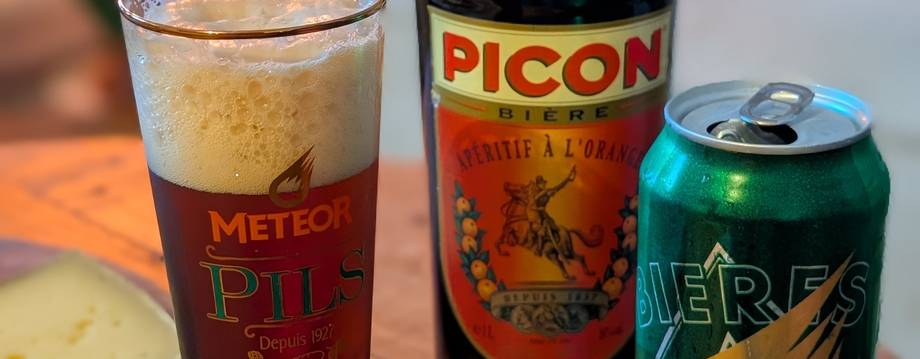
PHOTO: Anaïs Lecoq
“Everyone has their own Picon-Bière recipe, one they’ve inherited or adapted, something that needs to be passed down,” says Marie Le Gars, treasurer of L’Amicale Flamande du Picon-Bière, an association dedicated to the drink in French Flanders, next to Belgium. For Camille, it’s Meteor Pils from Alsatian brewery Meteor (which is also my personal favourite) or Luxe du Moulin, a lager from northern brewery 3 Monts. Both are “light, dry and not-too-sweet beers that pair perfectly with the sweetness of Picon”.
Depending on where they live, Picon drinkers enjoy the drink in different ways. In Alsace, people usually add a small dose of Picon to a light lager, until it takes on a coppery tint (called a Picon cuivré). In the north, people can pair it with a light blond beer as well as a tripel like Paix-Dieu, with a way stronger dosage, achieving an almost black beverage.
Members of L’Amicale call it a “Picon Bourbourg” as an homage to Chez Jeannine, a restaurant in the town of Bourbourg. “It’s a roadside restaurant, a no-frills joint where you’re expected to finish your plate or get scolded by the owner,” Marie says. “Jeannine pours Picons that are out of this world.”
In the small village of Houtkerque (978 inhabitants), there’s another place everyone considers a pilgrimage spot for any proper Picon lover: Café Saint-Éloi. At 91 years old, Gisèle Coudeville is still managing the place she took over from her parents in 1958, with the help of her daughter Annie. Her strong Picon — one with more spirit than beer — earned her the reputation she still enjoys: “It’s true that the pour is a bit heavy, I’m not stingy” Gisèle says simply. “I’ve always been here with my parents so it will be hard to let go, but I’ll have to one day.”
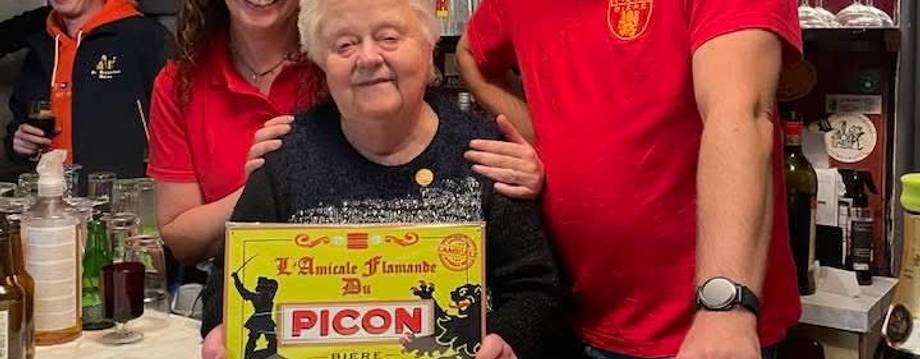
PHOTO: Gisèle Coudeville © Marie Le Gars
For now, Gisèle — also known as “the queen of Picon” — can count on a strong and loyal clientele coming from the area, as well as Belgium (though Belgian people would never pair Picon with beer and come for a mix of Picon with white wine and lemon syrup). “The decor feels straight out of the 1960s, the dusting gets done once a year, the tables are Formica, it’s the whole package,” Marie says. “After drinking Gisèle’s Picon, you’ll never be cold again. It’s just a truly exceptional venue, an institution, both Gisèle and the place itself.”
What makes Picon-Bière a staple in French drinking culture isn’t just the drink itself but what it represents to people. Regions where Picon still thrives today are historically industrial working-class areas. It’s that same demographic who adopted the drink and made it what it is today: miners and factory workers are the OG Picon drinkers, using the bitter spirit as a way to enhance their long labouring days.
“Wine tends to be seen as bourgeois here, while beer is more popular, more accessible, and far more unifying,” Marie says. “If you visit a friend who doesn’t have what you’d call ‘noble’ alcohols, Picon becomes that little treat when a guest comes over. It has that ‘pulling out all the stops’ feel.”
People who drink Picon-Bière usually claim an attachment to the working-class, which has also made their reputation. Foreigners have probably never heard of Picon while visiting France because it’s not deemed interesting enough to be displayed and advertised as a must-drink. “Beer is trendy again, but Picon will always be looked down on in some circles,” Marie says. “Honestly, I think that’s actually where its strength lies.”
Share this article
You’ve reached your limit of 5 free articles this month.
Unlock unlimited access and more

Join Beer52 and get your first month half price
-
Get your first box for £13.50 (RRP £27).
-
8 beers & 2 snacks delivered monthly.
-
Printed Ferment magazine included.
-
Unlimited access to all online content.