Berlin city guide
Relax, you're in Berlin!
Richard Croasdale
Header photo:
Florian Wehde
Saturday 19 September 2026
This article is from
Culinary Germany
issue 135
Share this article
Is there a style of cuisine or even a dish that Berlin can truly call its own? Prussian cooking was frugal, pork-based and meant to stick to your ribs, such as Eisbein, boiled pork knuckle with sauerkraut and pea purée, or Buletten, the flat, fried meatballs sold cold from bakery counters. Even the dish Berlin adopted as its own, the veal meatballs in caper sauce called Königsberger Klopse, arrived with refugees from East Prussia. The German capital has always embraced the foods arriving at its door.
Indeed, if there is a single dish that Berlin could claim as a signature innovation, it’s arguably the humble Currywurst. This street food staple was assembled in 1949 by Herta Heuwer at a snack stand in Charlottenburg, from curry powder and Worcestershire sauce acquired from British soldiers and ketchup from the Americans, poured over a boiled-then-fried pork sausage. It’s a dish made entirely from occupation rations, and – as even its most passionate admirers will concede – is best enjoyed with some prior knowledge of its cultural importance.
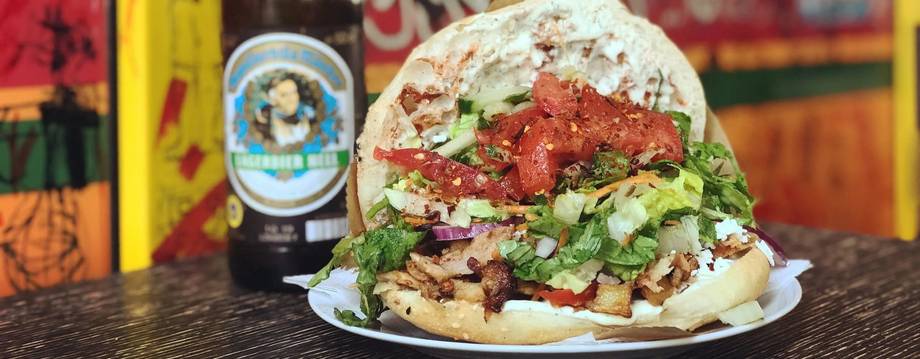
PHOTO: Sam Panzer
Then perhaps there’s Döner, usually credited to Kadir Nurman, a Turkish worker who in 1972 set up opposite the Zoo station, selling spit-grilled meat in flatbread to busy travellers. The claim is contested – another Berlin restaurateur says he did it a year earlier on Oranienstraße – but the salient point is the dish that became the de-facto patron saint of Big Nights Out across Europe was invented by people Berlin had recruited to work in its factories.
Kreuzberg and northern Neukölln are where Turkish and Arab cooking is best and cheapest, with markets to match. Out in Lichtenberg, a vast Vietnamese wholesale complex serves the community that arrived as contract workers in East Germany in the 1970s and 80s and stayed after the Wall came down, which is why Berlin's Vietnamese food is among the best you’ll find in Europe. Prenzlauer Berg seems for some reason to have committed itself to really nailing brunch (successfully), while upmarket Mitte is predictably well served in the fine dining department.
And there’s a lot going on at this top end; Berlin is the most starred city in Germany, with nineteen restaurants holding twenty-five stars in the 2026 Michelin guide. The prevailing style is less French than Nordic in temperament, with obsessive local sourcing (some kitchens refuse ingredients from outside Brandenburg entirely) and vegetables treated with as much reverence as meat, if not more. Berlin is arguably the vegan capital of Europe, with well over a hundred fully plant-based restaurants. Very cool.
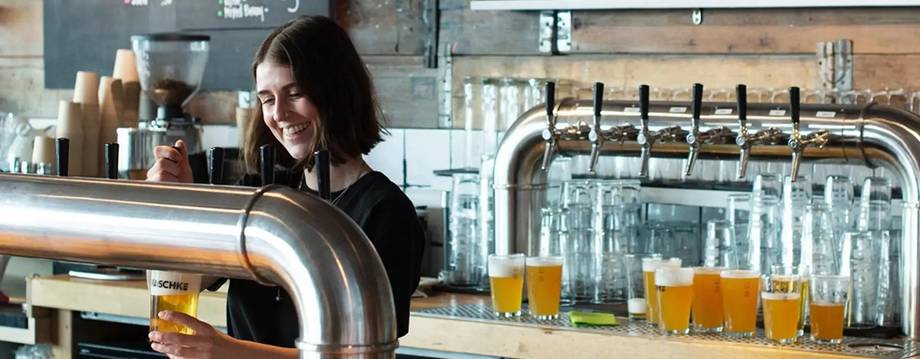
PHOTO: BRLO
A WORD TO THE WEISSE
One claim to home-grown originality that Berlin can solidly hang its hat on is Berliner Weisse, a sour, low-strength wheat beer fermented with lactic acid bacteria and Brettanomyces. By 1770 the city had 289 breweries, thirty of them making Weisse, and at its height something like 700 pubs specialised in it. Napoleon's troops are said to have called it the champagne of the north (its tight carbonation in particular gives it a Champagne-ish quality). Berliners drank it with a caraway schnapps chaser, which any Hamburger would recognise.
Then Pils arrived and Weisse – like so many beloved regional styles – was eviscerated by the lager beast. Worse, it wasn’t even allowed a dignified death; from the 1920s, drinkers began adulterating it with woodruff or raspberry syrup to mask the sourness, and the style spent the twentieth century as a green or red novelty, strictly for the tourists. By the 2000s a single industrial brewery still made it. Its revival came with the arrival of craft brewers, always on the lookout for under-appreciated regional styles to own. Berliner Weisse is now fully rehabilitated, brewed properly by several independent Berlin breweries and many more across the world.
Learn more about Berlin based brewery BRLO.
Share this article
You’ve reached your limit of 5 free articles this month.
Unlock unlimited access and more

Join Beer52 and get your first month half price
-
Get your first box for £13.50 (RRP £27).
-
8 beers & 2 snacks delivered monthly.
-
Printed Ferment magazine included.
-
Unlimited access to all online content.