Wiper and True: Home grown
Might Germany’s greatest export be its brewers? [Promotional feature]
Robyn Gilmour
Photos:
Wiper and True
Saturday 19 September 2026

This article is from
Culinary Germany
issue 135
Share this article
If you ever get the opportunity to buy Marvin Lindner a pint, I implore you to do so. I’d heard much about Wiper and True’s director of brewing operations long before I met him, mostly on occasions surrounding the brewery’s celebration of Oktoberfest, and how its annually brewed Festbier draws on Marvin’s experience as a German brewer. Wiper and True isn’t a German beer brewery, but speak to any member of staff and it’s obvious that Marvin’s experience is considered a real asset, and his coming from a German brewing tradition is widely celebrated. Such a setup begs the question; how do we differentiate German beer from German brewing? What assumptions do we make about the practice because of the product, and can considering other traditions teach us anything about our own attitudes to brewing?
Here in the UK, there’s countless ways to become a brewer – you can study at university, learn on the job, take a short intensive course, start as a homebrewer – and quite often brewing is a job that people fall into, usually through their passion project becoming a business. In times gone by, the more common route to a brewing career might have been to work your way up through the ranks at a large, regional brewery, but with few of these institutions of British beer remaining, brewing is a career that needs to be sought out, and often fought for. In Germany, and Bavaria in particular, such institutions are plentiful and consequently, there are more opportunities for people to engage with the brewing process, or simply work in a brewery setting.
“I started to work on school holidays in a local brewery,” says Marvin. “Schweiger is next to my hometown, so I just worked there, sorting the return bottles – because, in Germany, we have a return scheme – to earn pocket money when I was like, 14 years old. Then I did a few internships also during school holidays in different breweries like Paulaner, at Giesinger when they were in a very small garage. Then, when it came to getting a job, I was between becoming an aeroplane engineer or a brewer; most people do apprenticeships as part of any job, so I went for the brewer route and did my apprenticeship at Spartan-Franciscaner for three years. After that, I had to work there for one year to be able to do my Master Brewer.”
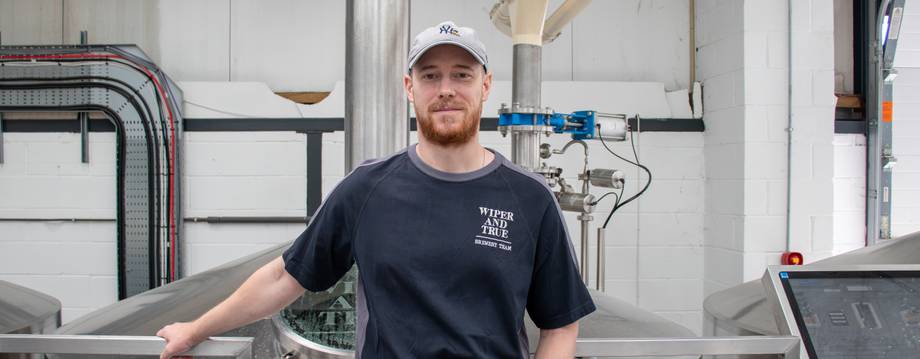
PHOTO: Marvin Linder, director of brewing operations
Reputation precedes each of the breweries mentioned, being either stalwarts of the Franconian beer trail, part of Munich’s Big Six breweries (the only six breweries permitted to brew Oktoberfest beer), or cult classics in their own right. The most fanatic German beer geek couldn’t concoct a more impressive resume and yet Marvin says he got into brewing because “in Germany, brewing is more like a job. In some of these breweries, I’ve worked with people who don’t even drink beer, either for religious reasons, or because they just don’t like the taste. It's very different to the whole journey of becoming a brewer here.
“In Germany you can go two routes. One is that you finish school and go straight to study at Weihenstephan for four years, and then you have a few months of working at a brewery. Or, you do the apprenticeship, in which you do three weeks of work then one week of school for three years, then you work for a year to be able to do your Master Brewer, and then you also have your bachelor. So it’s two different routes; one is more practical and one is more theoretical. I never really liked school so the more practical route worked better for me.”
Amusingly, when it came to choosing a job, Marvin had a choice of becoming a brewer, or an aerospace engineer – he had offers to do internships in both fields, but found the interview for the latter offputting. “The opportunity to become an aeroplane engineer was through the military and having military people interviewing me was a little weird,” says Marvin. “So I thought ‘nah, I’m going to do brewing.’ Obviously, the free beer you get was another contributing factor, but I always knew I wanted to leave Germany, so I thought maybe brewing was the better job to do for this.”
The year after getting his Master Brewer qualification, Marvin followed through on this promise to himself, moving to Spain to work with Cervesa Tyris, and then later to Bristol where he was offered a job with Wiper and True. In both instances, Marvin was an integral part of the brewery’s move into a bigger site, and was able to use his network in Bavaria to connect with brewkit manufacturers that would best serve the brewery’s needs. “The person who built the brewkit for us, is kind of like a mentor in a way,” says Marvin. “He's more than 60 years old now, so has seen everything. There are quite a few people I get back to now and then because they’ve been longer in the industry. I’d already worked with him on the project in Spain when I came here, so it was nice to work with him again.”

Marvin is still in touch with old colleagues at Spaten, as well as peers from his Master Brewer course, many of whom scattered around the world after graduation. As much as brewing is seen as a job like any other, in Germany, producing Master Brewers is a great source of pride for Munich. “There's maybe only 20 people who become a brewer every year in Munich, and when they do, part of the city centre is closed off and there’s a big parade and free beer for the public,” says Marvin. “You get knighted and have lunch with the mayor. It’s a big deal. I think they're very proud that people go out in the world but a lot of people stay in Munich too.”
I ask Marvin, given his training and the input of old colleagues, if the brewery at Wiper and True is set up to best brew German styles, but he says, that’s not really the point. “Direction doesn’t come from me. We are a brewery where everyone working here is influencing everything, we don't have a single person deciding all the beers we do, or all the recipes,” he says. “Normally everyone is involved, or people can come up with ideas. For example, one of our brewers is from the Czech Republic, and we made a Czech lager, which was entirely his doing. I think being a German brewer is a great asset, and what I found in the UK, or in the industry here, is that everyone's super interested. They want to ask questions and want to learn because they really respect the German brewing tradition, but I also equally respect the British tradition, or any other form of brewing, like from Belgium or the Czech Republic.”
Perhaps we’d do well to start thinking about countries with great beer traditions as producers of brewers as opposed to just beers, and consider breweries places of learning, instead of sites of production. In fifty years time, where will young people in Britain learn to brew cask beer? How do we create and protect the infrastructure that will allow people to pursue careers in brewing? Can people who study brewing in Britain afford to stay here? Perhaps it’s worth paying closer attention to other countries' attitudes to brewing, and asking ourselves what we can learn.
Share this article
You’ve reached your limit of 5 free articles this month.
Unlock unlimited access and more

Join Beer52 and get your first month half price
-
Get your first box for £13.50 (RRP £27).
-
8 beers & 2 snacks delivered monthly.
-
Printed Ferment magazine included.
-
Unlimited access to all online content.