It's giving me foam-o
From milk pours to kölsch service, Matthew Curtis considers whether British breweries could benefit from embracing different kinds of beer service.

Matthew Curtis
Header photo:
Pilsner Urquell
Saturday 19 September 2026

This article is from
Culinary Germany
issue 135
Share this article
It’s a typically beautiful day in the city of Fort Collins, Colorado. The sun is high in the azure-blue sky, with the creeping shadows it casts informing me it’s almost beer o’clock. Jumping on my bike, I ride along tree-lined streets until I arrive at Stodgy Brewing Company, one of the city’s smallest breweries.
Established in September 2020 by Natalie Yoder and Tyler Olpin, this suburban retreat quickly became popular thanks to its excellent beers and strong focus on local provenance, with many recipes using 100% Colorado-grown barley. It’s also a draw thanks to its massive beer garden, with plenty of that aforementioned tree coverage providing shelter from the intensity of the high-desert sun.
Usually on visits to the taproom, I might grab a pint of their award-winning Scottish Ale, or perhaps one of its IPAs that make use of locally-grown, Colorado hops. Not today, however, today I’m here for the service, as much as the beer. On certain occasions between late spring and early autumn, the taproom offers kölsch service. This means that, for a couple of hours at least, the choice is limited to Stodgy’s tribute to the ale/lager hybrid that originated in the German city of Cologne.
“When we brewed our first batch of kölsch-style ale, kölsch service was gaining popularity at craft breweries around the country, but no one in Fort Collins had tried it yet,” Tyler tells me.
“We wanted to do it right, so we went all out. We had custom kranz serving trays made [a circular tray designed specifically to carry stange glasses], purchased blue button-up vests to pay homage to the Köbes (servers) of Cologne, and dedicated the entire back patio to kölsch service, serving only stangen of kölsch for a more immersive experience.”
PHOTO © Stodgy Brewing Co
It’s an interesting proposition. Normally tap rooms are places you visit to experience a wide range of beers, but this type of service is designed to sell you just a single beer style. You can’t deny there’s something of an appeal to it; switching off and enjoying glass after glass of a delightful kölsch that’s just perfect for late-afternoon sunshine sipping. Each glass glides down, and before you know it a fresh one has been set down beside you. It offers something different, something memorable, something to maybe tell your friends about.
“People get excited about the experience and always want to know when the next one will be,” Olpin says.
After experiencing kölsch service at a couple of breweries in the US, I started to think about how trends have so often defined the identities of small breweries. At one point, being a small, contemporary brewery meant being invested in innovation and experimentation – which, for several breweries, simply meant hoppier and juicier IPAs. After a while though, a lot of breweries “innovating” in this way started to produce beers that, well, taste pretty similar to one another. How then, does a modern bar or brewery find its niche in a highly saturated market?
“The average craft beer drinker has matured and is either drinking less in general and/or just has less time to go to the taproom as often,” says Phil Vasquez, marketing manager at Beermiscuous, a specialist beer bar in Highwood, Illinois, on the outskirts of Chicago. “Hype around beer releases has died down.”
Phil explains how beer range alone no longer has enough pull to bring in customers, so the bar has had to innovate when it comes to “taproom experience”, as he calls it.
I’m visiting taprooms for the experience. Beer service is paramount to this
This means that, in addition to a concise, yet superb range of beer on draught, there is also a range of service options available. At Beermiscuous this includes traditional, British-style cask service via beer engine, foam-laden Czech pours via Lukr brand faucets, and something I hadn’t come across until very recently: the Japanese ‘sharp pour’. Originating from bars in Tokyo, it involves pouring beer without any foam at all, before topping it up with a tight, ‘wet’ head of dense foam at around a 70:30 beer-to-foam ratio. The idea is that it provides maximum aromatics, while keeping the crisp, refreshing quality of the beer wholly intact.
“We are able to put more of a barista-like care into pouring our beers on [the] Lukr faucet, and into the Japanese-style pouring,” Phil says. “Just like there’s a difference between a latte versus a cappuccino versus a flat white, there's a difference in texture and taste in the same beer whether it's served as a sharp pour, versus pour once [single-draw], versus mlíko [milk-pour].”
My experience with pours like this, which includes the fabulously frivolous ‘foam shots’ (small glasses of exactly what it sounds like), is one of sheer enjoyment. Gone are the days where I spent an age browsing through lengthy taplists looking for the most sought after release. Instead, I’m visiting taprooms for the experience. Beer service is paramount to this.
It got me thinking about whether or not there would be any enthusiasm for foam-heavy beer pours in the UK. Drinkers – especially younger drinkers – seem to love foam. You only have to see the reverence given to Guinness, or perhaps a great pint of cask beer pulled through a tight sparkler, to see this. But there also remains an attitude, a hangover if you will, that beers served with ‘too much’ foam are somehow short-changing customers.
Much of this originates from the Weights and Measures act of 1972, which mandates that beer is served in half and full pints, to the line (amended in 2011 to include thirds and two-thirds). This means that should a bar decide to go all out and start offering mlíko pours, any customer would be well within their rights to report the practise to Trading Standards, arguing patrons of said establishment were being undersold.
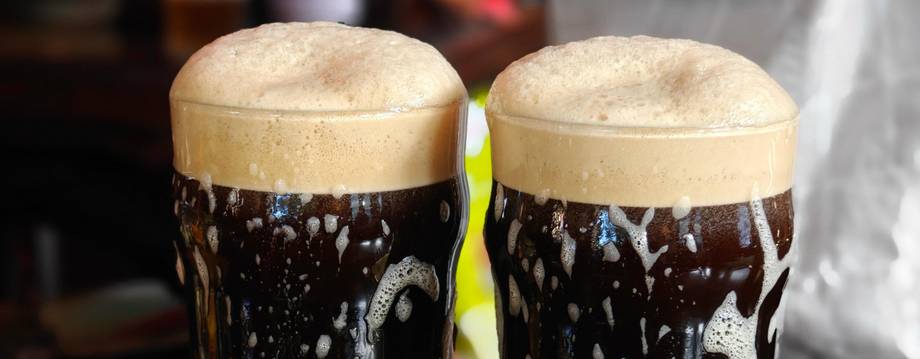
PHOTO © Woodshedding Brewery
“The Weights and Measures act is a bit of an issue if we want people to be able to offer the full range of pours,” says Lauren Soderberg, UK brand ambassador for Czech beer brand, Budvar. “In the UK we have our glasses lined at a two-thirds if people want to serve the classic Czech pour. [However] even with that line on it, its slightly less foam than you would get over in the Czech Republic.”
One British brewery seeking to provide an experience that is both rooted in tradition and breaks from the taproom norm is Woodshedding. Established in 2024 on Somerset’s Westcombe Farm, brewer Adrian Peskin is creating beers that draw on both his Germanic ancestry, and British brewing history.
A fine example of this is demonstrated by Adrian’s stout. Called HI-LO, serving it requires not one, but two casks: one heavily primed so that it pours mostly foam, and another far less so, pouring beer in its liquid state. The system is designed to mimic how Guinness was served before the advent of nitrogenated dispense in 1956, and involves using the first cask to fill a glass almost entirely with foam, before topping it up from the other after it has been given a few minutes to settle.
“I think you can be honest and open about a trick or illusion and it still be magical,” says Adrian, who adds that he came up with the idea after reading about the inventor of nitrogen dispense, Michael Ash.
The result is a visually appealing beer, with a dense, dome-like head of foam capping the satisfyingly brown stout. It’s more than a beer on a taplist; it gives the customer a genuinely memorable experience. Perhaps that experience is one more British brewers could find ways to capitalize upon?
Share this article
You’ve reached your limit of 5 free articles this month.
Unlock unlimited access and more

Join Beer52 and get your first month half price
-
Get your first box for £13.50 (RRP £27).
-
8 beers & 2 snacks delivered monthly.
-
Printed Ferment magazine included.
-
Unlimited access to all online content.