Rye on time
Considering the success of kombucha and kefir, Charlotte Cook reckons kvass is soon to find favour among UK drinkers.
Charlotte Cook
Saturday 19 September 2026

This article is from
Culinary Germany
issue 135
Share this article
Ask any eastern European about their childhood memories of summer and kvass will probably feature quite heavily. Across the region, great yellow cisterns would sit by roadsides and on lake shores, all filled with the non-alcoholic fermented soda made from rye bread. Nowadays many of the cisterns have been replaced by draught lines serving the sweet, malty drink, or big plastic bottles that are lugged to a picnic, but the love of kvass hasn’t gone away.
Far from an exclusively commercial product, kvass would traditionally have been made at home by fermenting leftover rye bread with yeast (either commercial varieties or wild strains from the skins of raisins) and sugar. The resulting drink would make for a healthier alternative to soda. In countries where pickling is a common way to preserve food, fermenting at home is a normal practice and doesn't suffer from the 'good life' association of homemade kombucha here in the UK.
While kvass might be unfamiliar to many people in Britain, the drink has been sold here for decades. When Poland joined the EU in 2004, and easier trade and travel allowed Polish people to settle in the UK, speciality supermarkets began opening to cater to new communities that were forming. As such, kvass has been stocked in a fridge near you for quite some time now. Most kvass that is industrially produced is made from sugary syrups and is artificially carbonated, more like a post-mix concentrate than a probiotic with thrifty origins. As eastern European society has changed over the last 35-or-so years, this version of kvass has also taken over the market, leaving it to craft kvass makers to keep the tradition alive. One such brewer is Martin Vahtra, the head brewer of Põhjala in Tallinn, where a kvass line has recently been launched. Martin grew up with kvass (known as kali in Estonia) and is one of a growing number of brewers across the Baltics who are swapping barley for rye bread, at least one day a month.
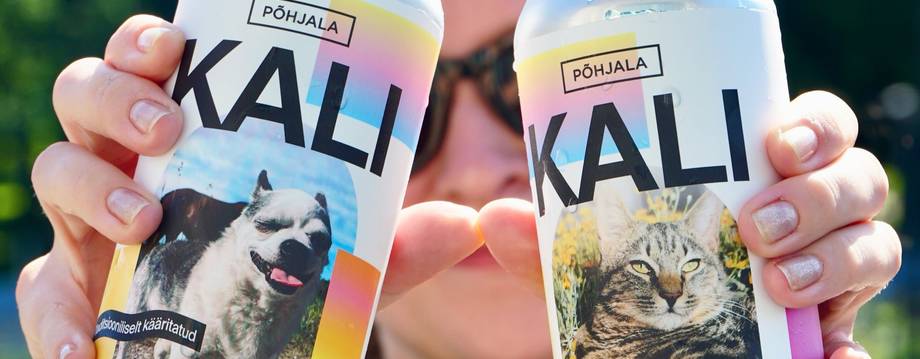
PHOTO © Põhjala
We are even seeing a small kvass revolution taking place in the UK. Brought over by people who have made their home here and want to share a taste of their childhood with Brits, craft kvass is primed to join kefir and kombucha as increasingly mainstream probiotic alternatives to alcohol.
One such kvass maker is Anton Puzorjov, a PhD scientist originally from Estonia, whose passion for kvass is evident. He wanted to make something that would serve as a high-quality alcohol alternative and now runs Quas, based in Edinburgh. He is brewing kvass weekly and shipping fresh, refrigerated cans out to customers, but also makes shelf-stable kvass for retail outlets throughout the UK.
Soon after Anton first started making kvass, he realised that the key to reproducing the complex flavours of the kvass he remembered from childhood, would be to find the right sourdough starter. After some searching, he connected with a family who have been making rye bread for generations, and with rye grown on the family farm no less. While Anton is very protective of the origin of the sourdough starter he acquired, he does tell me it is 180 years old, and he brought it across many borders to start making the first authentic kvass in the UK.
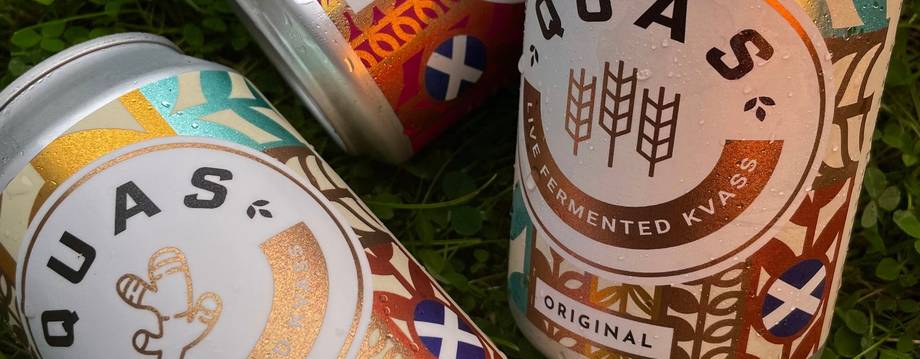
PHOTO © Quas
The sourdough starter is key to Anton’s kvass; he tried multiple cultures until he was certain of the one he wanted. Unlike commercial brewer’s yeast, sourdough starters contain many strains of yeast and lactic acid bacteria, giving a unique terroir to the bread, and indeed to kvass. The added benefit of using such an old strain is that it is stable. Some family breweries in the UK pride themselves on using the same yeast for generations, giving the beer a unique taste that can never be replicated. In the same way, Anton’s yeast ensures his kvass has a unique flavour, and reflects his cultural heritage in a tangible yet romantic way.
Whether or not Estonia's rich sauna culture has anything to do with it, Quas has found a particularly strong market among community sauna goers. These portable units are increasingly springing up across the UK, and are largely attended by those interested in health and wellness. For this demographic, the fibre content of kvass – all 6.7g per can, in the case of Quas' offering – seems to be of particular interest, though Anton says that taste is the most important thing to him. “We focus entirely on flavour. Expect toasted grain, dried fruit, gentle spice, and a clean sourness, with a natural, restrained carbonation that is not cloying.”
Good kvass to me is experimental. There are so many different ways you can make and flavour it!
Another champion of craft kvass is Viltė Fuller, a former artist from Lithuania who is now making kvass in London. Her brand, Spooky’s Kiosk, also came from a childhood love of kvass. When Viltė noticed the rise of kefir, she says; “I was so shocked that Brits would be interested in fermented milk. As a result, I started to think, who is going to bring kvass over if kefir managed to succeed?” She wanted a career change, and kvass was a lingering thought, and so, cheered on by her husband, she found a production facility and began fermenting.
Spooky’s Kiosk sells several flavours, including rye and cherry, and beetroot and orange, with Viltė saying “good kvass to me is experimental. There are so many different ways you can make and flavour it! I think there's a lot of room to have fun with this beverage. Whether you make it yourself at home or save time and buy it.” Her kvass is made by producing the base liquid and then adding juices in, it is then gently pasteurised and probiotics added back in. Without the pasteurisation the kvass wouldn’t be shelf stable for retail, and Viltė wants to spread the word about kvass as far as she can.
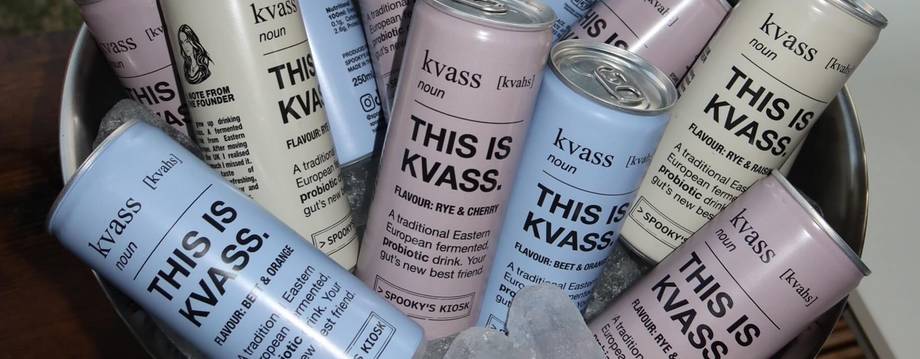
PHOTO © Spooky's Kiosk
Like Anton, Viltė also wants kvass to be a good alcohol alternative, and so is sponsoring events at Paris Fashion Week where she'll also be making inventive cocktails. She doesn't want kvass to be seen only as a health drink, but something that can be fun after dark as well.
Spooky’s Kiosk only recently launched, but Viltė says that the reception has already been positive, with pre-orders showing how much enthusiasm people have for the drink. Whilst kvass isn’t likely to supersede the more common soft drinks, there is definitely room in the market for interesting beverages that offer a more complex taste. As recently as ten years ago most Brits hadn't heard of kefir – now it’s a breakfast staple and the gut microbiome can be a dinner-table topic of conversation. All things fermentation are here to stay, and with passionate people bringing their childhood memories to the British market, there’s never been a better time to add a little bit of eastern Europe to your picnic.
Share this article
You’ve reached your limit of 5 free articles this month.
Unlock unlimited access and more

Join Beer52 and get your first month half price
-
Get your first box for £13.50 (RRP £27).
-
8 beers & 2 snacks delivered monthly.
-
Printed Ferment magazine included.
-
Unlimited access to all online content.