Trans-Europe express
Mark Dredge has traversed the continent to learn everything he can about beer on the mainland. Lucky for you, he's got some recommendations.
Mark Dredge
Header image:
FWT magazine
Saturday 19 September 2026

This article is from
Culinary Germany
issue 135
Share this article
Europe has a fascinating brewing heritage, comprising a patchwork of unique drinking cultures, and often hyper-local beer styles which have prevailed for generations. The best way to understand why any of this matters, is to taste the resulting beer for yourself.
Visiting the Pilsner Urquell brewery in Pilsen, Czechia, is undoubtedly in the top 10 list of must-do beer things in the whole world.
Long story short: back in the 1830s, the citizens of Pilsen revolted over the dire state of the local beer and pulled together to build a new brewery for their town. They used an innovative new malting technique to produce sweet, pale malts, and they took inspiration from neighbouring Bavaria by digging deep cellars into which they ‘lagered’ big wooden barrels of pale beer. It became the first golden lager, named after its hometown.
Some of those cellars still exist and on the Pilsner Urquell brewery tour you go down into the underground cellars and drink fresh cold pilsner lager directly from a wooden barrel. It’s an unrivalled beer drinking experience for its history and for how atmospheric it is to drink in 180-year-old cellars.
If I could tell you to go to any city in the world for a beer trip I’d point you straight to Bamberg in Germany. Think of it as the epicentre of lager where you can visit at least nine breweries and between them drink a dozen different lager styles, enjoying them in old cellars, cosy beer halls and quintessential beer gardens.
Bamberg is well-known for rauchbier, or smoked lager, and you should definitely try a glass of Schlenkerla Rauchbier Marzen in the brewery’s tavern – like a cloistered old inn, it’s wooden and smoky, and a place where brewing can be dated back to at least 1678. The smoky dark beer won’t be for everyone, but no one can leave this place unimpressed.
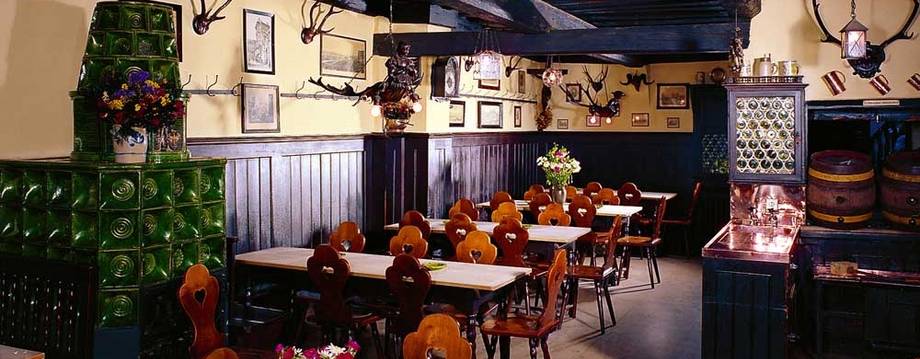
PHOTO © Schlenkerla
On a nice day, head up to Spezial Keller for a classic Franconian beer garden experience and a good view back over the city; check out Mahrs Bräu for their Ungespundet, known locally as ‘U’, for a malty amber lager that’s a classic taste of Franconian beer; then go opposite to Keesmann for their bright, bitter Herren Pils.
Want to drink at the oldest brewery in the world? Then go to Weihenstephan, just outside of Munich, which was founded in 1040 in a Benedictine monastery. Built on top of a hill, it’s now a modern brewery in the middle of a university campus, but still a great place to visit. Have their famous Hefeweissbier.
It’s not even a cliché that Oktoberfest is on this list because it’s actually an incredible thing to experience at least once. If you’ve been then you’ll know why it’s on the list. If you haven’t been then imagine what you expect Oktoberfest to be like and then treble it in size, make it even louder, even more fun, make the beer even more delicious, and then add a huge funfair on the side.
From the most famous festival to the most unique: Annafest.
A few hundred years ago, brewers in Forchheim, just south of Bamberg, would brew their beer in town and then transport it to a nearby hilly forest, where cellars were dug to ferment and store their beer. Over time, beer gardens were built above ground and it became a popular place for locals to go to drink fresh cool lager straight from the cellars. The area is now known as the ‘kellerwald’ or ‘forest of cellars’, and every year at the end of July there’s a beer festival called Annafest with beer gardens open all around the forest, which makes for a fun and unique location to drink litres of local ‘Annafestbier’.
While you're taking in beer gardens and cellars, beer halls are not to be missed. Developed in the 1800s, these used to be fairly utilitarian spaces: go in, find your own mug, rinse it at a special sink, pay a cashier who passed your mug to a man standing in front of a big barrel who poured you a beer. That same process still exists at the Augustiner Monastery in Salzburg (only now the stone mugs are clean when you collect them, though you can still rinse them in a central fountain). The beer is an excellent Austrian Märzen which you can take and sit in the various rooms of the beer hall or head out into the beer garden. It’s a nice reminder of what all big beer halls used to be like.
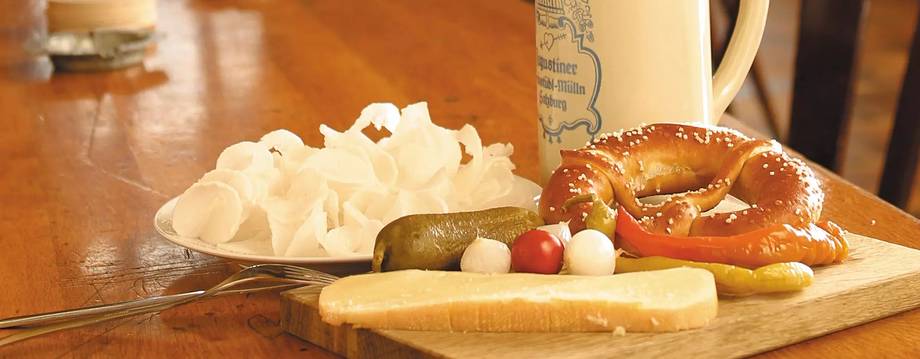
PHOTO © Marketing Concepts
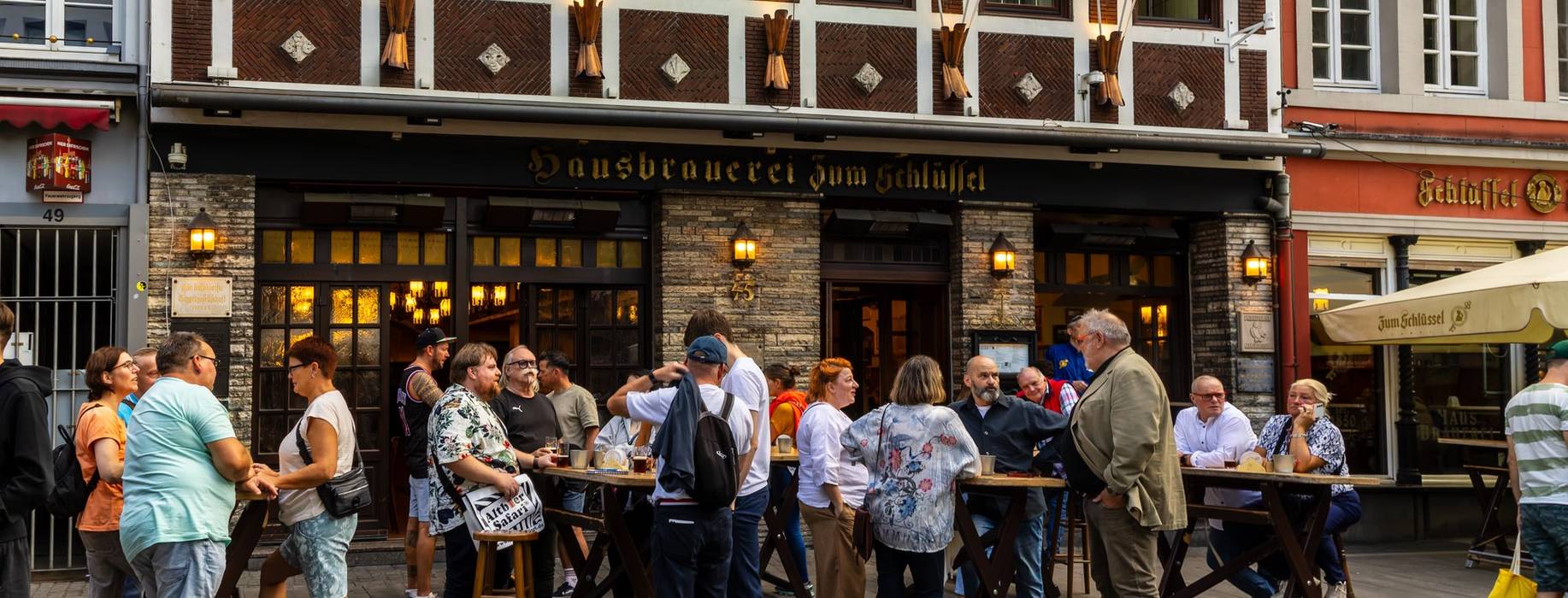
I think it should be part of any beer education that you’re made to go to Cologne and Düsseldorf. In Cologne you’ll have lots of Kölsch, a pale, dry and crisp beer served in small 200ml glasses, where as soon as you get close to finishing a glass, known as a stange, you’ll have a fresh beer placed in front of you and a pencil tick will be scratched into your beer mat.
Then go to Düsseldorf, a 20-minute train ride away, for almost the exact same experience but the beer is Altbier and it’s brown and bitter, and the 200ml glass is known as a becher, which is squatter in shape than a stange. Doing those two hyper-local beer experiences side-by-side is a brilliant way to understand how quirky local beer cultures remain in places – and how local rivalries can be based around beer (so you’ll need to pick a team: are you Kölsch or Altbier?)
In Belgium, Cantillon is one of the most fascinating and interesting breweries you can visit. It’s a short walk from the Gare du Midi in Brussels, and yet when you walk in it’s like you’ve stepped through a time warp and into a gnarly old barn (filled with beer tourists in colourful brewery t-shirts).
The tour at Cantillon is one of the best ways to properly understand how spontaneously-fermented lambic is made. As you pass through the brewery, you see the mash tun and kettle, then you pull yourself up a narrow wooden staircase to the top of the old now-innercity farmhouse where the coolship lives. It’s in this large, flat pan where hopped wort cools overnight and where wild yeast, which lives in the wooden rafters and the air all around, spontaneously starts fermentation. From there the liquid goes into wooden barrels in the cellar to ferment and mature for up to three years.
The really wonderful part is the smell in the cellar, where hundreds of barrels are stored, giving a strong aroma of old wood and the heady fruitiness of fermentation. Finish in the bar where you should be met with a glass of lambic – the beer straight from those barrels – or opt for a gueuze, a blend of barrels that’s bottled and carbonated.
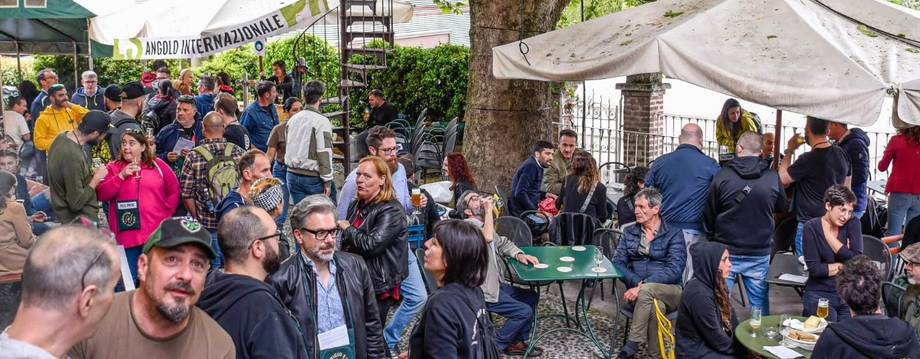
PHOTO © Birrificio Italiano
Belgium has so many other great beer experiences and amazing beer bars without any one single thing standing out. I think you should visit a few Trappist monasteries to drink in their brewery cafes, including Westvleteren to drink their 12 which has long been regarded as one of the best beers in the world (and you should at least drink a beer from each of the breweries). You should go to the brewery which makes your favourite Belgian beer (for me that’s Duvel). You should drink a glass of Stella Artois in Leuven, because no matter where you go, it should also be a rule that you need to have at least one glass of mainstream lager in a country.
There are lots of classic old styles in Europe, but there are also great modern ones, like the Italian Pilsner, first made by Birrificio Italiano. The original brewery bar is in Lurago Marinone, near lake Como, and they also have a newer bar in Milan. Start with the modern classic Tipopils. It’s a crisply bitter Pilsner dry-hopped with aromatic German hops, slow-poured into a tall, thin glass, with a thick white foam.
Part of the greatness of visiting Birrificio Italiano is the attention to detail in the service, with each beer coming in a unique glass, and altogether it feels like a neat combination of drinking in Belgium, UK and Germany. Their Bibock is a stronger, hoppier amber lager, while the Vudu Dunkelweizen comes in a squat, wide bowl of a glass. All the beers are great.
Then there’s Dublin, where it’s true that Guinness tastes better there than anywhere else, mostly because of the atmosphere and the freshness of the beer and just because you’re in Dublin. There are famous pubs, must-drink pints and places to go, but honestly part of the fun is just going from pub to pub and pint to pint and noticing those subtle differences as you look for your own favourite pint of Guinness in Dublin (I think my favourite pints have been in The Cobblestone, if you’re wondering).
There are more brilliant beer experiences throughout Europe. Go to the ruin bars of Budapest. Do a craft beer crawl around Copenhagen. Drink farmhouse ales in Lithuania. Go to upper Franconia to try zoigl which is made in communal breweries. It’s easy to read these things and see that Europe has a lot of history and variety, but to have actually experienced them gives you a much deeper understanding of why beer is such a wonderful drink, and how it developed in different ways in different places, and why that all matters to locals wherever you go.
Share this article
You’ve reached your limit of 5 free articles this month.
Unlock unlimited access and more

Join Beer52 and get your first month half price
-
Get your first box for £13.50 (RRP £27).
-
8 beers & 2 snacks delivered monthly.
-
Printed Ferment magazine included.
-
Unlimited access to all online content.