Devil's Peak: The Leviathan
What happens when a brewery gets so big that it takes on a life of its own? Cape Town-based brewery Devil’s Peak offers us a glimpse into life after exponential growth.

Robyn Gilmour
Photos:
Devil's Peak
Saturday 17 October 2026
This article is from
South Africa
issue 136
Share this article
Anyone who starts a business wants to see it become a success. Of course, what success looks like will vary from person to person, but Business 101 tells us that growth is good. I’d be surprised to learn of a brewery that didn’t at least occasionally dream of how a greater economy of scale might benefit them, but – for a myriad of reasons – exponential growth is something we rarely get to witness play out in the craft beer world. So, when it does happen, it’s worth sitting up and taking note. Between 2012 and 2026, Cape Town-born brewery, Devil’s Peak, went from producing 3,000 to 3,000,000 litres a month, a journey that has seen both the benefits and the demands of volume play out.
“It sounds very corporate to say that it’s only when you get the volume going that you can really start to dilute your overheads but that’s what you’ve got to do to survive,” says JC Steyn, general manager of Signal Hill Products and the first ever employee at Devil’s Peak. As one of the brewery’s four co-founders, and the man who’s been on the frontline of the brewery’s production since its first ever brew, he’s entitled to comment on what constitutes critical mass, even if it does sound corporate.
In his telling, Devil’s Peak started super small – literally brewing 500 litres a day – and was then heavily influenced by US craft and associated styles. “From there, we grew almost in a way that wasn’t organic,” he begins. “Craft was so big in South Africa then that a lot of investment was available, a lot of players entered the game, and people were building breweries that are still around today. As a brewery born around that time, we invested quite a bit, with our first big step up in growth coming when we bought this secondhand copper brew house – a really lovely 15hl system – from Germany, that initially came to Cape Town with one of Paulaner’s Brewhouse pubs.”
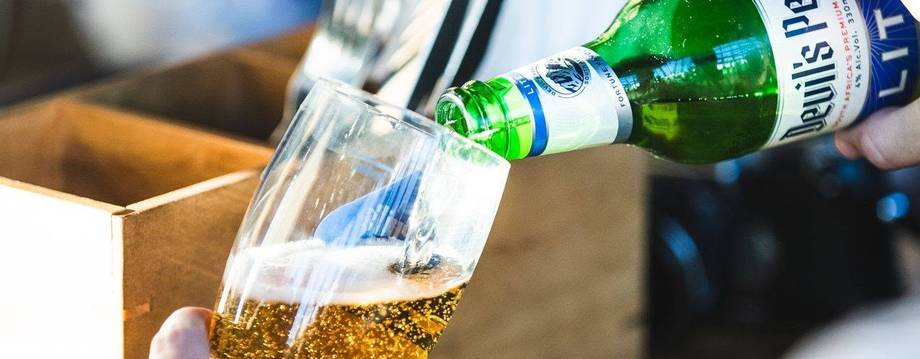
The team brewed on this system for three years, during which time its ambition outgrew the capabilities of the space. It began contract brewing whenever humanly possible, all to the ends of getting as much beer out in the world as possible. “Obviously, you always want to kind of remain true to this ‘craft’ notion, it’s romantic to a degree but it also remains a key part of what Devil’s Peak is today,” says JC. “That said, what keeps you going and what drives volume is making volume beers. You know, they don’t have to be mainstream lagers, and they don’t have to be boring by any means, but there came a time when we had to pivot.”
“There’s a huge market here but, at worst, 80% of it is dominated by one brand, and then Heineken could catch up a little bit of that, so craft is left with 1% of the market. We realised then that selling IPAs and pale ales, as great as they are, wasn’t going to help us grow in South Africa, where the climate is conducive to drinking lagers.”
Given Devil’s Peak had made a point of saying they’d never brew a lager – the style historically, and overwhelmingly consumed in South Africa – the decision to concede to demand wasn’t an easy one. That said, the volume that lager promised immediately freed up the team to work and play in other ways. In 2016, the same year that Devil’s Peak embraced lager, it began construction on the Cape Town-based facility it currently calls home, and where it now produces 3,000,000 litres a month.
“It didn’t start off like that,” JC assures me. “It was small volumes, and then we grew. Our brew house was always big enough, and over time we just added more fermenters, more bright beer tanks, more staff, a second packaging line.” With lager sales diluting overheads, the Devil’s Peak team had time and space to innovate. It developed a sizeable barrel programme that I’ve heard other South African breweries describe as nothing short of extraordinary. JC trained and worked as a wine maker for 10 years prior to joining Devil’s Peak, and so brought that experience to an expansive wild fermentation, blending and barrel-ageing programme that incorporated elements of beer, wine and cider making.
It developed a sizeable barrel programme that I’ve heard other South African breweries describe as nothing short of extraordinary
During this time, the team also developed an alcohol-free offering which, just a couple of years later, would allow Devil’s Peak to remain operational during South Africa’s pandemic-induced prohibition. “During lockdown no one was allowed to brew alcohol, but because we had our non-alc, we were allowed to come back to work after three weeks,” says JC. “It’s quite funny, because for one month we were the biggest beer brand in South Africa. SAB [South African Brewers, owned by AB Inbev] decided not to make their non-alc, and Heineken couldn’t get theirs into the country because of the lockdown, so we were the biggest beer brand in the country, because there was nobody else. That’s one for our resumé.”
Finally, and perhaps most importantly, in this period of innovation between 2016 and 2020, Devil’s Peak acquired a still, and began distilling. The resulting spirit warranted its own brand, which instigated the creation of Signal Hill Products, the parent company of Devil’s Peak, this distillery, and later, many other drinks brands.
“Then in 2023, we made a bid to purchase Strongbow Cider in South Africa,” says JC, marking the point at which Signal Hill took a hard right turn, out of the world of craft, and into much deeper, open water. “We bought that because of the merger between Heineken and Distel. Distel owned Savanna and Hunter’s Dry, which are the two biggest ciders in South Africa, and so Heineken then had to sell the third one because of the monopoly [laws]. So they sold Strongbow Cider, we bid for that and purchased that. Then we started building another purpose-built brewery and cidery in Johannesburg because our Cape Town Brewery would never have been big enough to produce Strongbow. It was initially a purpose built cidery with a brewery, but now it’s almost a brewery with a cidery, just because of pure volumes. It’s about four times the size of the one in Cape Town, so it’s really large.
“So then we started producing Strongbow cider up there. We also purchased another brand called Striped Horse – we have a lager and a stout in that range. So we’ve got a lot of beers. I think the Cape Town Brewery also does some contract production for Diageo. We do Smirnoff products. We do some production for Bavaria – their non-alcs – so it’s kind of a mix between our crafty things, and then our mainstream contracts that keep the lights on allow us to play.”
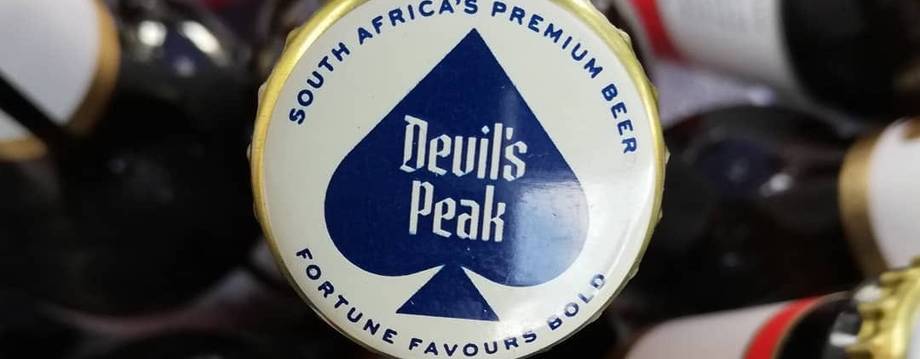
The more romantic among us might see Signal Hill as playing on both sides of the field but, for better or worse, straddling the micro and macro world has allowed Devil’s Peak to remain independent. What’s more, such positioning has the potential to massively benefit South Africa’s craft beer industry (and already has in so many ways), whether that looks like offering access to its technology, sharing insights with industry peers, or training brewery staff that will take their skills and experience into other parts of the industry.
“I think we’ll always use the Devil’s Peak space to innovate, try new things, test new hop products that come out,” says JC. “We don’t stagnate, and we’ve got a lot of learnings that’ll go out to our other brands, and vice versa. Our Cape Town brewery’s also got a dedicated research and development team, which allows us to play and try new methods and optimise things, and then that gets translated to the other brews, you know, as well. Devil’s Peak will always remain core to what our focus was from day one, and we’ll always stay quite loyal to that brand.”
Curious what the future looks like for a brand so ambitious and already so big, I ask JC if there’s any end to Signal Hill’s hunger for growth. With his Signal Hill cap on, he says the company will continue its current focus on the RTD [Ready To Drink] and functional drinks space, but from a beer perspective, he points out a couple of different opportunities for expansion – not just for Devil’s Peak, but South African beer overall.
“I think a lot of people might anticipate that South Africa, or Africa as a whole, will move along with a lot of global trends, but for me personally, I don’t see South Africa playing so much into those trends as the rest of the world. We’re still big beer drinkers, and I don’t think we’ve slowed down at all on that front. Domestically, we’ve got this association in South Africa called BASA [Beer Association South Africa] and they were trying to lobby to have beer sold at grocers, as opposed to just having wine at grocers. That was one thing we were trying hard to get. I don’t think it’s made any ground so far, but it’s something we’re trying hard to work towards.”
I get the impression, speaking to JC, that in spite of its size, Devil’s Peak has not yet arrived at its final destination, and that the next fourteen years promise to be as eventful as the last.
Share this article
You’ve reached your limit of 5 free articles this month.
Unlock unlimited access and more

Join Beer52 and get your first month half price
-
Get your first box for £13.50 (RRP £27).
-
8 beers & 2 snacks delivered monthly.
-
Printed Ferment magazine included.
-
Unlimited access to all online content.