Jump Brewing: Leap of faith
Jump Brewing has a couple of new tricks up its sleeve.
Robyn Gilmour
Photos:
Jump Brewing
Saturday 17 October 2026

This article is from
South Africa
issue 136
Share this article
There seems to never be a dull moment in the life of Murray Middleton, founder of Jump Brewing. I’m sure he’d disagree, but with it being three years since we last caught up, Jump updates are exciting to me in a way they’re old news to Murray. What’s that old saying? Day to day nothing changes, but looking back everything is different, something like that?
To jog your memory on Jump’s journey to date; Murray worked at Cape Town-based craft brewery, Metal Lane, at the start of his brewing career – in the mid 2010s – and eventually moved on to work at Devil’s Peak for a short while prior to COVID. The onset of the pandemic coincided with Murray being offered a job with Heineken, and the opportunity to relocate from South Africa to the Netherlands. He had planned to launch his own outfit, Jump Brewing, long before this move was ever on the cards, and so he decided, given how entrenched he was in South Africa’s craft brewing scene, that distance shouldn’t be a barrier to him remotely managing his own South Africa-based nomadic brewery.
After all, he was regularly back in South Africa, the plan had always been to contract brew at breweries he was friendly with, and he had the brewing experience needed to write and share his own recipes. So – with a major move and new job in the background – Murray launched Jump Brewing in 2020, aiming to always work in limited releases, and in collaborations with other South African craft breweries. This is how Jump Brewing was operating when we last caught up with Murray, in 2023.
Jump Brewing – a one man band with a big community around it – has always been a flexible entity and efficient with resources. So, when Murray left Heineken to work at hop oil producer, Totally Natural Solutions (TNS), in 2025, he immediately saw how hop oils could be of benefit to breweries like his own. “From my perspective, everything that’s gone into it [hop oil] is still hops, so it’s not like it’s losing anything, or anything is majorly different,” he says. “It’s still the core of what you’re looking for…
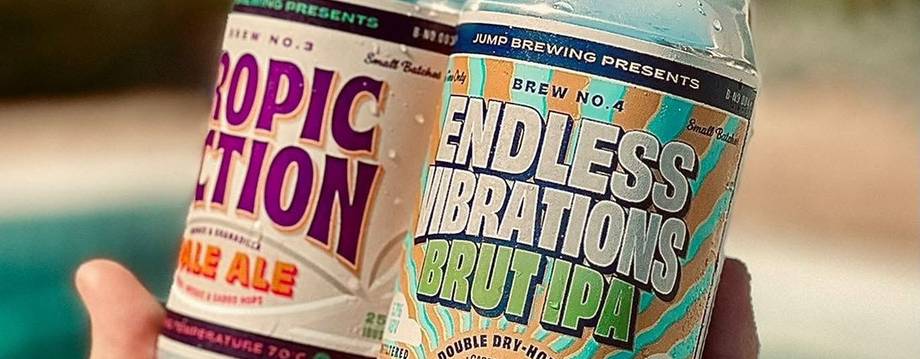
“When T45 hop pellets came along, people who were brewing with whole leaf hops were like ‘that’s not traditional, and it’s not the way we do things’, but over time, they started to see yields were higher, the beer quality was just as good, and it saved on costs. It’s the exact same with hop oils. There’s a bit of pushback from some people but I genuinely believe that we’re moving in that direction for the future.”
We’re discussing Jump Brewing’s 7% West Coast DIPA, which has been brewed entirely with hop oils, a heady bet on the oils’ ability to deliver high impact flavour and aroma. Hop oils aren’t uncommon in the UK, but they’re not widely used either. In my conversations with brewers, I’ve heard of them being used to supplement or emphasise specific flavours and aromas, but rarely for a full brew.
That might be because – if a brewery is so inclined to use hop extracts – a liquid hop format like Spectrum, Incognito or Dynaboost is more readily available through a brewery’s main hop supplier. Or, the brewery has been invited by its supplier to select its own hops, which can then only be pelletised.
When it comes to hop formats, innovation has looked largely at how hop processing can better retain the desirable components of hops – namely alpha acids for bittering, and delicate essential oils that contribute to flavour and aroma – while excess plant matter is kept to a minimum. Dried plant matter absorbs liquid and so lowers the yield of the finished brew, sometimes dramatically, hence why T90 pellets (contains 90% of the whole hop’s weight) were developed as an alternative to whole hop use, and then the T45 pellet (contains 45% of the whole hop’s weight) as a more concentrated version of the T90.
Liquid hops take this a step further, and hop oils, further still, with the aim of all these formats being to maximise yield. For small, brick-and-mortar breweries with thin margins, yield is important – brewing a tank’s worth of wort to get half a tank’s worth of beer is costly – but for nomadic breweries renting tank space by the day, the price tag that comes with time and space is particularly stark.
All this said, hop oils are not uniquely relevant to small breweries, and have capabilities that the whole beer brewing world should be paying close attention to. Most familiar with TNS’s range, thanks to his day job, Murray uses its products as examples when explaining why.
Hop oils are not uniquely relevant to small breweries, and have capabilities the whole beer brewing world should be paying close attention to
“TNS uses a process called fractionation – which is way over my head – but involves distilling hop material to extract its oils,” Murray begins. “Then you put those oils in supercritical CO2 – so, relatively high temperature and high pressure – so you can essentially stretch out the oil, and you can pull out individual hydrocarbons, which you can then use to build an extract, or the profile of a hop.” In other words; hop oil products can come either as specific, individual flavour and aroma compounds – say, for example, citrus – or as a direct derivative of, for example, Nelson Sauvin.
Now, here’s where it gets really interesting. “For the very low yielding hops, like your old world Saaz, EKG [East Kent Goldings], Hallertau – their oil content has gotten less and less over the years,” Murray continues. “To distil those, there’s huge volumes of hops going in, but very little volume of oils coming out. So for these hops, we would build a ‘type’, meaning it wouldn’t be directly derived from the specific varietal.
“What we would do there is, we would stretch out those hydrocarbons, and identify exactly the profile needed to build Saaz. We would then use the oils from another hop to create the exact same profile as Saaz. It’s more cost effective for us. It’s more cost effective for the brewery. For other varieties that are more high yielding in their oils, like your Cascades, Simcoes, Mosaics, all of those would be a direct derivative, meaning we would extract the oils in these hops, directly from the hops themselves.”
Sure, there’s a cost saving element to this way of working, but just below the surface, so too is there a dimension in which hop oils might preserve the flavour and aroma of varieties that are looking like they won’t be around forever. This method of identifying, mapping out, and isolating the building blocks of varieties that are struggling in the field, might be a way for future generations to experience their flavours and aroma long after we’ve stopped planting them.
Equally, the building blocks of hops have the potential to offer us a glimpse into the future. “We thought it would be really cool to get together and build our own experimental hop variety, that’s actually never been grown, but built up by combining different oils from different varieties,” says Murray. It’s yet to come to fruition, but never say never.
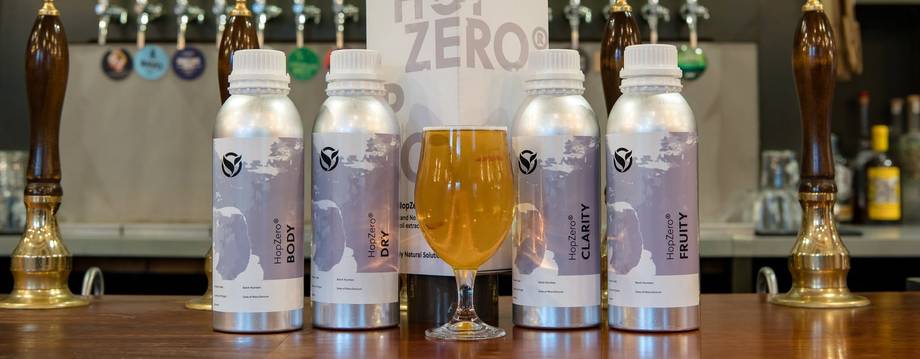
PHOTO: Totally Natural Solutions
So, if hop oils are such a volume saver, and so cutting edge, why isn’t everyone using them like Murray is? Something tells me Murray would be the first to say ‘you don’t have to’ – each to their own. He acknowledges that what one brewery might view as a drawback, another would see as an advantage, just as we did when transitioning from whole leaf hops to T90 pellets. One thing is lost, but something else is gained in the process.
Murray points out that hop oils are so easy to use, and remove so many problems from the brewing process – eliminating the potential for hop creep, correcting worty flavours in non-alcoholic beers, reintroducing fruity esters – that some people also view it as taking the skill out of brewing.
“One of the skills that comes with brewing is that it allows you to put recipes together without first testing, trialling and tasting them because by the time you’re finished a brew, it’s too late to go back and add more hops at this stage or that stage. Because hop oils are only added from the whirlpool onwards – and that includes IBU additions – you really are just brewing a great base beer that you can build on top of once the beer’s finished fermenting. You’re basically building this canvas that you can paint afterwards, which is really epic from a development perspective because you can keep tweaking until you say ‘this is what I want’, and then you just scale it up, dose it, and it’s done.”
It’s a different way of working, but craft beer has always been open to working in whatever way achieves the desired result – namely, high impact flavours and aromas, achieved using quality ingredients, that drinkers can enjoy irrespective of how nerdy they want to get about the finer details. And in this day and age, when things never seem to not be tough, efficiencies that keep the lights on can only be a good thing.
Share this article
You’ve reached your limit of 5 free articles this month.
Unlock unlimited access and more

Join Beer52 and get your first month half price
-
Get your first box for £13.50 (RRP £27).
-
8 beers & 2 snacks delivered monthly.
-
Printed Ferment magazine included.
-
Unlimited access to all online content.