Mother culture
Before the arrival of lager, South Africa enjoyed a beer culture rooted in land, family, and community. Anaïs Lecoq meets the matriarchs keeping it alive today.
Anaïs Lecoq
Saturday 17 October 2026
This article is from
South Africa
issue 136
Share this article
It’s a scene Obakeng Malope, brewer and filmmaker, is familiar with: watching her grandmother make beer. As a kid, she remembers picking up firewood to help nourish the fire, then silently watching her grandmother cook and brew a mixture of malted sorghum and maize. One of her favourite parts was eating the sour porridge that the grain would turn into, right before alcohol conversion began. From that point on, children were not allowed near the beverage. “We were looking forward to this, eating porridge and watching our elders brew,” she says. “Not just for fun but because we have to carry that torch later on in life, when they leave this earth.”
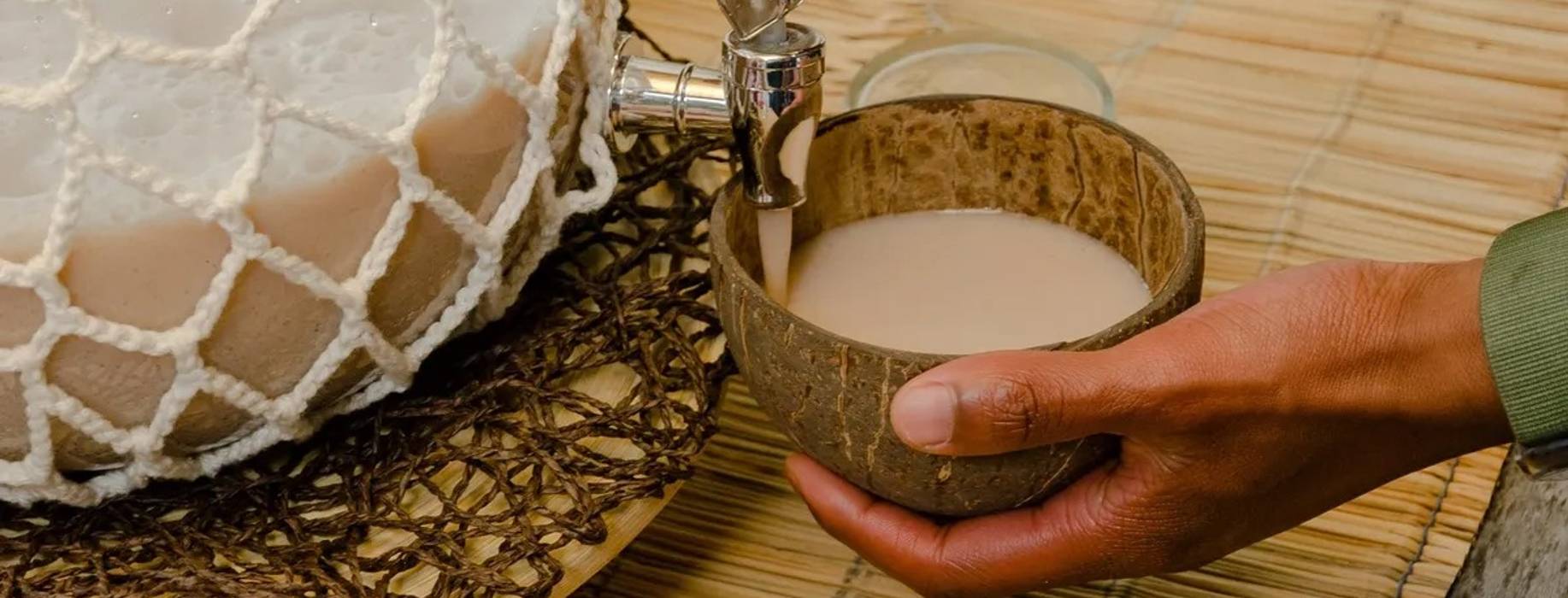
In Jericho, a small rural village in the Northwest Province of South Africa, Obakeng’s grandmother didn’t brew just any beer: she made Bojalwa jwa Setswana, roughly translating as Setswana traditional beer. There was nothing unusual about this, per se, as Obakeng sums up pretty simply: “A man is not allowed to touch traditional beer, it is our role as women.” From grandmothers, to their daughters and granddaughters, this knowledge has been passed on, generation after generation. Setswana (or Umqombothi, another name for the sorghum-based beer) is not just a drink; it’s made to show respect to ancestors and bring people together, specifically during births, weddings, funerals and many more celebrations.
Not only did Obakeng learn to brew that traditional beer herself, but she also set the goal of not letting people forget about it. She could see the brewing traditions that structured her childhood were at risk of dying out with older generations. “Once our grandmothers pass on, we have no one to make that kind of beer because people see it as boring,” she says. “When we're not embracing our culture, our tradition, somebody else comes and takes it to make something that will not benefit us.”
As a filmmaker, she saw her camera was the best way to preserve the tradition. In a documentary released in May 2025 and named after the South African water spirit Mamogaswa, Obakeng filmed her own grandmother and five other women, from age 76 to 93. The goal was to document and preserve their expertise: “These are the only people we are left with that still have the indigenous knowledge,” she says. “Once they are gone, their knowledge will be gone with them.”
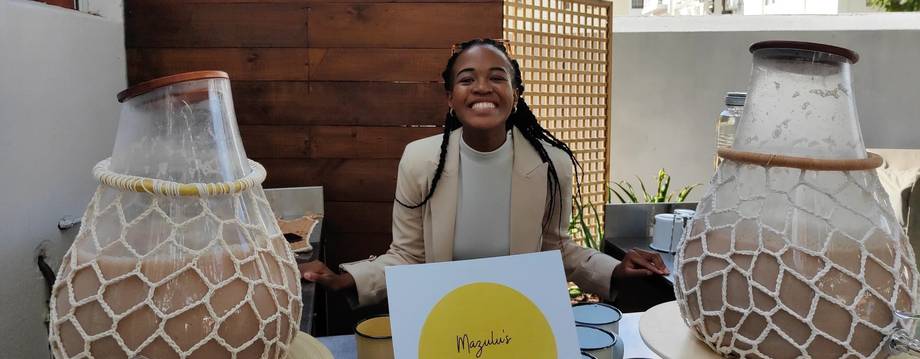
PHOTO: Reitumetse Kholumo, Kwela Brews founder © Kwela Brews
“It is centuries of process knowledge, none of it written down,” adds Reitumetse Kholumo, founder of Kwela Brews, a company dedicated to supporting homebrewers. “When a lineage breaks, that knowledge disappears and we start brewing by someone else’s logic, on someone else’s terms, against our own ancestral values.”
Thembisile Ndlovu, who has started her own Umqombothi business, shares the same memories as Obakeng and Reitumetse, and had the same difficult realisation that her culture was fading away. “We’re losing more than recipes. We’re losing our identity, culture, language, family traditions and history,” she says. By running her business (and earning the nickname of “Queen of Umqombothi”), Thembisile wants to show that “traditional products can succeed in modern markets without losing their authenticity”. She does so by modernising the packaging and educating young people about traditional brewing.
And like every lineage has its own recipe, every woman who works to preserve traditional Afrikan beer has her own way of doing it. Obakeng uses her filmmaker skills to document and preserve her elders' voices and knowledge; Reitumetse supports and provides for skilled homebrewers; Thembisile makes Umqombothi accessible to a general audience. Most of these initiatives are led by black women, like Apiwe Nxusani-Mawela, a trailblazer in South Africa’s brewing industry. Behind the brand Tolokazi, she’s the first black woman to own a craft brewery, and also founded the Brewster Academy, a school dedicated to increasing diversity in beer. She has inspired and helped many women to find their path in brewing: in fact, it was only after placing third at the Umqombothi Brewing Competition created by Apiwe, that Thembisile started her own business.
All of these women carry the common goal and belief that when it comes to preserving their culture, brewing traditional beer must be a way for black women (40.5% of whom are unemployed, the highest rate in the country) to make a living and empower themselves in the process. “Traditional brewing allows women to preserve culture while earning an income and supporting their families,” Thembisile says. “It also gives them confidence to turn indigenous knowledge into successful businesses and become leaders in their communities.”
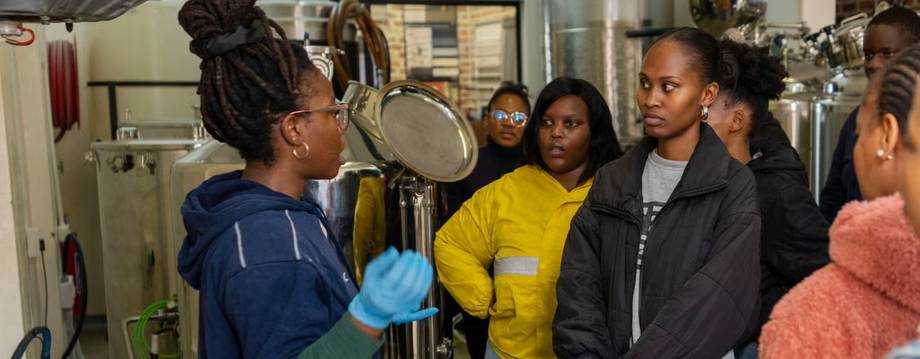
PHOTO: Tolokazi Beer
That younger generations switched their interest towards craft beer is not the primary reason that traditional Afrikan beer is undervalued today. Colonisation played a huge part in devaluating indigenous knowledge and even tried to kill it altogether. The brutality of colonisation does not lie solely in the act of enforcing the law and culture of one place on another (often by force), but jointly in the destruction of native traditions, language and ways of life. In South Africa, European colonisers quickly realised the role that traditional beer played in villages, tribes and families, and so they banned it. In 1908, the Native Beer Act made it illegal for women to brew traditional Afrikan beer. Searches and controls would happen in the middle of the night, during which beer and equipment were destroyed, and anyone caught brewing could be arrested and fined. The goal was to terrorise black women and make sure they would stop brewing, stop earning money, and stop sharing their knowledge and culture.
“The 1908 Act represents the dispossession and disruption of our indigenous foodways through state violence,” Reitumetse says. “A functioning women’s economy was outlawed, handed to municipalities, and the revenue was used to fund the very system that policed those same women.”
It wasn’t long after that 'beer halls' started opening all around the country. Places where black women weren’t allowed, and only black men deemed “educated” enough to receive a permit, could enter. These were places where only beer imported from Europe was sold and consumed. In 1929, women took action and led boycotts and riots towards these beer halls. These riots continued all the way to the 1960s, with another major demonstration in Cato Manor, in 1959. “Nobody teaches the 1929 beer hall riots or Cato Manor as a story about women defending an economy,” Reitumetse says. “History reached me through music before I understood what I was hearing. The song that stayed with me from childhood was Kwela Kwela: I loved it and sang it without knowing it was about police raids on homebrewers.”
The Native Beer Act ended with Apartheid, in 1994, but the consequence of that period still bears its marks on how homebrewers and traditional beer is perceived in the country. “Traditional brewers still face challenges in gaining recognition, funding and access to markets,” Thembisile says.
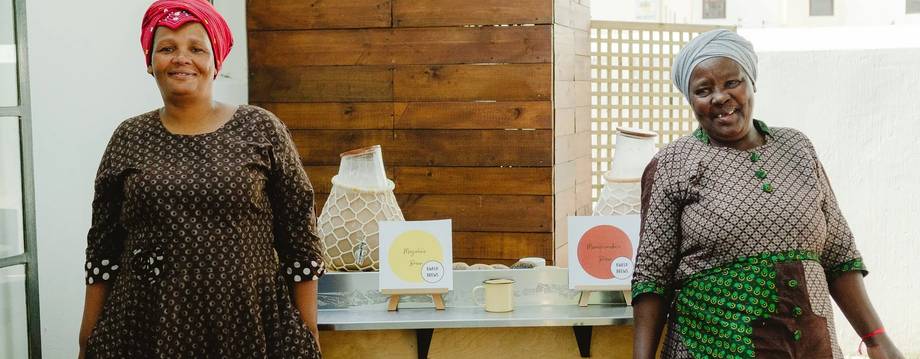
PHOTO: Kwela Brews
“Umqombothi still commands respect in its ceremonial place but the woman who brews it for income is read differently,” Reitumetse adds. “She is unlicensed, she is a shebeen, she is a social problem. The judgement flips the moment money changes hands.” At Kwela Brews, Reitumetse works with skilled brewers from Kayamandi and Langa, some of whom have been brewing traditional beer since 1996, “all taught by women in their families,” Reitumetse adds. Kwela Brews gives these women access to equipment that cuts smoke exposure and wood use, uses affordable and qualitative ingredients, helps set “indigenous malting and brewing method alongside formal food safety protocol rather than beneath it”, and opens markets that pay them properly.
What Obakeng, Reitumetse and Thembisile quickly understood, upon setting out on their respective missions, is that their elders' knowledge was never archaic. What they learned at school or during brewing programs was similar to what their mothers and grandmothers had always been doing. Obakeng’s grandmother used to grow, germinate and malt her own sorghum: “Because I studied beer brewing, I told her that what she was doing had a name, 'germination',” she says. “She didn’t know the word, she didn’t have a proper explanation of what she was doing, all she knows is that she’s doing what her grandmother did.”
Reitumetse’s grandmother taught her traditional brewing when Reitumetse was studying chemical and bioprocess engineering. “I recognised that she was managing a spontaneous fermentation without a single instrument. She was controlling acidity, judging temperature, reading the grain, knowing by smell and by hand when it was ready,” she says. “I was being taught those same principles in a lecture theatre, but she had held them in her body for decades with very little formal education.”
Whether it's called Setswana or Umqombothi, traditional beer is actually unique to every brewer who’s making it. Everyone has their own recipe, their own ratio of maize, sorghum and water, and their own timeline. This variance is what makes it incompatible with – or at least unrecognisable to – our Western way of seeing and producing beer, which we measure against a very specific description, in terms of colour, taste, ABV etc. That doesn’t mean brewing traditional Afrikan beer shouldn’t be recognised for what it is: an integral part of the global brewing culture, as important as any beer style there is, and, as Thembisile says, “a skill that carries history, love and responsibility.”
Share this article
You’ve reached your limit of 5 free articles this month.
Unlock unlimited access and more

Join Beer52 and get your first month half price
-
Get your first box for £13.50 (RRP £27).
-
8 beers & 2 snacks delivered monthly.
-
Printed Ferment magazine included.
-
Unlimited access to all online content.