A pint of science
Jacopo Mazzeo discovers how a London pub outreach evening became a global movement to bring science to the people.
Jacopo Mazzeo
Saturday 17 October 2026
This article is from
South Africa
issue 136
Share this article
During my years at the University of Southampton, I was a regular at The Crown Inn. It was never a particularly remarkable pub (although Timmy Taylor and London Pride on tap were more than enough to keep everyone happy), but it had that quintessential British boozer cosiness and homely unpretentiousness and, crucially, was just a five-minute walk from the campus. Every weekday, from early afternoon onwards, it would inexorably start filling up. Lecturers, researchers and postgraduate students would descend, ready to unwind after a long day of work, quaffing pints and wolfing down burgers, all interspersed with quintessential academic gibberish. Well, gibberish it may have been, but somehow the conversations at The Crown Inn felt less pretentious and formulaic than the discussions taking place inside the university walls, almost as if the pub’s atmosphere encouraged people to take off their academic masks.
After all, the pub has long offered the ideal conditions for conversations to wander, arguments to be tested and great ideas to take root, free from the pressures of official environments and workplace hierarchies, yet equipped with tables, comfy chairs and a pint within easy reach at all times. J.R.R. Tolkien, C.S. Lewis and the rest of the Inklings literary group famously gathered at The Eagle and Child in Oxford, for instance, while the Sons of Liberty met in secret at Boston's Green Dragon Tavern to plot the Boston Tea Party of 1773.
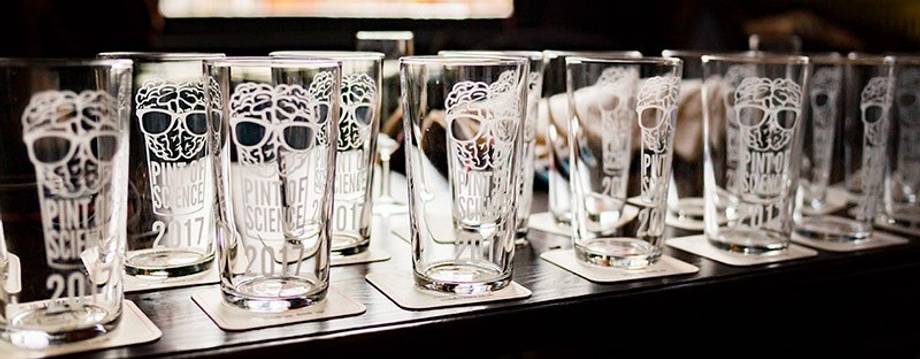
PHOTO: nature.com
Pint of Science
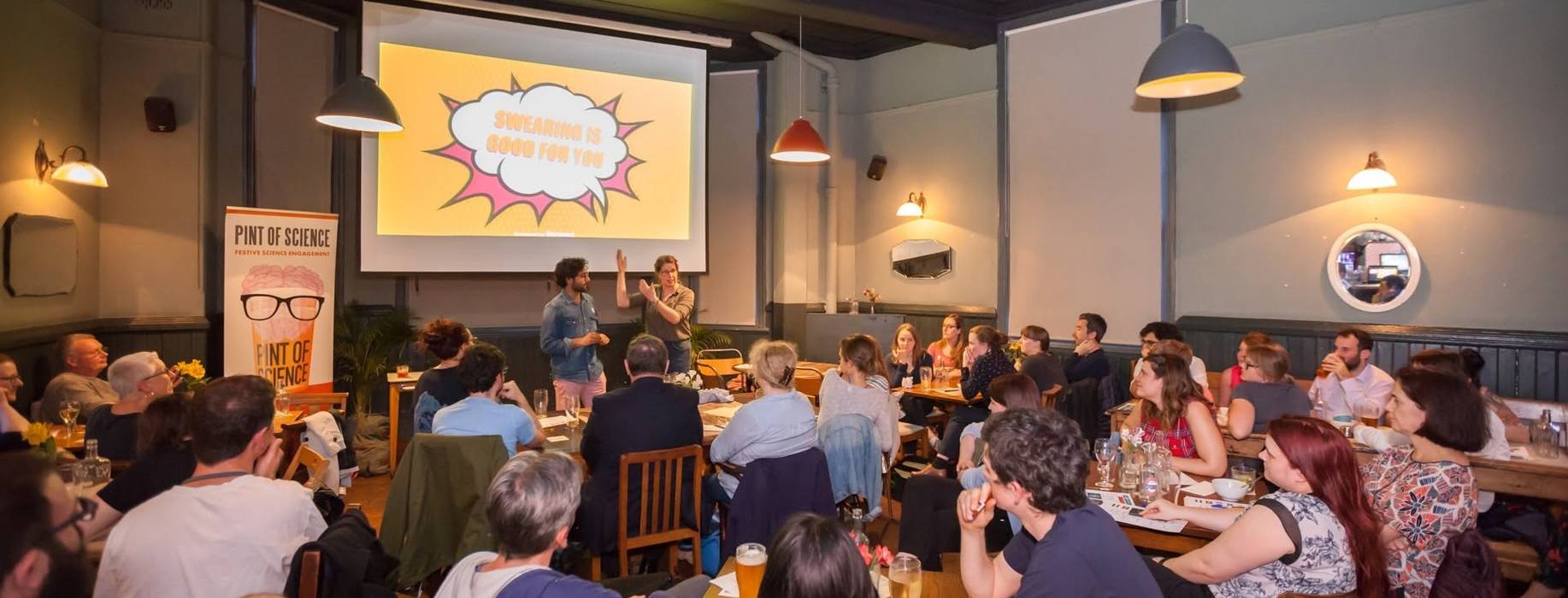
It was on this premise that, in 2012, Imperial College London neuroscientists Praveen Paul and Michael Motskin began developing the idea to bring together academics and pubgoers. “One day Michael said, ‘Isn't it funny that we spend all our time looking down microscopes trying to understand [certain] human conditions, yet we never actually meet the people affected by them?’” recalls Paul. Their first attempt at bridging that gap simply involved inviting members of the public into their laboratory for a tour. But the excitement generated around that event encouraged them to think on a much larger scale. “We thought, if people are interested in coming to see us, why can't we take science to more people? Michael was going to a lot of music festivals, and he loved the idea that you could choose which band to see on which stage. If you're interested in black holes, psychology or AI, why shouldn't you be able to pick the talk that interests you?” So the pair took the idea outside academia. Their vision translated into an annual, three-day event modelled on a music festival, but held in venues far better suited to conversation than lecture theatres, where scientists would present their own research to the general public over a pint.
Aptly dubbed ‘Pint of Science’, the first edition took place in May 2013 across three UK cities, but the concept quickly caught on. Within a year it had expanded further across Britain and internationally, launching in Ireland, France and the United States, before spreading to around 30 countries worldwide, with India being the latest addition. Today, the festival remains a grassroots operation, run almost entirely by volunteers – mostly academics and researchers – who recruit speakers, find venues and coordinate the events. The talks themselves are given by active scientists discussing their own work, rather than professional communicators. “Initially, we intended it to be a one-off. We didn't expect it to become anything bigger than it was,” Paul says. “But then we started getting emails from people asking why it wasn’t happening elsewhere so we thought: ‘Why not?’ We went through a phase where we didn't say no to anybody, and the whole thing just snowballed.”
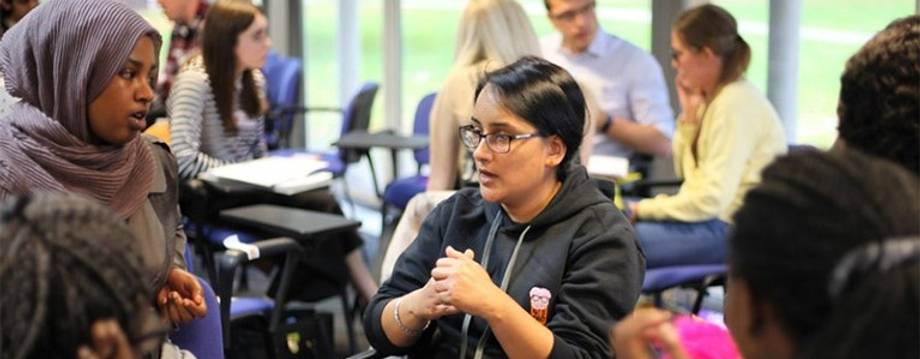
PHOTO: On the right: Praveen Paul, the director and co-founder © nature.com
A different audience
Major capitals such as London or Paris inevitably end up hosting large numbers of events every year, but cities where social life naturally revolves around the local pub or bar have proved especially fertile ground for the festival.
Deepanshi Karwall, a PhD student at the University of Manchester and the city's Pint of Science coordinator, argues that the area’s vibrant drinking-out culture has helped make Pint of Science a pretty big deal there. “It's a combination of factors. Manchester being Manchester, we have some really great pubs, and it's such a student city that people are always keen to come to events like this. The whole vibe of the city is geared towards learning and discovery,” she says.
Brazil offers perhaps the clearest example of how the “Pint” element – the culture of meeting over a beer – is fundamental to the festival's success. What began in 2017 as a small initiative in a single university town has grown into a nationwide event spanning more than 200 cities, with Brazil's strong culture of outdoor socialising playing a key role in the process. Brazil is one of the world’s largest countries by land mass, and Pint of Science has provided the ideal framework for bringing intellectually stimulating events to its smaller, more remote towns that would otherwise feel isolated from the wider cultural conversation. There, Pint of Science becomes a genuine community celebration, attracting large and remarkably diverse audiences. “We had one event in Vila Bela da Santíssima Trindade, a small town on the Bolivian border,” says Eduardo Bessa, a biologist and zoology professor at the University of Brasília and the national coordinator for Pint of Science Brazil. “Around 240 were packed into the bar for one night. It was huge. The whole bar plus the street around it. I heard people even came from Bolivia to watch it.”
The case of Brazil illustrates how an event like Pint of Science can help make academia feel less distant and more accessible, allowing people to see universities and scientists as part of their own communities rather than remote institutions. Just two years after the event’s launch, the newly elected government of Jair Bolsonaro announced sweeping cuts to education as well as major reductions in science and technology funding. The festival became a crucial platform during the nationwide protests that followed, allowing researchers to explain directly to people who might otherwise have had little access to reliable information or contact with scientists what was happening and why it mattered. “Our speakers showed their support for science and brought these issues to the stage. It became a way to communicate the importance of public investment in research and to raise awareness among ordinary people,” says Bessa. “What we did was really important, particularly here in Brasília, where we had the opportunity to make our voices heard by people who had the power to make decisions.”
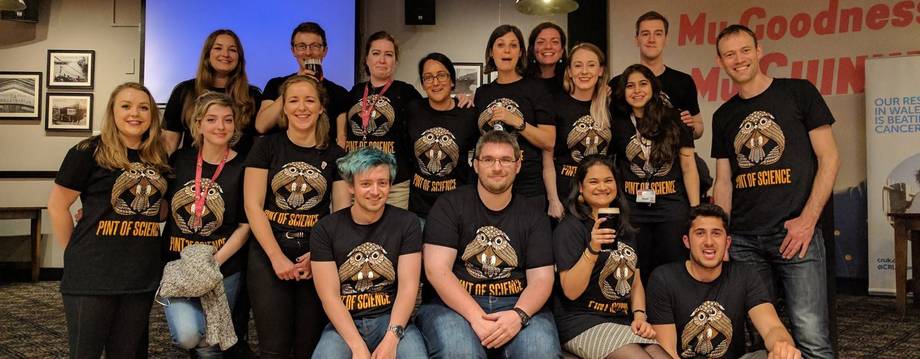
PHOTO: Pint of Science
Mutually beneficial
Taking research into the pub does not benefit the public alone. Universities can be remarkably insular environments. Researchers spend years talking primarily to colleagues who share the same vocabulary, assumptions and priorities. Some academics can go an entire career without ever being seriously challenged to explain their work to laypeople. “Public outreach is something scientists should be getting better at, especially in the current political climate of ‘I don't trust science’,” admits Calvin Laursen, a psychology technician at Bournemouth University, who’s been involved in the city’s Pint of Science events. “A lot of research is incredibly dry and boring when put on paper, but it can be made exciting and engaging for the general public.” For Laursen, the setting is an undervalued yet crucial factor in making the process work. “Reaching out in a pub is far more effective than most other kinds of outreach. I've helped organise public events at the university, but they end up feeling too clinical and rehearsed,” he continues. “In a pub, if a talk isn't for you, you can grab another drink, join a different conversation or chat to people who share your interests. It all feels much more natural.”
The success of Pint of Science shows the extent to which this might be true, by demonstrating the pub's ability to dissolve barriers between different groups, including those who produce knowledge and those who live with its consequences. Research that never leaves the university risks becoming detached from the society it is meant to serve. The pub, with its uniquely informal and democratic atmosphere, might well be the ideal setting to rebuild that connection.
Share this article
You’ve reached your limit of 5 free articles this month.
Unlock unlimited access and more

Join Beer52 and get your first month half price
-
Get your first box for £13.50 (RRP £27).
-
8 beers & 2 snacks delivered monthly.
-
Printed Ferment magazine included.
-
Unlimited access to all online content.