Family, belonging, and kimchi
For Eddie Kim, the slow, deliberate fermentation of Kimchi is an act of preservation, in more ways than you might think.
Eddie Kim
Illustrations:
Phoebe Wilman
Saturday 14 November 2026
This article is from
Global Brews
issue 137
Share this article
“It should taste like the ocean,” says my Gomo, my paternal aunt, when I ask her the salt-to-water ratio for the brine. I pause and think about every ocean I’ve swum in, licking the lips of memory. I appreciate the poetry of her response, but it’s not helping as I stare back and forth from the large metal basin to a bag of salt big enough for rice. It has taken years to get here, making kimchi in Gomo’s Bundang flat with a GoPro camera strapped to my forehead. Years since realising, over lunch at Umma’s (my mother) with my brother and cousins, that none of us really knows how to make any of the foods we grew up eating, let alone kimchi. Years of repeatedly asking gomo. Years of her replying, “No. You don’t want to know. You think you do, but you don’t.” It’s been years since, but it’s always present.
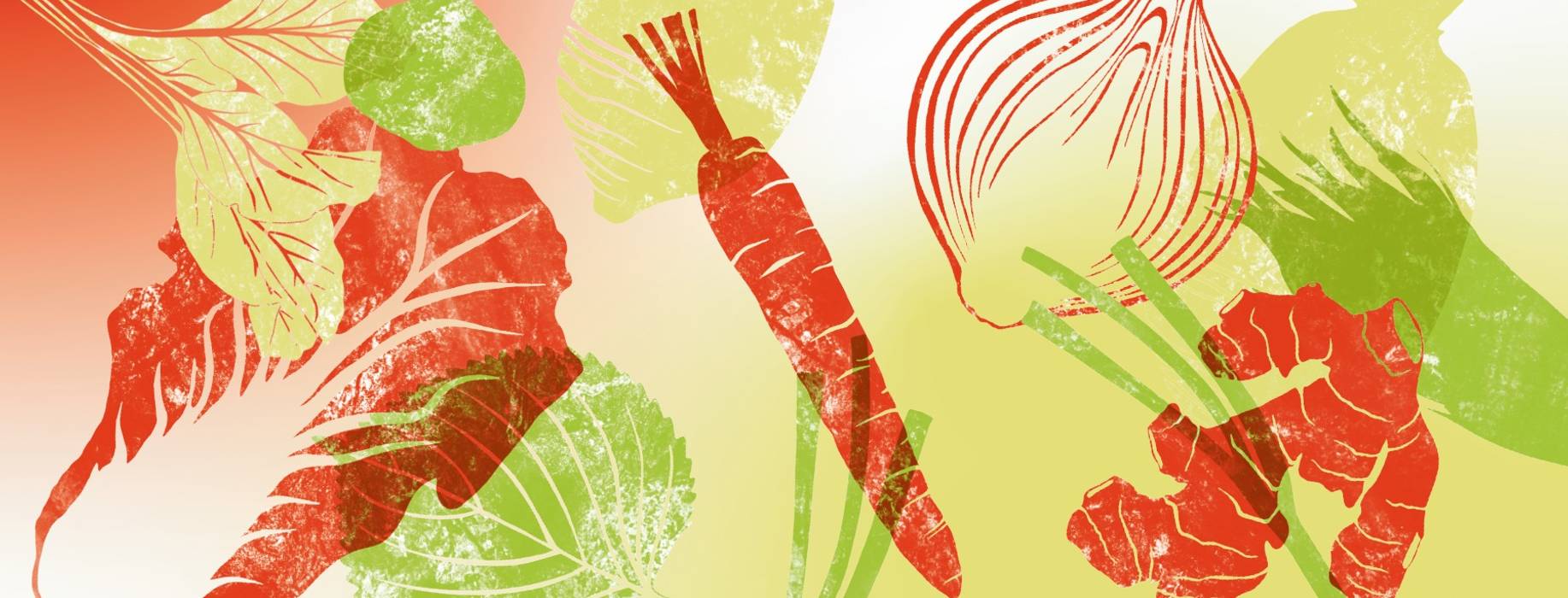
Gomo’s kitchen isn’t especially large, but its open Scandinavian design gives us room to work on the floor, old spread-out newspapers finding some semblance of purpose underneath our feet. Several bowls filled with baechu, mu, gat, buchu, pa, minari, and a pot of kimchi sauce arranged like a drum kit around Gomo sitting on a wooden stool but a few inches off the ground before bay windows eight stories up. Warm refracted possibilities shining through autumn’s cool stroll down.
So many of the meals I grew up eating started like this, days or even weeks before the actual meal. Umma and gomo sitting around folding mandu, making kimchi, picking hairs and stems off various namuls, mincing and julienning, well before H Mart or K-pop ventured west. It was an act of love, survival and resilience. There was no way for me to know at the time that we lived a bus ride from bankruptcy.
In Korea, Gomo was an Olympic speedskater. When she and the family moved stateside, she brought with her a jar of kimchi sauce and what little cash she could cobble together, both clutched closely. “I was afraid I’d get kicked out of the country if they smelled the sauce,” she says. The first batch of kimchi she made in the states was like Prohibition, made in a garbage bin buried in the ground, brined in a bleached-out bathtub using Dutch white cabbages because this was before the proliferation of Napa cabbage. Gomo-bu and Appa ate it with a hunger only homesickness can conjure.
Every family’s ingredient list is different – little idiosyncrasies and secrets – so every family’s kimchi tastes different. The first time I had dinner at a Korean friend’s house, I said “Your family’s kimchi tastes funny”. Fortunately, he didn’t punch me in the face; kimchi preferences, particularly for Korean diasporas, can be deeply personal. It’s a vestige of where we come from and where we are, one we fought through place and ridicule to keep. I would never put carrots in my kimchi, and in my ignorance, I bristled at the notion the first time I saw it in one. That was before I learned of a carrot kimchi from the Korean diaspora in the former Soviet Union and Central Asia, where they couldn’t get traditional ingredients. As an immigrant child, I can be quick to prove my belonging. It’s especially disappointing when the childish instinct of denying another’s experience is seized to do so.
It’s how we communicate, and build community, how we welcome strangers and make new friends
You can’t oversell the importance of kimchi to Koreans. The Korean government spends exorbitant amounts of money on commercializing kimchi, from the first cans produced for soldiers in the Vietnam War to the recent millions spent on developing tins that survive space travel so Korean astronauts can enjoy kimchi while in orbit. Insert diaspora lunch-time traumas here. Now kimchi has been ‘discovered’ by the west, you can find it in your local Tesco Express, get it on a burger or find it on a chic small-plate menu in the city centre.
Kimchi, like all fermentation, is an act of preservation. I don’t speak for all Koreans, but it’s how our family preserved a piece of ourselves, how we preserved sustenance, familiarity, family, home. It’s how we make space for ourselves in unfamiliar places, and how we share ourselves with those places. First in America, and now in the UK. It’s how we communicate and build community, how we welcome strangers and make new friends. But growing up, we didn’t tout our food. My parents owned and operated three different restaurants – a teriyaki shop, a burger joint, and a pan-American restaurant that included a handful of takeout Chinese dishes – not one of them served a single Korean dish. We assumed nobody would be interested. We kept it for ourselves almost out of courtesy.
“I know how to make kimchi. That’s it,” I say during kimchi workshops. Usually followed by, “I’m not an expert. I’m not a kimchi master. I’m not a chef.” As an adolescent, I bussed tables and washed dishes for my parents’ restaurant, grilled a burger once. The value of making something like kimchi is in the everyday nature of it, not just out of necessity or utility, but a different kind of need. Daily moments of craft we’ve fallen into the habit of hacking out for the sake of convenience and time.
We’re in such a rush. Careering toward an ending lacking any depth of flavour. We’re in this race, but I couldn’t tell you what the race is about. I return to these C.P. Cavafy lines in his poem, Ithaka:
But don’t hurry the journey at all.
Better if it lasts for years,
so you’re old by the time you reach the island,
wealthy with all you have gained along the way,
not expecting Ithaka to make you rich.
Ithaka gave you the marvelous journey.
In this age of automated artificial intelligence, life-hacking all things, speed supplants substance and the destination justifies the means. We hack our coffee machines, how we drive, how we cook, how we listen to music, how we write, how we make art, how we engage friends, how we love, how we learn. There’s an app for every one of these things. Everything moves faster with each iteration, and everyone is afraid of being left behind. But to what end, and what are we leaving behind?
Is it irony that we seek ‘artisanal,’ ‘authentic,’ ‘bespoke,’ ‘homemade,’ ‘handcrafted,’ ‘local,’ ‘genuine,’ products and experiences when our everyday actions choke out the ecosystem in which these adjectives thrive? How quickly we embrace shadows. How quickly we embrace a diminished reality. How quickly we embrace it as ‘the way it is’. And in doing so, we embrace so little of ourselves.
Fermentation, by its nature, requires time (kind of like me getting to this point), requires you to slow down. Good kimchi requires patience, its fermentation best done low and slow like a thick cut of meat. Oversalt the brine to quicken it, and your cabbage becomes mush, fake the ferment with vinegar and your kimchi lacks complexity and subtlety. With time, your reward is the feeling accompanying making something from scratch, leaf by leaf. You feel capable and confident.
In Gomo’s kitchen, I feel connected. I feel Umma’s meticulous hand-picking clean chives and minari, I feel Gomo’s warmth imbuing each step, each morsel with care and intention. The way their brows furrow and eyes narrow if something tastes off holds gravity. Changing the world wasn’t something they ever considered, but they did in tangible ways. They shaped our family’s world, my brother, my cousins and I were wrought and raised by their hands, their kimchi, their sacrifice, patience and effort. Now, when I hear Gomo’s voice saying, “It should taste like the ocean,” I taste immigrant story, childhood, adaptation through creation. I taste preservation and a future.
Share this article
You’ve reached your limit of 5 free articles this month.
Unlock unlimited access and more

Join Beer52 and get your first month half price
-
Get your first box for £13.50 (RRP £27).
-
8 beers & 2 snacks delivered monthly.
-
Printed Ferment magazine included.
-
Unlimited access to all online content.