Gettin' twiggy with it
Charlotte Cook explores one of the world’s most out-there farmhouse ales, and finds a lot to admire.
Charlotte Cook
Saturday 14 November 2026

This article is from
Global Brews
issue 137
Share this article
Farmhouse ales – rustic brews that are often endemic to one small region – are survivors. Some have been around for millennia, such as Peruvian chicha, the corn-based beer brewed by chewing the grain to get the enzymes in saliva to start breaking down the starch into sugars. Others are more recent; saison from Wallonia in Belgium has a history only dating back to, at most, the 18th century, although its rustic taste invokes images of medieval peasants getting sloshed on the back of carts.
Farmhouse beers tend to have one unique characteristic. For kveik it’s throwing a wooden wheel (that looks more like an offering to a proto-pagan deity than a vehicle for yeast) into the brew. But for one beer, made 100km north of Helsinki, the idiosyncrasies come thick and fast: it’s flat, strong, uses logs and juniper while minimising both hops and boiling, and is fermented with bread yeast. This is sahti.
Sahti has been brewed since at least the 1500s in southern Finland (a region known as the sahti belt) usually for momentous life events, such as births, weddings, and funerals, though a few commercial breweries today make it year-round for less auspicious drinking.
My first encounter with sahti was when my American friend announced we would be making one more stop on our bar crawl, to try the fresh sahti that had just arrived from Finland. Põrgu, meaning hell, was an infamous beer haunt in Tallinn, where sea buckthorn shots and pork ribs streamed out of the kitchen, but they also sold traditional farmhouse brews from around the Baltics.
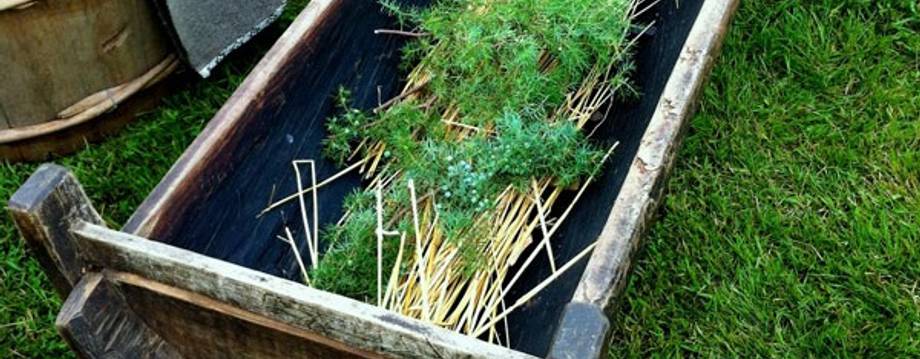
PHOTO: A kuurna © Mika Laitinen
I can’t say I was overly impressed, and I wouldn’t have been surprised to see sticks still floating in the liquid. But sahti tastes of something old and primal, of the forests and mysteries that hide in them. The Finnish Sahti Society echoes this, saying “With a glass of Sahti, you are part of something bigger, something eternal”.
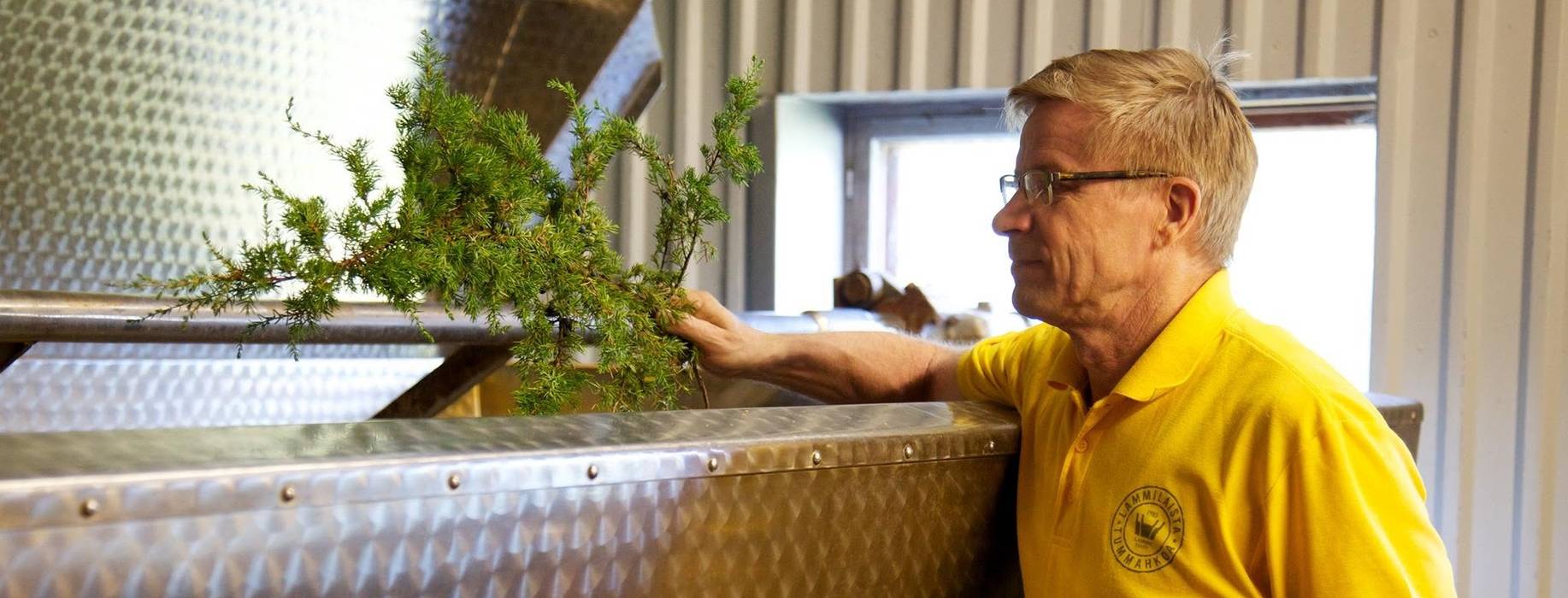
The way that sahti is made feels just as ancient. Sahti was traditionally made on farms, in what they called the ‘cattle kitchen’, a room used to sterilise dairy equipment, with the skill passed from master to student. It is usually made from barley and rye, though wheat and oats are also common, and the mash (with added juniper twigs) is typically direct fired, and boiled, so that the Maillard reaction (when a sugar and amino acid react, similar to toasting bread) can take place, giving sahti its golden amber colour. The mash is then strained through a kuurna, a hollowed out log filled with juniper branches to act as a filter and imbue the uniquely arboreal and herbaceous aroma associated with sahti. The wort is often not boiled, or only boiled briefly, and a small number of hops can be added, before the wort is cooled, by dispensing it into 40-litre milk churns which are immersed in cold water, and then pitched with bread yeast, usually Suomen Hiiva brand fresh yeast.
The bread yeast gives sahti its unique taste. These yeasts contain small amounts of lactic acid bacteria (one bacterium per 10,000 yeast cells), which means sahti is strictly drunk fresh, often going sour after a couple of weeks. Baker’s yeast is the same species as brewer’s yeast, Saccharomyces cerevisiae, but just as spaniels are designed to flush out birds, and chihuahuas are built to growl at you from a designer bag, they perform different functions. Baker’s yeast does not flocculate well (drop out of solution) so sahti is typically very hazy with a distinctly bready and banana aroma. Baker’s yeast is also designed to ferment very quickly, so premature bottling could result in an explosive mess.
It creates a bond between modern Finnish culture and something that’s a huge part of our cultural tradition
In the past, people would purchase sahti wort to ferment at home, but today this practice is rapidly diminishing. Nowadays people will get sahti from a neighbour or one of the commercial breweries. One such brewery is Lammin Sahti, established in 1985 by Pekka Kääriäinen, who learned the art of sahti brewing from his neighbour when he was just a teenager. Kääriäinen’s sahti is 7.5%, and is now available year-round, including from Alko, the Finnish alcohol monopoly, and is the most widely sold sahti on the market. Most sahti is still locally brewed and consumed, and very little makes it to export, which is why my American friend was so excited to go and try the real deal.
Indeed, there is a risk of sahti dying out. Jussi Tamminen, founder of Maku Brewing in Tuusula, says: “These farms [where sahti is brewed] are becoming more and more rare, and the people who had the skills to make traditional sahti are getting old.”
The Finnish Sahti Society is one body working to preserve the drink. They run a yearly competition to crown the ‘sahti-monarch’ and tirelessly promote the history and culture of sahti in Finland. Today sahti has EU Traditional Speciality Guaranteed protection, meaning that when you see Finnish sahti on the menu it will be made in the traditional way, although some brewers now use a stainless steel kuurna, which is more efficient. Viking Malt, the Finnish maltsters popular all over the Baltic and Nordic regions, also produce a specialised sahti malt. This contains barley and crystal malts, which gives the wort that traditional dark colour for brewers who may lack the ability to boil their mash.
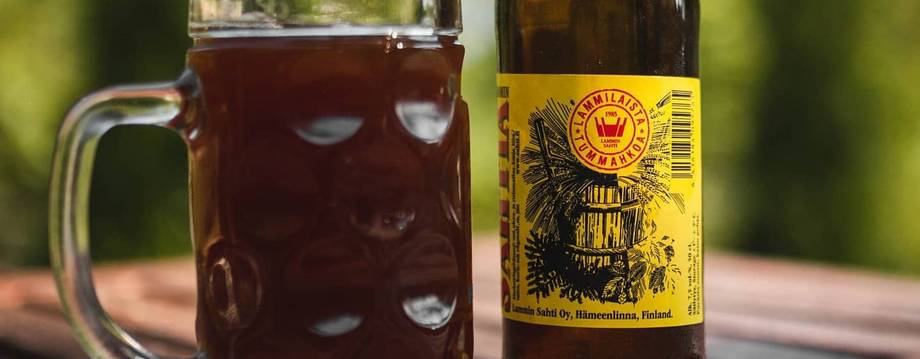
PHOTO: Lammin Sahti
Christoffer Tuominen, a Finnish brewer and beer judge, is part of the Swedish-speaking minority in Finland, so had a different experience of sahti growing up, trying it for the first time at a friend’s summer cottage during university. “I know that sahti used to be made at farms in the region where I grew up before the wars (Östra-Nyland) for celebrations, but you just didn’t see it. You’d have to go to Helsinki and seek out a pub that happens to have some available. Lately that’s changed with craft brewers modernising the style and there are more commercial options available.”
Jussi Tamminen is part of this revival, brewing a wheat sahti for midsummer (a large celebration around the Baltic region) as well as a darker sahti for Christmas. In part Tamminen brews to keep the tradition alive. “There is a risk we might lose thousands of years of tradition. By making sahti at our brewery we want to do our share of preserving history and tradition,” he says.
Tuominen is hopeful for the future of sahti, and the commercial brewers bringing it to a new audience, saying: “It creates a bond between modern Finnish culture and something that’s a huge part of our cultural tradition. I know some might disagree with me, but I think the modernisation of sahti was exactly what was needed to keep it alive.”
This modernisation means that sahti, unlikely to be the next big trend in brewing, can now be found outside of the narrow sahti belt. Simple Things Fermentations have made their own UK version, so this means even some of us in British cities can connect to the ‘something eternal’ of this ancient Nordic drink.
Share this article
You’ve reached your limit of 5 free articles this month.
Unlock unlimited access and more

Join Beer52 and get your first month half price
-
Get your first box for £13.50 (RRP £27).
-
8 beers & 2 snacks delivered monthly.
-
Printed Ferment magazine included.
-
Unlimited access to all online content.