Birra Baladin: Farmer, brewer, bard
By keeping focus on terroir Birra Baladin has found that beer and wine have more in common than you’d think.
Robyn Gilmour
Photos:
Birra Baladin
Promotional feature
Saturday 14 November 2026
This article is from
Global Brews
issue 137
Share this article
"You know, here in Piedmont, you can dig with your hands and find fragments of shell,” says Alvise Lunardi, export manager at Birra Baladin. “Twenty million years ago we were on the seabed of the Mediterranean, so today, our soil is like a fridge full of food for the roots and spores of anything and everything that grows here. Our food, our wine, is full of flavour but very delicate because Italian land is delicate.” This is where Birra Baladin’s story starts; with hands in soil.
Founder Teo Musso grew up surrounded, for miles, by vineyards and the expectation that he would one day work in the world of wine like generations of his family before him. “In Barolo, when you are 14, your dad gives you a glass of nebbiolo and tells you ‘now you’re a man,’” says Alvise, explaining the extent to which wine is embedded in the culture and identity of the region. For Teo, then a young punk with dyed hair, a pierced ear, and strange friends, such conformity felt like a fate worse than death.
In the 1980s, Italian beer was in a bad way – bitter, sticky, fizzy, industrial – but it seemed to Teo an obvious opposition to wine and so, in 1986, he opened a pub, Le Baladin, in Piozzo selling artisanal beer from around the world. His father was distraught, the villagers were confused, but over time it attracted like-minded people from far and wide, eventually earning widespread acclaim.
Over time, however, Teo began to feel the pull of the land. Even if wine had not been his calling, he’d grown up in an environment in which farming was an instinct, and the origin of food and drink was always close by. By comparison, beer felt like something from far away, which was divorced from land and the traditions of those who farmed it. Teo needed to know more about where beer came from, and how it was made. So he set off, as many nascent brewers do, travelling the world in search of different brewing traditions, and breweries that would teach him their ways.
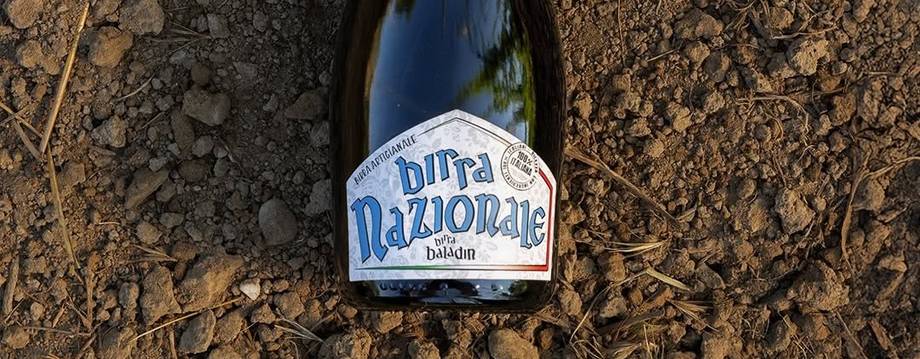
Teo would return to Piozzo with a clear and (in Alvise’s words) “commercially suicidal” vision; to open a brewery that grew the ingredients it needed to make beer. Birra Baladin was born in 1996 and in 2018 became Italy’s ‘birrifico agricolo’ – a category of brewery now recognised and accredited by the Italian government, and which grows 51% or more of the ingredients used in its beer.
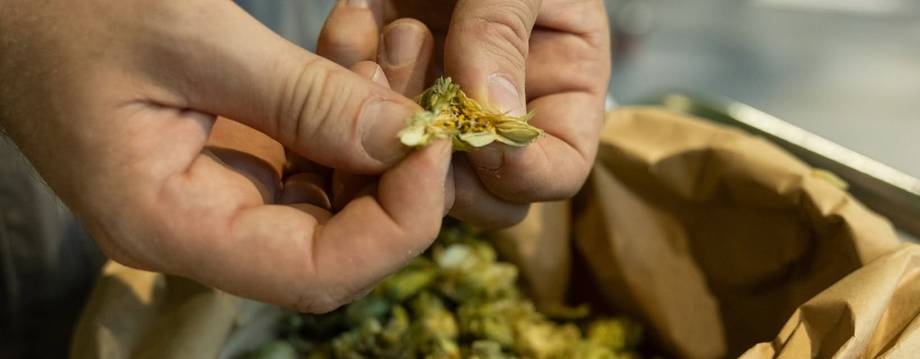
Today, there are almost 300 agricultural breweries in Italy, but among them, Baladin still stands out as unique. Where most agricultural breweries focus on the production of malt, Baladin also grows a combined six acres of hops: Magnum, Hallertau, Cascade, Amarillo, and even a couple of indigenous varieties.
“Growing hops is a pain in the neck,” says Alvise, but concedes that doing so is essential if Baladin is to produce 100% Italian beer. In his telling, hops offer an additional perspective on the region’s terroir and, therefore, are as important to farm as any other ingredient. At Baladin, the name of the hop is not what’s important, nor is its reputation elsewhere in the world; that Magnum, Hallertau, Cascade, and Amarillo adopt a uniquely Piedmontese expression is what counts. Alvise, a winemaker by training, talks fluidly – even poetically – about hops and terroir, using grapes as a comparative tool to further his point.
“We don’t have the dramatic changes in temperature that other parts of the hop-growing world do,” Alvise says. “In Colorado, Utah, Idaho, when it gets cold, it’s freezing, and when it gets warm, it’s roasting. The bigger the thermal swing between summer and winter, and day and night, the more developed the phenolics. The phenolics is the molecular composition of flavour, and develops with the maturation of the fruit or flower. The bigger the swing, the more aromatic the flower. So, we found that hops – even Cascade, Citra, Hallertau, Magnum – become more mineral when grown in Italy, in line with anything that is Italian, really,
“It’s the exact same with grapes. The phenolic season starts here, in April/May time, and that is when the grapes start growing. There is a movement in the grapes as they grow – they concentrate at night, and expand during the day – which creates a molecular friction and, by osmosis, some molecules become volatile and are very attractive to insects. That’s why, every nine or ten rows of vines, we plant a rose, which comes into its phenolic season at the same time as the grapes. Its scent is so strong that the insects will attack the rose before the grapes, and when we see evidence of damage to the rose, we know it’s time to protect the vineyard with nets.”
Crucial to Alvise’s point here, is that the phenolic season – when a fruit or flower starts to develop its flavour – does not just affect hops and grapes, it affects everything, including barley. If grains and hops are subject to the same weather conditions, the same soil, the same fluctuations in temperature, their phenolics develop together, proportionately. Of course, the product of the hop plant and the barley plant couldn’t be more different, but they are made using the same building blocks and so have a natural synergy between them. This is the true wisdom of the old adage ‘if it grows together, it goes together’.
In celebration of this very idea, Baladin recently released the first 100% Piedmontese beer, Soraya, which is infused with petals from the roses that guard Piozzo’s vineyards. “So in the nose, you have the same nose as the nebbiolo wine when you have the wild roses,” says Alvise. “It’s very rosy and it’s very dry, so it goes with any food, any dish. It’s very interesting. It actually also uses a local wine yeast, which was a nightmare to manage alongside our normal yeast. To get the two to co-ferment, and eat the sugars at the same time, we had to use 60% barley, 35% spelter, 5% rice. Then, of course, we use water from the local Alps.”
To the Piedmontese, these petals mark the beginning of the phenolic season, and to Baladin, they’re a reminder that being brewers surrounded by vineyards isn’t such a bad thing after all.
Luckily you need not venture as far as Piedmont for a taste of Soraya – although you should. Baladin’s recent partnership with a new UK distributor, Alvini, means Baladin beers are available for purchase online, and can be ordered wholesale by restaurants across the UK. It’s about time. Baladin has famously been a stalwart of Michelin destinations around the world for almost thirty years now, with the brewery’s focus on terroir lending itself to food pairings, and high calibre cuisine.
ALVINI: Distributing Italian Excellence to the UK Since 1975 https://alivini.com/
Share this article
You’ve reached your limit of 5 free articles this month.
Unlock unlimited access and more

Join Beer52 and get your first month half price
-
Get your first box for £13.50 (RRP £27).
-
8 beers & 2 snacks delivered monthly.
-
Printed Ferment magazine included.
-
Unlimited access to all online content.