Hop Chocolate
Richard Croasdale drops in on Chocolatiers Edward and Irwyn with a bag of hops and a challenge…
Richard Croasdale
Monday 21 May 2018

This article is from
The Hops Project
issue 24
Share this article
I’ve been fortunate enough to know Edda Holt and Kirsty Irvine of Edinburgh’s Chocolatier Edward & Irwyn for a number of years, and have come to learn that they love a challenge. So when it came to finding new ways to explore the versatility and unique charms of the hop, they were the first people I turned to.
With backgrounds in perfumery and film-making, Edda and Kirsty are true aesthetes, and very partial to a good beer. Yet combining hops and chocolate was uncharted territory to them, and after a short initial conversation they set off with great enthusiasm. To give their experimentation some shape, we settled on three hops to focus on, representing what I hoped would be an interesting cross-section of the hop world: US cascade, East Kent Goldings and Moteuka.
“The first thing is that hops are really overwhelmingly bitter, and that to get anything interesting out of them, we knew we would need to be very careful about exposing them to any heat,” says Edda. “We tried several ways of infusing them, but in the end found leaving them in melted cocoa butter for a good length of time really worked well.
“This cocoa butter is un-deodorised. A lot of the stuff you get has had everything taken out – it deliberately tastes almost of nothing. This still smells of dark chocolate and is quite acidic. But it means we can add it straight into the chocolate; we couldn’t add another oil or anything else, because it would mess with the crystalline structure.”
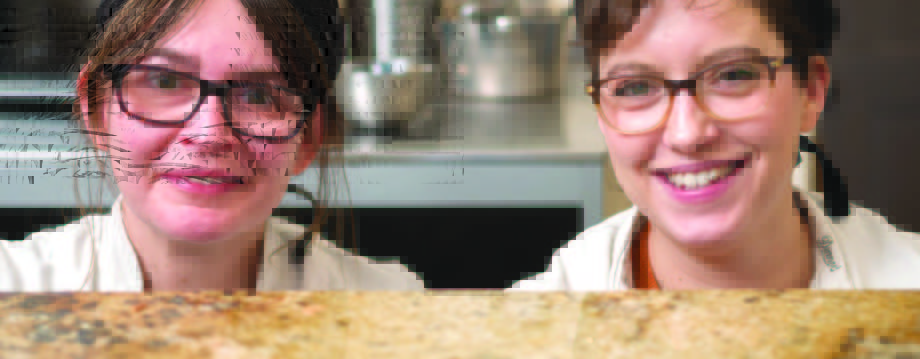
Edward and Irwyn’s kitchen/ shop in the well-to-do Edinburgh neighbourhood of Morningside is a tiny and somewhat chaotic Aladdin’s cave of chocolate sorcery. Vials of pungent oil jostle with bowls of infusing butter and caramel, under towering shelves of raw chocolate and arcane equipment. In the centre is a huge slab of thick marble, which is where the magic happens.
Edda informs me the marble isn’t simply theatre; it’s the perfect surface for steadily drawing the heat out of chocolate during tempering and at various other stages of the process. Much as is the case in brewing, temperature control is vital to the chocolatier.
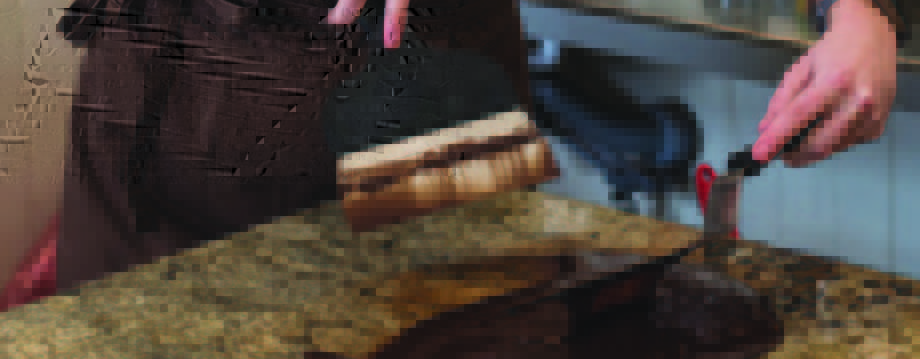
The process for making a single tray of the dome-shaped chocolates is suitably impressive, yet all happens remarkable quickly – once again, it seems that time is a factor in these things, and the various stages really need to happen on cue. Tempering is a vital first step, in which most of a batch of chocolate is heated to around 40 degrees, poured onto the marble and rapidly cooled, before being transferred back into the bowl and recombined with the warm chocolate.
“When you get chocolate that’s been in the sun and it ends up with white swirls or spots on it, that’s the crystalline structure coming apart,” explains Kirsty. “To make chocolate uniformly brown and shiny with a snap like these, you have to temper it. You can get machines that do this, but doing it by hand means you really understand tempering and can get a feel for how the chocolate behaves.”
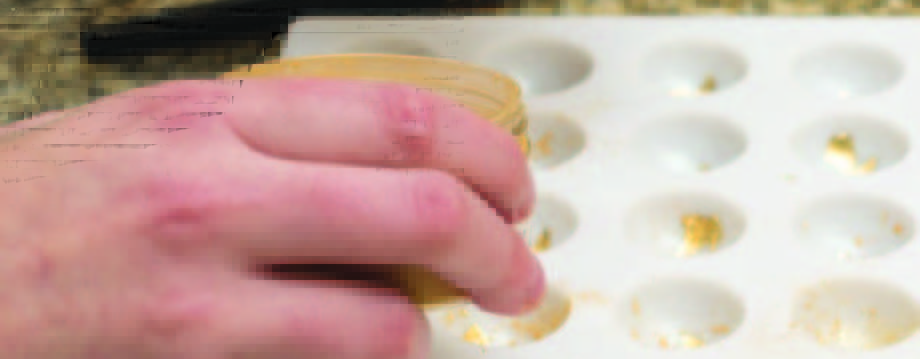
The chocolate we’re using today has already been mixed with a good dollop of that hop-infused cocoa butter, and a distinctive layer of Cascade wafts up from the more familiar dark chocolate aromas.
“We went for the Cascade because of how citrusy it is,” says Edda. “It was easily the most pungent of the three you gave us, and we thought it would work really nicely with that blend of chocolate and the caramel. We matched that with dark chocolate because milk chocolate with the caramel might be too sweet and the dark has more intense flavours. This is a blend of fairtrade organic dark, which is a 72% cocoa - it’s not too bitter, it’s quite mild - and then we added a Cuban chocolate which is super fruity.”
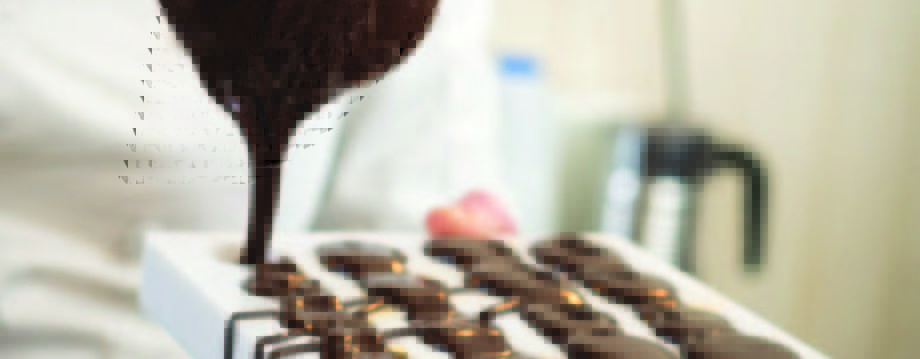
Gossamer sheets of gold leaf are brushed into the inside of each dimple in the plastic mould, along with a dusting of an edible green metallic powder. On top of this, Edda pours melted dark chocolate, already mixed with Cascade-infused fat. The mould is then upended over the chocolate bowl and the contents mostly knocked back into the mix; what is left in the mould will form the hard upper shell of our caramels.
Into each of these tiny chocolate cups is added a sprinkling of toasted breadcrumbs. These are from Icelandic rye bread, baked the traditional way – slowly, inside a hot volcanic spring – and brought back to the UK a few days earlier. We are not messing about here.
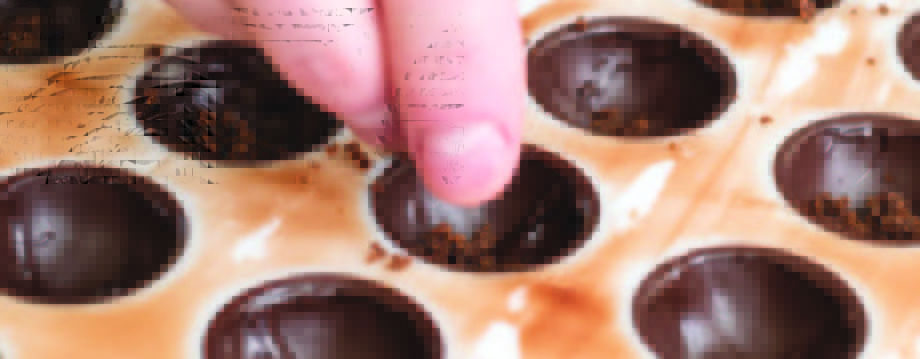
Kirsty says: “Icelandic rye bread is quite sweet, and they put dark sugar into it - it’s quite cakey. It’s really tasty and amazing. Since the hops were going in, we figured we could balance that by using something in the same malted family - that would be a flavour combination familiar to beer lovers.”
Next up, the caramel, which has been first heated and then cooled to the perfect temperature; warm enough to be piped, but not so warm that it will melt the chocolate shell. The caramel contains a sprinkle of smoked salt, which Edda describes as “quite subtle, but enough to give the caramel that savoury edge”. Watching warm caramel being piped into chocolate cups is one of the most oddly meditative things I’ve ever seen, and (I’ve discovered) quite popular on YouTube. Finally, it’s another layer of dark chocolate, levelled off with a palette knife to form the base.
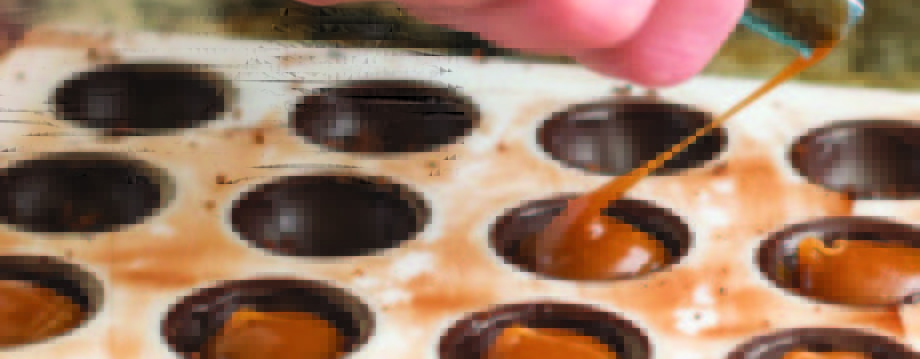
While we’re waiting for our creations to set, Edda talks us through the pair’s preference for northern-inspired flavours – most chocolatiers reach for the more southern flavour elements such as nuts and fruit – and how Icelandic beer in particular influenced today’s recipe.
“One of our favourite beers in the world, Borg Garún No. 19, is from Iceland,” she says. “It’s really dark, slightly chocolatey with liquorice notes. It’s a great combination of flavours and we love matching things like that; not too much bitter, not too much citrus. We once drank a whole load of them when we were sitting down at the harbour in Reykjavik, and then tried to stand up to meet our friends at the pub!”
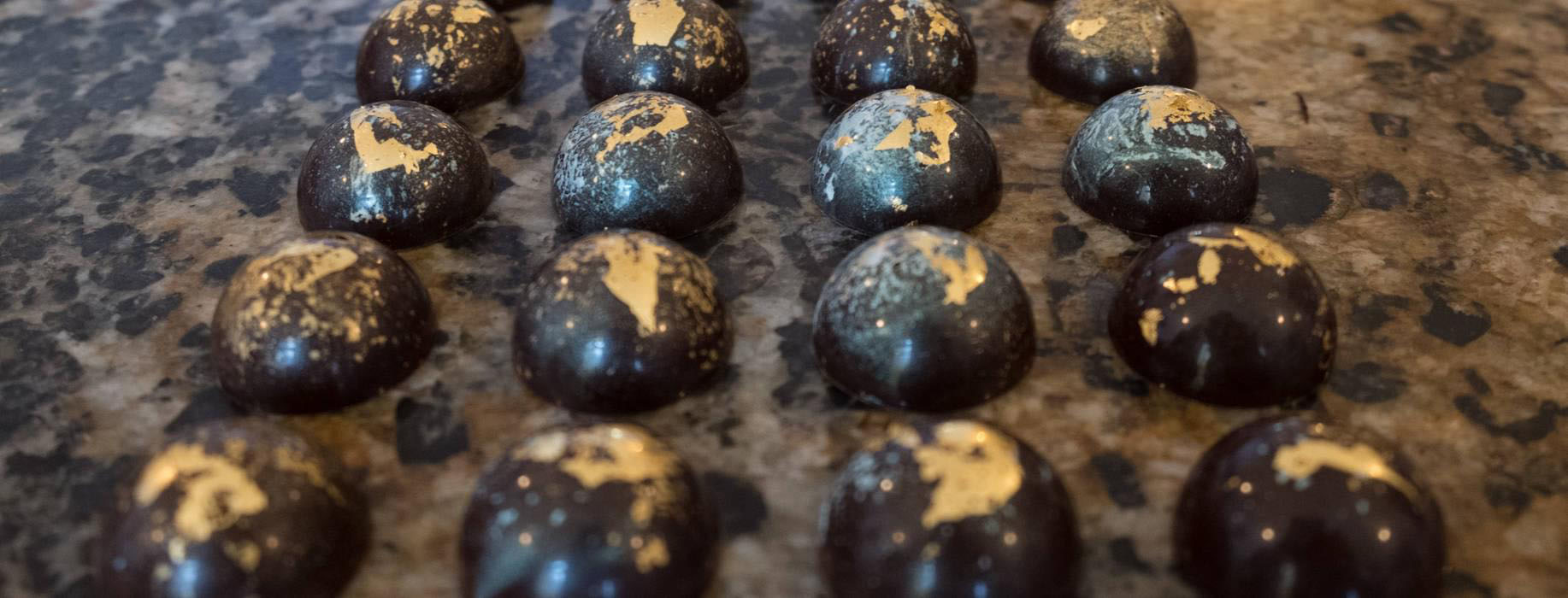
The chocolates are finally set, and it’s time for the moment of truth. Kirsty deftly turns the tray out onto the marble surface and we are rewarded with a clatter of dark chocolate hitting the stone. The results are stunning to look at: perfect domes of shiny dark chocolate, laced with constellations of sparkling green and swirling nebulae of gold leaf.
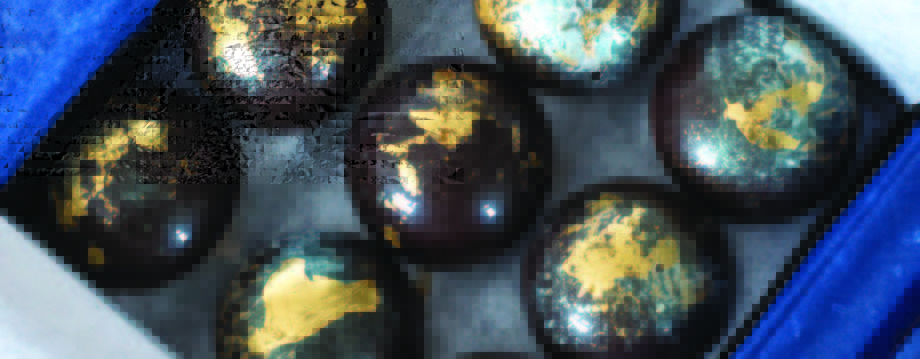
Kirsty and Edda are about more than the visuals though, and encourage us to tuck in. Biting down through the snap of the shell, onto the crystalline crunch of the breadcrumbs and the soft pillow of caramel unleashes a barrage of complementary flavours: buttery sweetness is shot through by bitter fruit and the toasty malt of the rye bread and, like a thread though it all, comes the unmistakable citrus tang of the US Cascade.
“We’ll definitely experiment with hops again,” says Edda, rightly pleased with how the chocolates have turned out. “We really like the unusual quality of fruity bitterness they bring to the chocolate. It’s something really unusual that no-one else is really doing. We’ve got some of the infused chocolate left over, so at some point will do something different with that and test it on the locals. It could turn into a whole thing!”
Share this article
You’ve reached your limit of 5 free articles this month.
Unlock unlimited access and more

Join Beer52 and get your first month half price
-
Get your first box for £13.50 (RRP £27).
-
8 beers & 2 snacks delivered monthly.
-
Printed Ferment magazine included.
-
Unlimited access to all online content.