Crate expectations
In a brand new (yet temporary) brewery made from recycled shipping containers, BRLO is one of the most exciting forces in Berlin’s burgeoning craft beer scene

Richard Croasdale
Tuesday 02 June 2026

This article is from
Berlin
issue 9
Share this article
In a brand new (yet temporary) brewery made from recycled shipping containers, BRLO is one of the most exciting forces in Berlin’s burgeoning craft beer scene
As statements go, BRLO’s brand new city centre brewery is a loud one. Constructed from more than 40 corrugated steel shipping containers welded together and painted gunmental grey, it is imposing, obtrusive and undeniably stylish.
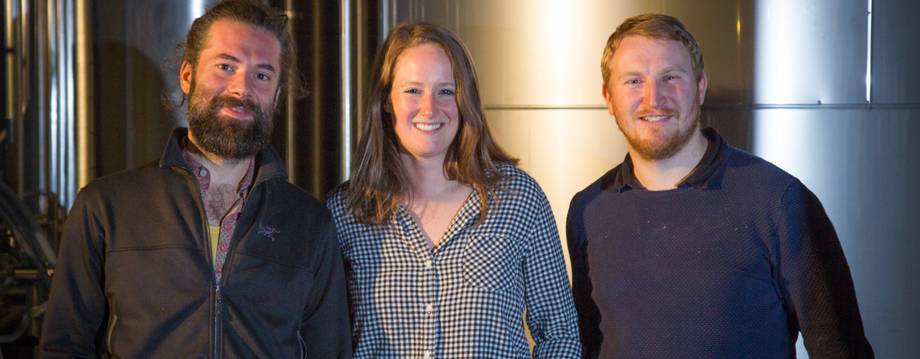
We arrive during the last week of construction, entering across an expanse of tyre-churned earth, into a brewhouse lit by industrial lamps and filled with the grinding and clanging of powertools. Brewers Michael Lembke and Veronica Menzel are there to meet us, both smattered with yeast; they’ve not stopped brewing, even as the structure takes shape around them.
And it’s quite a place. The Brewhouse takes up about half the building, with stylish offices sitting on a mezzanine level, up a set of suitably industrial metal steps. A glass partition behind the mash tuns looks out onto a taproom and restaurant, again on two levels.
Walking us around the building, Michael tells us there is capacity for around 140 guests, the first of whom (a party from Stone Brewing, no less) will be arriving for their Christmas dinner in six short days. Looking at the wires hanging from the ceiling, the air of activity takes on a fresh sense of urgency.
This is BRLO’s first permanent home, having previously been a nomadic brewery. It was founded in 2014 by three friends: Michael, Katharina Kurz and Christian Laase, who met at college, and Michael, a brewing graduate who had become disaffected with life at a large “industrial” brewery. For its first couple of years, the trio brewed at two breweries, one in Brandenburg and one in Lower Saxony. But the runaway success of a beer garden project in 2015 – not to mention growing demand for BRLO’s beers – cemented the trio’s long-held ambition to set up on their own.
The plot they found is, in Katharina’s words, “a dream”, right in the city centre, close to an S-Bahn station, on a large piece of unused land ripe for expansion. There’s just one drawback: the entire plot is scheduled to be transformed into “another Potsdamer Platz” within the next five years, featuring five massive office developments and no quirky craft beer projects.
Katharina seems oddly relaxed about the idea that her brewery is doomed to a three to five-year lifespan, before the first beer has been brewed
“We fell in love with this spot right here; it’s urban, untouched, right in the centre and it’s perfect for BRLO right now,” she says. “We love the idea that we don’t know what’s going to happen. Maybe we’ll need to cut the brewery up and move it in five years, but plans change, and every year we can stay here will be great. We’re a Berlin brewery at heart, and embracing the idea of constant change is a very Berlin attitude.”
Precisely what constitutes a “Berlin brewery” is something I’m keen to delve into with BRLO, as they’ve not been shy of tackling traditional styles, as well as fashionable UK and American beers. She explains that, while BRLO counts itself among the city’s new wave of brewers, it started out at a time when the market was still dominated by styles like Pilsener and Hefeweizen.
“Berlin definitely has the most brewing projects and craft beer bars in Germany, but it’s still baby steps compared to other countries,” she muses. “One of the reasons is that we already have great baseline quality. So, it’s not like in the US where there was pisswater from the big industrial breweries and anything was better than that. If you look at Franconian brewing tradition, it’s amazing and always has been. I think that’s why it’s taking a little bit longer.
“The result is that, when we launched two years ago with a helles and a pale ale, we had to explain 15 times a day what a pale ale was. Now of course everyone’s quite nonchalant about it, and all the breweries are producing these hop-forward IPAs.”
It sounds like progress, but part of me is a little sad at the idea of a strident American craft culture being superimposed onto Germany’s rich brewing heritage.
“In terms of beer tradition, I think we’re trying to build a bridge,” Katharina counters. “We’re not super adamant against Reinheitsgebot [Germany’s beer purity law – see page 95] for example, like some breweries. We take the view that tradition has given us an awful lot in terms of heritage and beer culture, so we shouldn’t set out to tear all of that up just for the sake of it.
“In our beers, we try to reinterpret old German styles, as well as getting inspired by pale ales and IPAs and that other tradition. It’s a mix of everything, and in that sense is very representative of Berlin.”

She says the Berliner Weisse has gone down particularly well with fans of the style, and that it was enjoying something of a renaissance.
“I think eventually, craft brewers – or people who perceive themselves as craft brewers – in Germany will come back around and take on those traditional styles, as we’ve seen happen in countries whose craft movement is ahead of ours. Today, people will say a Märzen just isn’t cool, but I’m pretty sure at some point it’s going to be rediscovered and German craft brewers will build up a separate identity,” she concludes.
Share this article
You’ve reached your limit of 5 free articles this month.
Unlock unlimited access and more

Join Beer52 and get your first month half price
-
Get your first box for £13.50 (RRP £27).
-
8 beers & 2 snacks delivered monthly.
-
Printed Ferment magazine included.
-
Unlimited access to all online content.